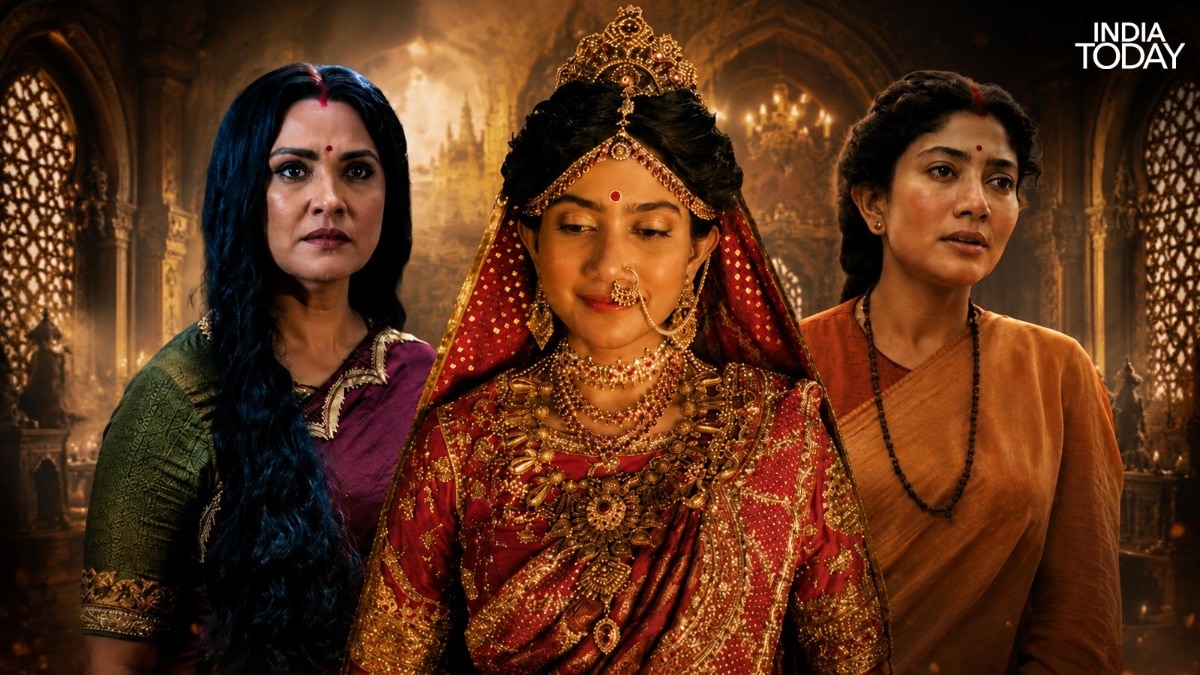
It is a fact that stitched blouses entered Indian wardrobes only a few hundred years ago. So what are they doing in Nitesh Tiwari's Ramayana? Here, we not only trace the history of this garment but also unstitch the whole controversy surrounding the blouse that has sparked a debate over history, mythology and costume design.“Why does Sita Mata look like Alia Bhatt walking to the song Kudmayi?”“Lara Dutta as Kaikeyi looks like a character from an Ekta Kapoor serial?”“Aren’t stitched blouses a post-colonial addition in Indian clothing?”“Oh, Sai Pallavi looks more like a 2026 bride than Sita.”These are just a few of the many viral reactions doing the rounds online after the trailer for Nitesh Tiwari’s Ramayana finally dropped. The multi-thousand-crore-budget film is slated for a special Diwali release and boasts several buzzworthy elements, including a larger-than-life ensemble cast - Ranbir Kapoor as Ram, Yash as Ravana, Sunny Deol as Hanuman, and Sai Pallavi as Sita; a joint musical score by Hans Zimmer and A.R. Rahman; and world-class visual effects by Oscar-winning studio DNEG.Yet, after the trailer launch, one of the biggest talking points turned out to be something far smaller: a blouse. Social media platforms have been flooded with debates over the film's costumes, particularly the women's attire and the decision to depict Sita in a stitched blouse. Sai Pallavi as Sita in Ramayana. (Photo: IMDb) Sai Pallavi's Sita appears in several outfits styled with heavily embroidered, stitched blouses. In one scene set during the Vanavasa, she is seen in a neatly draped saree paired with a delicate blouse featuring tone-on-tone threadwork. Lara Dutta's Kaikeyi, meanwhile, is dressed in a maroon saree paired with a fitted green blouse featuring half-length sleeves and intricate gold borders that complement the drape.Tbh, social media users aren't entirely wrong when they say the outfits resemble a still from a modern-day television drama. In fact, the stitched blouse is a colonial-era garment not an ancient one. A social media reaction questioning the costume design in the Ramayana trailer. The blouse storyFor something we instinctively call "traditional," the combination of neatly pleated saree, pallu draped over the left shoulder, paired with a stitched blouse and petticoat is surprisingly recent - and not entirely indigenous in the form we know it today.Much of that transformation is credited to Jnanadanandini Devi (an author, social reformer and sister-in-law of Rabindranath Tagore), who popularised a new way of wearing the saree in late 19th-century Bengal by blending Indian drapes with Victorian notions of modesty.In earlier times, women across the subcontinent wore a variety of garments such as the antariya, uttariya and stanapatta, with regional styles differing significantly. In many parts of India - particularly the warmer regions - the upper torso was often left uncovered, a practice well documented in temple sculptures and early Indian art.The stitched blouse, as we know it today, simply did not exist. It came much, much later. Here is a quick fashion history lesson from a professor:“Ancient India dressed in drapes not tailoring. An unstitched lower cloth, an upper drape and at most a soft breast band. Our traditional saree with blouse was standardised barely 150 years ago popularised by women like Jnanadanandini Devi and Maharani Indira Devi, who married Indian drape to Victorian modesty. A woman of Sita's world would have worn flowing cloth, the fitted blouse is a misfit,” said Mitali Ambekar, professor, fashion styling department, Pearl Academy Delhi.Here is little anecdote featuring Jnanadanandini Devi that explains how the blouse became a product of colonial ideas of modesty.After moving to Bombay, Jnanadanandini was turned away from British social spaces for wearing her sari the traditional Bengali way - without a stitched blouse, over bare skin. Rather than abandoning the saree altogether, she chose to borrow from British fashion to redesign how it was worn rather than abandon it to satisfy colonial sensibilities. She built her version by studying the Parsi gara style worn by women like Lady Bachoobai Nowroji Vakil in Bombay, then fused Parsi jacket-and-petticoat elements with the Bengali habit of draping the pallu over the left shoulder. You can read more on it here. Jnanadanandini Devi. When there are no archivesBut Ramayana is not history, it is mythology. Achieving historical accuracy in terms of costume styling is tricky as compared to other period dramas that recreate documented eras,Whether it's the French court or the Peshwa era, period dramas come with a paper trail - portraits, court records, surviving garments and textile archives that designers can study before recreating a look on screen. For Sofia Coppola's Marie Antoinette (2006), costume designer Milena Canonero had an extensive eighteenth-century wardrobe to draw from, allowing her to create historically grounded silhouettes while reserving creative liberties for narrative effect.Closer home, when Rimple and Harpreet Narula - the same duo behind Ramayana - were brought on board for Padmaavat, they relied on antique textile samples collected over years of travel, including fabrics sourced from Istanbul's Grand Bazaar and Ottoman-influenced embroidered cloth. Similarly, for Bajirao Mastani, designer Anju Modi built Mastani's jewellery around an actual miniature portrait of the queen wearing a Persian hat. Deepika Padukone in Padmaavat. Mythological epics, however, offer no such luxury. There are no surviving garments, portraits or court records from the Treta or Dwapar Yugas, leaving costume designers to interpret characters through scriptures, temple art and centuries of artistic imagination.That is perhaps why the Star Plus Mahabharat has found itself back in the conversation, thanks to the blouses seen in the Ramayana trailer. Though based on the Dwapar Yuga, unlike Ramayana, which is set in the Treta Yuga, the show's costumes spoke a royal language and were devoid of the modern-day blouses we have seen in the Ramayana trailer. Instead, we saw Gandhari and Draupadi dressed in heavy ornaments and sleeveless, at times one-shoulder, drapes. From the Star Plus' Mahabharat. (Images: IMDb) The challenge of dressing the divineWe reached out to Nidhi Yasha, fashion designer and the costume stylist behind Mahabharat's much-lauded costumes. When asked whether she feels there were any lapses in terms of historical accuracy in the Ramayana outfits, she offered a clear response: “For a film built on such a large scale, with in-depth research and development, nothing can be a lapse. They all have to be well-thought-out and pre-contemplated decisions.”She further added:“Let me remind you that we are not as liberal as a people or as a nation as we were 13 years ago, when Mahabharat aired on Star Plus. A lot of these decisions are taken keeping in mind the times, public expectations, perception, and palatability, as religion is a VERY, very sensitive area to work in.”Yasha pointed out that the idea of historical accuracy itself becomes complicated when depicting mythological eras, as there are no definitive historical records from the yugas. The closest visual references available (like temple art and later scriptures) date to the post-Vedic period, "hundreds of years later," making them interpretive rather than definitive sources, she noted.But faithfully following even those references, she argued, would create another problem. Many temple sculptures depict women bare-chested or wearing minimal upper garments. "Would the current social structure be comfortable with that?" she asked.By the colonial period, Yasha said, ideas of modesty had already begun reshaping how mythological figures were imagined. "Raja Ravi Varma's paintings further solidified this perception, so did the ISKCON Renaissance-style paintings for Krishna Leela. This is what modern India has largely consumed." 'Jatayu Vadh' by Raja Ravi Varma ft Sita in a blouse. (Photo: Google Arts and Culture) Yasha, who has worked on several mythological projects and herself used blouses on women characters in the 2026 release Krishnavataram Part 1: The Heart (Hridayam), said mythology is ultimately viewed through the lens of faith rather than historical precision."Most viewers would come viewing from a lens of devotion and not accuracy, and that needs to be respected, as Gods and Goddesses belong to everyone," she said, adding that costume designers must constantly negotiate the delicate balance between public perception and visual authenticity. "It has to be addressed with a lot of caution and clarity, which is what makes mythology exceedingly difficult to excel in as a costumer.The designers behind Nitesh Tiwari's Ramayana speak upMeanwhile, Rimple and Harpreet Narula, the costume designers for Nitesh Tiwari’s Ramayana, acknowledged the criticism but maintained that it was more about interpretation for them."There isn't one single visual reference for how everyone in the Ramayana period dressed," they explained. India's diverse cultural history, they argued, naturally allows multiple interpretations.“We wanted the costumes to feel rooted in India and in our understanding of the epic, but also work for the actors, the movement, the camera and the scale of a film like this.”As for the blouse, it was “never introduced because we wanted to make Sita or the other women look modern. That was never the intention," they clarified.Instead, the decision came from a more character-first approach to the design process. "When we design, we look at the entire character — not just whether a garment existed in a particular form. We look at her personality, her body language, her movement, her environment and what we want you to feel when you see her," they explained. For Sita specifically, the brief to themselves was simple: grace over grandeur. "Our intention was always to keep her very graceful, pure and understated. The silhouette had to have dignity and softness."The other blouse debateBut, the blouse debate doesn't end with Sita. Another costume that has sparked discussion is Rakul Preet Singh's portrayal of Surpanakha.While Sita appears in a modest, fully covered blouse, Surpanakha is seen in a far more revealing, bare-shouldered ensemble. The stark contrast has sparked debate online, with many questioning whether the film is falling back on the familiar trope of dressing 'good' women more modestly and 'evil' or seductive women in more revealing costumes. Rakul Preet Singh plays Surpanakha in Ramayan. (Photo: IMDb) Rimple and Harpreet Narula, however, said the distinction was an intentional storytelling choice rather than a moral one."Surpanakha was a completely different story. We didn't want to dress her like Sita because, emotionally and visually, they are worlds apart," she explains.According to them, Surpanakha embodies "a very strong sensuality and a certain wildness." "She is confident, provocative, powerful and unpredictable. We wanted her costume to have that energy," she said.For them, the bare shoulder and bandeau-like element were conceived to create a striking visual identity for the character. "It was about creating a strong silhouette and expressing the character - not about putting a contemporary fashion garment into a mythological film.”Ambekar, meanwhile, believes the visual contrast reinforces a long-standing cinematic stereotype. "It risks repeating the familiar 'good woman covered, dangerous woman exposed' stereotype. Cinema has often used clothing to decide which kind of femininity is respectable," she said.While she acknowledged that the contrast may have been intended to distinguish a princess from a forest-dwelling rakshasi, Ambekar argued that such differences need not rely on the amount of skin shown. "Colour, texture, drape, jewellery, movement and silhouette can communicate identity much more intelligently. A costume should reveal a woman's character, not judge her morality."If there's one takeaway from the blouse controversy, it's that costumes in mythology are never just costumes. They carry centuries of memory, faith, politics, aesthetics and evolving ideas of morality. Perhaps that's why a stitched blouse has managed to generate almost as much discussion as a multi-crore visual spectacle.- EndsPublished By: Medha ChawlaPublished On: Aug 5, 2026 10:07 IST
The Ramayana blouse controversy unstitched
Full Article
Original Source
Read the full article at Indiatoday →KhanList aggregates and links to publicly available news content. We do not host full articles from third-party sources. Always verify important information with original sources.