
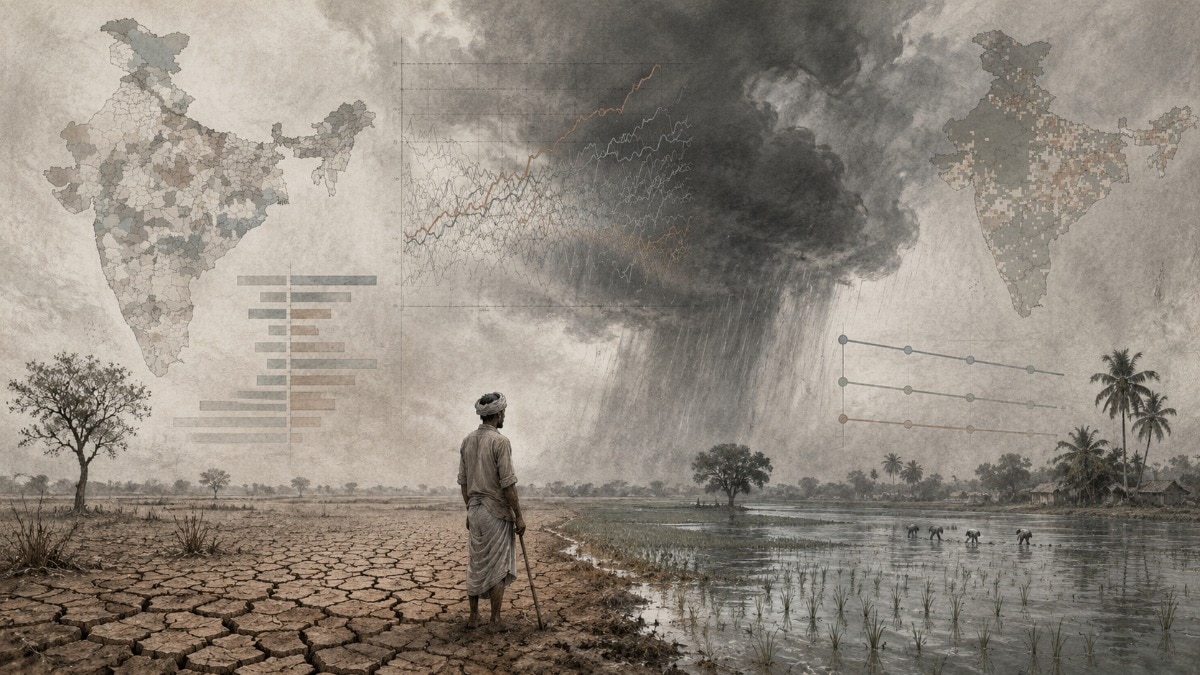
Nearly half of India's districts are short of rain, a third of the country is drying out, and farmers have planted less than they had by this time last year.About half of India's net sown area is rainfed, and the kharif crop — rice, millets, pulses — is planted in these weeks. (Image: India Today)India's monsoon is two and a half months old and, on paper, it arrived. Rivers are up, underpasses have flooded. But look at where the rain landed and a different season appears: 46 per cent of India's districts have had below-normal rainfall between June 1 and Aug 14, according to the India Meteorological Department.The monsoon on the news is not the monsoon a farmer needs. About half of India's net sown area is rainfed, and the kharif crop — rice, millets, pulses — is planted in these weeks. This is not a failed monsoon but a badly distributed one, and the cost lands on the food table, not the road.Why it matters: Kharif is India's main cropping season, sown on the monsoon and harvested from October. IMD counts rainfall within 19 per cent of normal as "normal"; a shortfall of 20 per cent or more is "deficient". A season can therefore look adequate on a national average while individual districts go short, which is exactly what has happened this year.In numbers:46 per cent of districts below normal, June 1 to Aug 14, 2026Three of the nine big kharif states are deficient on their own average: Andhra Pradesh (35 per cent), Uttar Pradesh (25 per cent) and Karnataka (21 per cent)39 per cent of Maharashtra's districts are deficient, though the state average is only 2 per cent below normal36 per cent of the India Drought Monitor's grid is abnormally dry or in drought; a tenth of it severe or worse967.92 lakh hectares sown as on Aug 7 against 985.89 lakh a year earlier — down 1.8 per centRice down 4.4 per cent, coarse cereals 2.7, pulses 1.8Fertiliser sales down 13 per cent in July, to 77.44 lakh tonnes against 89.41 lakh+2.66 °C — the Nio 3.4 sea-surface temperature anomaly on Aug 12, the highest for that date in the 44-year record90 per cent of the long-period average — IMD's seasonal forecast, cut from 92 per centIn-depth: The spread is extreme: Odisha has had 33 per cent more rain than normal, Andhra Pradesh 35 per cent less, both kharif states on the same bulletin. The government has said as much in Parliament. July delivered 1 per cent morerain than normal across India as a whole, and still left 47 per cent of districts deficient or large-deficient, the Ministry of Earth Sciences told the Lok Sabha on Aug 12.The same pattern holds at state level. Maharashtra reads almost exactly normal at 2 per cent below, yet 39 per cent of its districts are deficient, and nearly half of Telangana's are. Patchy is harder to plan for than dry. Rain in bursts runs off rather than soaking in. "Momentarily, soil will be wet, but then there will be long dry periods," said Karthikeyan Lanka, associate professor at IIT Bombay and principal investigator of the All India Experimental Agricultural Drought Forecasts, the expert said. "We are seeing swings happening even at the root-zone level.”By Aug 12, 36 per cent of the India Drought Monitor's grid was abnormally dry or in drought, a tenth of it severe or worse, according to the Water and Climate Lab at IIT Gandhinagar. Drought is spreading in a season that has also produced flash floods. The two are no longer alternatives.The stress is showing in the fields. India had planted 967.92 lakh hectares as on Aug 7, against 985.89 lakh a year earlier, 1.8 per cent less. Rice is down 4.4 per cent, coarse cereals 2.7, pulses 1.8. "There may be crop yield loss in kharif," Lanka said.That 1.8 per cent sounds survivable. What farmers are spending tells a harder story. Fertiliser sales fell 13 per cent in July, to 77.44 lakh tonnes from 89.41 lakh a year earlier, with urea down 9 per cent and complex fertilisers 29 per cent.Area barely moved; spending on the crop fell off a cliff. A farmer who sows but will not buy nutrients does not expect the rain to reward it, and fertiliser withheld now is yield lost later, whatever falls in September.Big picture: The season is not finished. Gujarat and Odisha are wetter than usual, half of India's districts are at or above normal, and sowing answers to prices and credit too.What makes this year different sits in the Pacific. Sea-surface temperatures in the Nino 3.4 region ran 2.66 degrees Celsius above the 1991–2020 average on Aug 12, the highest for that date in the 44-year record. Only 1982, 2015 and 2016 have reached it at all.IMD saw it coming: its April forecast put the season at 92 per cent of the long-period average, later cut to 90. El Nio formed in June and strengthened to moderate, "acting as a major large-scale climate driver in suppressing monsoon circulation across the country", the ministry told Parliament, and "directly contributed" to a shortfall that stood at 12 per cent below normal on Aug 2.The ministry lists what it expects to follow: prolonged dry spells, localised meteorological drought, lower soil moisture and moisture stress on rain-fed crops. August and September are still to be counted, and they decide the harvest.What they said: "There may be crop yield loss in kharif," Karthikeyan Lanka of IIT Bombay, describing soil that wets briefly and then dries through long gaps. The Ministry of Earth Sciences, in a written reply to the Lok Sabha on Aug 12, said El Nio acted as "a major large-scale climate driver in suppressing monsoon circulation across the country" and "directly contributed" to the season's 12 per cent cumulative shortfall.The question was never whether the monsoon came, but whether it came to the right districts, at the right time, and stayed long enough to matter. On the evidence of 75 days, much of India says no.- EndsPublished By: Ritaban MisraPublished On: Aug 14, 2026 19:21 IST
The rain is falling. Just not where India farms
Full Article
Original Source
Read the full article at Indiatoday →KhanList aggregates and links to publicly available news content. We do not host full articles from third-party sources. Always verify important information with original sources.