
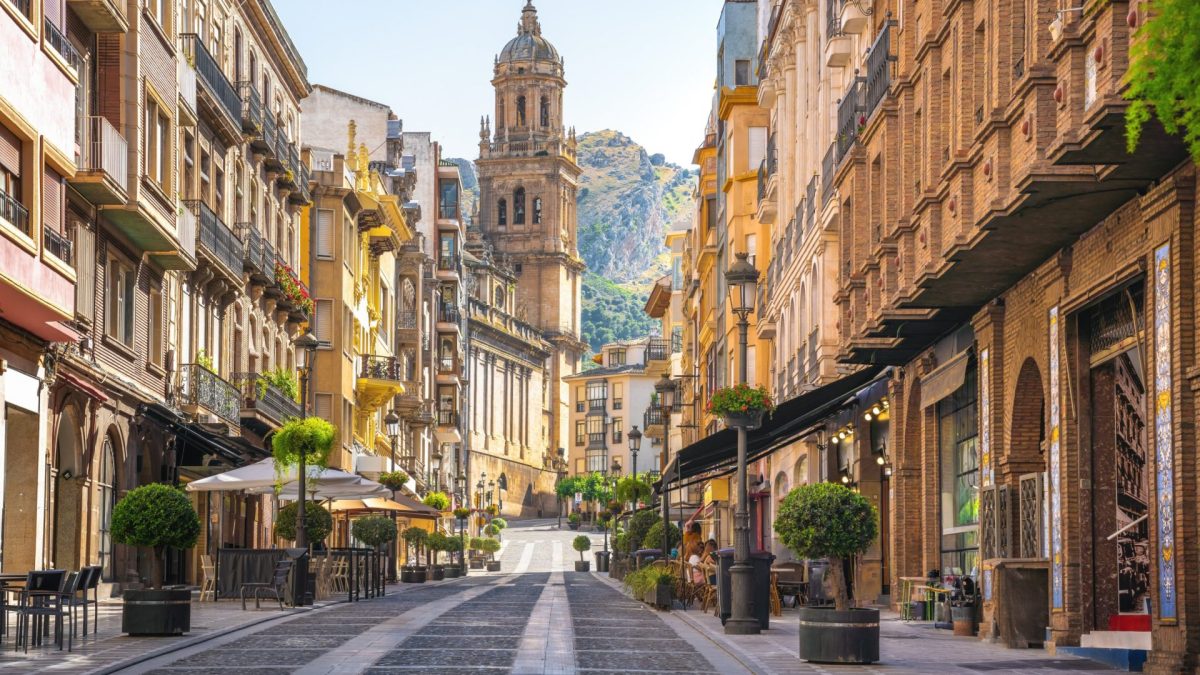
“You can smell that, no?” asks my guide Helena, as we stand on the viewing platform. I sniff the air and detect a familiar earthy, green perfume: “Olives!” Helena nods. “There are 68 million olive trees in the province of Jaén,” she says, leading me down from the rooftop. “We make 25 per cent of the world’s olive oil.” We descend to the basement of the grand building in the Andalucian city’s old town, past mounds of rubble, until we reach a vaulted room. “These are the largest Arab baths in Europe,” she tells me.The former bathing chambers are replete with Islamic-style arches and star-shaped roof lights pristinely preserved from the 11th century. Discovered in 1913 and excavated and restored from the 1930s, they’re in remarkable condition. Previously unknown frescoes were revealed as recently as 2019, yet we’re the only visitors here.I ask Helena if it’s always this quiet. “Not always, but it’s never busy – that’s what makes Jaén so great,” she says. Roughly equidistant from Cordoba and Granada, the city remains off the typical Andalucian city break circuit. Inside the Arab baths (Photo: diegograndi/Getty Images) We saunter towards the cathedral – a great Renaissance structure designed by stonemason and architect Andrés de Vandelvira that became the blueprint for many churches and cathedrals in Latin America. The cathedral houses a holy veil relic, said to have been used by Saint Veronica to wash Jesus’s face, as well as the tomb of Pope Saint Pius I.But first, we stop for coffee and tostada (a toasted, halved baguette) at Quintana Centro, a café popular with locals, and have a nose at Helena’s own souvenir shop, which is filled with local wines and a selection of olive oils. Inside the cathedral, the devout are preparing for an upcoming festival, polishing the plinths of a statue of Jesus that will be paraded around the streets of Jaén. The cathedral is immense and its ornate baroque façade is peculiar, with balconies overlooking the main town square. The cathedral chapel containing the holy relic of the veil (Photo: Juan Jose Quesada Garcia/Getty) A similar mix of eras and architecture can be found in nearby Martos, a steep hill town at the heart of olive country, surrounded by one of the largest man-made forests in the world. Roman tombstones adorn 16th-century Mannerist walls. I hit the road to get a sense of the olive tree-lined landscape. I’m on my way to meet Álvaro from VíaBike Martos, who’s waiting for me with a bike and helmet. We’re going to ride a section of the 128km Vía Verde de Aceite – an old train track once used to transport olive oil, now a bike path. As I coast through the countryside, I begin to feel the sheer magnitude of my surroundings. Millions of olive trees seem to stretch out for eternity in every direction. Álvaro tells me he would love to do this full time but there are not enough tourists yet to allow it, so he has another day job. I don’t want to quell his dreams but I am giddy from having the landscape to myself. Cycling among the olives on the green way (Photo: Antonio Garcia Recena/Getty) Having worked up an appetite, I venture back into central Jaén for dinner at a family-run restaurant called Bar Colmado Tradicional Palique. Here I order pipirrana – a refreshing tomato salad with green peppers, tuna and eggs – and habas con jamón, broad beans with ham, slicked with picual olive oil. For centuries, the region of Jaén was the frontier between the Christian Kingdom of Castile in the north and the Muslim Nasrid Kingdom of Granada to the south. With their high elevations, the towns of Baeza and Úbeda – both within 40 minutes’ drive of Jaén – were of strategic importance to both sides, but were eventually captured by Christian forces in the 13th century. The towns flourished in the 16th century, having become rich from olive oil, and constructed many grand stone buildings – a large number of which still stand today. I venture to Úbeda to meet guide Andrea, who fills me in on the history of the town as we stroll. “You’ve been in Jaén, so you will know the builder of this,” he says, pointing to the façade of the Sacra Capilla del Salvador, a church and funeral chapel. “Andrés de Vandelvira – you’ll see his name crop up all around here and Baeza.” Inside, the dome and altar are a masterclass in Italian Renaissance design. Vats of olive oil at Aoveland (Photo: juananbarrosarquitectura.com) It’s started raining, so we make tracks for Baeza, stopping for a tour at Aoveland, a beautiful building that reminds me of a modern winery – except its focus is on olives rather than grapes. There’s an interactive studio telling the story of olives in this region, and a tasting room where we try a selection that ranges from mild, grassy arbequina to the peppery, apple-green picual. Baeza’s main square must be one of the largest I’ve ever seen. A former marketplace, the plaza is lined with buildings from the last five centuries, but I’m here to seek out a tiny tapas bar in one corner: Restaurante La Ajedrea. With its partly open kitchen and whitewashed brick walls, it has a cool vibe, serving local wines and dishes such as avocado tempura tacos and sea bass with citrus pickles. I’m just about to tuck into the basket of amber-hued, paprika-laced ochíos bread rolls when a selection of olive oils hit the table, so I start dipping into the liquid gold. When in Jaén. How to get there Wizz Air flies from Luton to Granada (one hour from Jaén by car or coach); easyJet, British Airways, Jet2, Ryanair and Wizz Air fly from the UK to Malaga (a 2.5-hour drive). Where to stay The historic Parador de Jaén looks out over the city and has doubles from €114 (£94). If stopping over in Malaga, the newly opened Hotel Áurea Palacio de la Tinta has doubles from €184. More information The writer was a guest of the Spanish Tourist Office, Turismo Andaluz, and Jaén Turismo. For more on olive oil tourism in the region visit oleotourjaen.es
The quietly magnificent Spanish city that’s a crowd-free alternative to Granada
Full Article
Original Source
Read the full article at Inews →KhanList aggregates and links to publicly available news content. We do not host full articles from third-party sources. Always verify important information with original sources.