
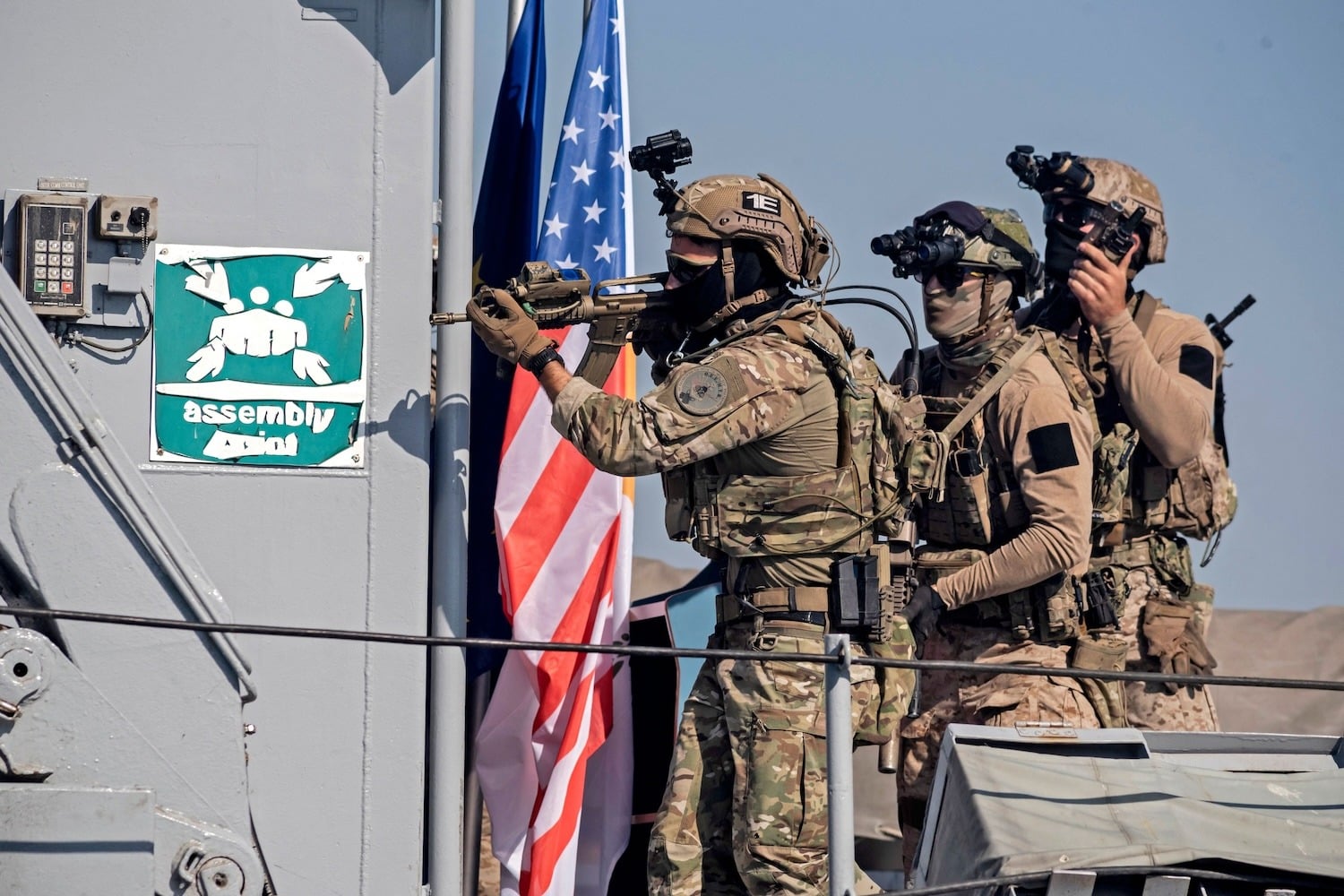
Since the 1974 Turkish invasion of Cyprus, Washington has almost exclusively seen the island as a problem in need of solution. But that dynamic has now quietly changed. Over the past decade, the Republic of Cyprus (ROC) has positioned itself as a critical security partner for an increasingly receptive United States. The bilateral relationship has gradually expanded to include defense, trade, basing, military training and exercises, crisis-response cooperation, and regular strategic dialogue. Given Cyprus’s strategic location, it is perhaps surprising that the initial impetus for this growing security relationship came from Cyprus, not Washington. In short, despite its ongoing division, Cyprus is emerging as a security producer for the United States and the West. For Nicosia, this relationship serves as an effective deterrent against any future Turkish threat, which remains the ROC’s primary security preoccupation. Beyond that, deepening ties with the United States help boost Cyprus’s international status and provide cover for its growing arms relationships and other security ties with other states, such as France and Israel. Turkey has watched these developments warily, though so far without a forceful response. Since 1974, the ROC has governed only the island’s southern two-thirds while enjoying near-universal recognition as the de jure government of the entire island (other than two sovereign British bases constituting less than 3 percent of the island). Turkey occupies the island’s northern third, which declared independence in 1983 as the Turkish Republic of Northern Cyprus (TRNC). Only Turkey recognizes the TRNC, and its military is believed to maintain 30,000-40,000 troops there. The overwhelmingly Greek Cypriot population of ROC-held territory numbers just under a million; the Turkish Cypriot population in the north is about a quarter that size. During the Cold War, the ROC joined the Non-Aligned Movement as a founding member in 1961 and remained in the group until it joined the European Union in 2004, which forced it to abandon formal neutrality. Maintaining reasonably good ties with both Washington and Moscow made sense, as both permanent members of the U.N. Security Council would influence any settlement of the island’s division. Even after securing EU membership, Cyprus’s ties to Moscow initially remained close. The United States, for its part, was wary of pursuing security ties with the ROC. Concerned that close relations with Cyprus would upset the Turks and jeopardize prospects for Cypriot reunification, Washington went so far as to put an arms embargo on the country in 1987. Cyprus’s East-West balancing act began to change significantly in 2013, when the ROC elected the pro-Western Nicos Anastasiades as president, replacing his Moscow-friendly, anti-NATO predecessor, Demetris Christofias of the communist Progressive Party of Working People. Rather than wait for another attempt at reunification to transform Cyprus’s geopolitical position, Anastasiades sought to build a U.S.-Cypriot relationship. He pitched Washington on the island’s strategic location at the intersection of Europe and the Middle East, with ports, airfields, offshore energy resources, and diplomatic ties across the region. Washington, perhaps increasingly skeptical that decades-old reunification efforts would ever bear fruit, responded in kind to Cypriot overtures. By 2014, then-Vice President Joe Biden had publicly described the bilateral relationship as a “strategic partnership.” This mutual shift in outlook accelerated during the first Trump administration, likely reinforced by the collapse of the most recent diplomatic effort at reunification in July 2017. The result was a 2018 bilateral statement of intent that laid the groundwork for future security cooperation. The U.S. Congress followed with the 2019 Eastern Mediterranean Security and Energy Partnership Act, which formally declared Cyprus a “key strategic partner” and created a path toward suspending the 1987 U.S. arms embargo. For the United States, the opening reflected a reconceptualization of the region, accelerated by a worsening relationship with Turkey in the 2010s. Former Assistant Secretary of State for Eurasian Affairs A. Wess Mitchell, widely viewed as the chief architect of the shift, argued in 2018 congressional testimony that Washington’s thinking about the region had grown stale. The United States, he said, had for decades mistakenly treated the Eastern Mediterranean as settled terrain anchored by Turkey while reducing Cyprus merely to a matter of reunification talks. In Mitchell’s vision, the Eastern Mediterranean was an “emerging maritime frontier” warranting greater attention. Greece and Cyprus, he reasoned, offered the United States strategic opportunities while also providing a hedge against an increasingly erratic Turkey. For Cyprus, however, the reason for turning toward Washington wasn’t merely strategic; it was existential. Nicosia was seeking a suspension of Washington’s arms embargo, but more than that, it wanted a sense of strategic belonging. As the lone EU member outside both NATO and NATO’s Partnership for Peace program, which allows non-NATO governments to build a bilateral relationship with the alliance, Cyprus has tried to shed its status as Europe’s “half-in” member. The ROC’s president, Nikos Christodoulides, has gone beyond his predecessors in that regard, saying repeatedly that he wants Cyprus inside NATO. Christodoulides knows that, given Turkey’s veto, that is a nearly inconceivable prospect absent a Cyprus settlement agreement. Nevertheless, he has cast cooperation with Washington as a means of bringing the Cypriot National Guard, as the Cypriot army is called, up to alliance standards. Cooperation with the United States has helped professionalize the Cypriot military and upgrade Cyprus’s military infrastructure. Cypriot and American troops now train together, including by conducting special operations exercises beyond emergency rescue drills. U.S. Navy SEALs and the Cypriot navy’s underwater team conducted joint maritime counterterrorism and ship-boarding training in 2021 and 2024. Since 2022, Cyprus has partnered with the New Jersey National Guard for joint training and disaster response. In December 2024, Congress made Cyprus eligible for U.S.-financed multilateral training—the only non-NATO, non-Partnership for Peace country with this status. Through the U.S. European Command (EUCOM), Washington funded a roughly $588,000 assessment in 2025 to bring Andreas Papandreou Air Base up to NATO standards, recommending a new heavy-lift apron and expanded runway, which Cyprus will finance. A new EUCOM-funded heliport at Evangelos Florakis Naval Base will accommodate large Chinook-type helicopters, and the Ministry of Defense is studying expansion to host eight large warships. Limassol has become a routine U.S. Navy port of call, hosting 22 vessels since 2022, including 15 since 2024. Cyprus has expanded its cooperation with the United States by taking on regional responsibilities that leverage its strategic location while seeking to avoid provoking Turkey. The country’s national plan enables rapid noncombatant evacuation, opening ports and airports for civilians fleeing conflicts. In 2024, U.S. Marines and Ospreys deployed to Papandreou Air Base for possible evacuations from Lebanon, and Cyprus served as a transit point for those leaving Israel during the June 2025 Iran conflict. Beyond evacuations, Cyprus has supported humanitarian deliveries to Gaza in partnership with the U.N., sending more than 37,000 metric tons of supplies. Its location at the crossroads of Europe, North Africa, and the Middle East has also made it a regional training hub. By 2025, the U.S.-funded Cyprus Center for Land, Open Seas, and Port Security in Larnaca had trained more than 2,000 officials from more than 20 countries in security and counterterrorism. Of course, the question of Turkey is never far from Cypriot calculations. Closer ties to Washington plainly serve Nicosia’s concerns about its neighbor. An example of how U.S. ties provide indirect deterrence is found in Cyprus’s recently acquired air-defense capability. When Cyprus sought to field Russian S-300 air-defense missiles in 1997, Ankara threatened to bomb the batteries before they were fully deployed. Washington defused that crisis by pressing Nicosia to transfer the S-300s to Greece, which then stored them unobtrusively on Crete. When Cyprus purchased the Israeli Barak MX system in 2024, however, Turkey warned of dangerous consequences but never threatened direct military intervention to block Cyprus from deploying it. Several factors may explain Turkey’s more restrained response in 2024, but Cyprus’s new security relationship with the United States, including the limited but consistent presence of U.S. troops in the ROC, is certainly among the most important. Meanwhile, Israel also has emerged as a key security partner for Cyprus. Although Cyprus’s security relationship with Israel predates the acceleration of its security ties with Washington, the latter has accelerated expansion of the former. Beyond bilateral Israeli-Cypriot relations, Cyprus, Israel, and Greece hold regular joint summits and cooperate in several areas, including energy. That triangular relationship has made the Turks uneasy, but the United States has blessed it and, since Trump’s first term, occasionally participates in it, creating a grouping known as the “3+1.” Cyprus has also built important ties with other regional actors, including Egypt, Jordan, and several Persian Gulf states. This emerging strategy carries risks for both Washington and Nicosia. The island now hosts more arms than at any point in decades, and each proposed U.S. transfer forces a judgment about whether additional weaponry and military infrastructure projects bolster stability or erode it. Perhaps tellingly, Washington has yet to act on a Cypriot request for excess defense articles made more than a year ago. The broader challenge for the United States is to draw on Cyprus’s location and strengthen its military without stoking Turkish fears to the point of reigniting long-dormant hostilities, an outcome that is squarely against U.S. interests. For Cyprus, the corresponding danger is losing control over a relationship with a far more powerful partner, as a U.S. military increasingly comfortable operating from the island may eventually seek to stage operations from it, drawing the ROC into conflicts that it would prefer to avoid. Conversely, Cyprus has to reckon with the possibility that a more isolationist United States might abandon the security relationship altogether. Cyprus’s deepening ties with Israel sharpen that exposure. As relations between Turkey and Israel have deteriorated since Oct. 7, 2023, Cyprus risks becoming another arena of Turkish-Israeli friction, alongside Syria and the Horn of Africa. Closer alignment with Washington and Israel also draws the island nearer to the confrontation with Iran: In March 2026, a drone most likely launched by Hezbollah from Lebanon struck a sovereign British base in the island’s south, just a few miles from ROC territory—a reminder that Cyprus can be targeted in conflicts not of its own making. Nicosia must therefore work to keep Israeli-Turkish tensions, and the wider Iranian threat, from boiling over onto the island. Nicosia wants Washington to see it as a natural ally, even absent a treaty to that effect, as well as a security producer rather than a divided country whose enduring security problem overwhelms all other considerations. To that end, it has positioned itself as a friendly, democratic government in a tough region that can help evacuate Americans from Middle Eastern wars, train regional security officials, host naval vessels, support humanitarian missions, counter illicit finance, obstruct terrorism, and operate alongside Western militaries. Still, that transformation remains incomplete. Cyprus may be an unsinkable aircraft carrier, but the United States is still deferential to Turkish sensibilities regarding Cyprus, even if it is much less deferential than it was a decade ago, and for now has not sought to exploit Cyprus’s full military potential. Cyprus, too, likes to emphasize that it does not allow foreign militaries to stage offensive operations from its territory, a position most recently reiterated at the outset of the Iran war. Cyprus is not a formal U.S. ally, hosts no permanent U.S. bases, and remains outside NATO. The island’s unresolved division will likely continue to constrain how far military cooperation with the United States can go. Should the prospect of reunification vanish altogether, the strategic ambiguity that has allowed the partnership to deepen quietly may grow harder to sustain, pressing Washington to weigh Cypriot opportunity against Turkish sensitivities more openly than it has so far. But Nicosia no longer appears willing to let that dispute define the boundaries and ambition of its foreign policy. After decades of waiting for geopolitics to change its circumstances, Cyprus is now actively using its geography and growing strategic importance to change its geopolitics.
The Quiet Revolution in U.S.-Cypriot Relations
Full Article
Original Source
Read the full article at Foreignpolicy →KhanList aggregates and links to publicly available news content. We do not host full articles from third-party sources. Always verify important information with original sources.