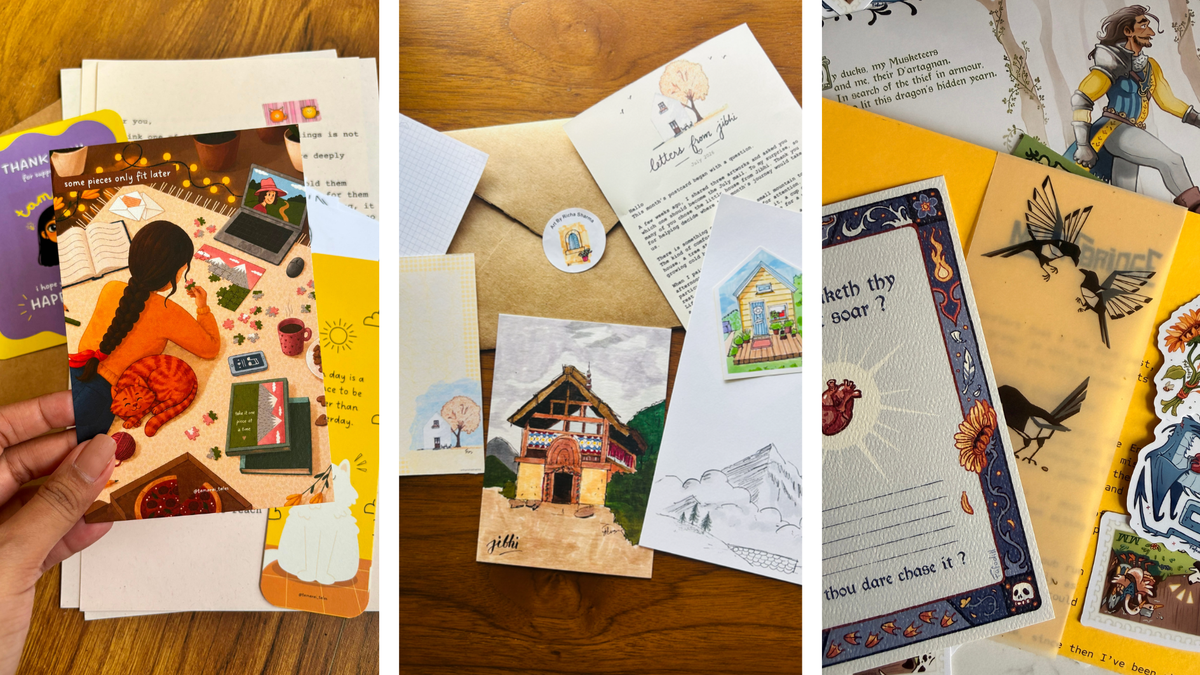
On the last weekend of every month, Sowbharanika Lakshmipathy’s dining table disappears beneath piles of paper. Handwritten letters wait to be folded, stickers are trimmed into neat sheets, bookmarks are stacked beside colouring pages, and rolls of washi tape lie scattered between envelopes waiting to be sealed.Preparing each month’s batch of mail is a process that unfolds over nearly two weeks. “I want every envelope to feel like it was put together for one person, not produced in bulk,” says the Coimbatore-based founder of snail mail club Tamarai Tales. “By the time I’m done, it feels like I’m sending little pieces of myself.” A curation from snail mail club Tamarai Tales Much of what goes into each package is written or designed by the 27-year-old IT professional. The rest is carefully curated by her from stationery makers. Each month revolves around a single idea. One package asks subscribers whether they feel they are falling behind in life. Another explores what it means to start over. Others centre on loneliness, friendship, self-worth and well-being.Before sealing the last envelope, Lakshmipathy props up her phone against her ceramic coffee cup and records the process. Time-lapse videos of handwritten notes and finished envelopes have become a familiar feature on her Instagram page, where many of her subscribers first discovered the club. It is an irony she readily acknowledges. “Social media helps people find me,” she says. “But what I’m really hoping to give them is a reason to spend a little less time on it.” Sowbharanika Lakshmipathy of Tamarai Tales The envelopes make their way across India — to Bengaluru and Bhopal, Chennai and Chandigarh, Kochi and Kolkata, moving through post offices, sorting centres, mailbags and delivery vans before arriving at someone’s doorstep. For most of human history, this would have seemed ordinary. In 2026, it feels almost radical. Snail mail club envelopes make their way across India Life beyond the digitalIt is precisely this slowness that is drawing people in. As interactions become digital and social media fills up with AI slop, young people are rediscovering analogue experiences. Vinyl records are enjoying a resurgence; independent bookstores and pen-pal communities are flourishing; typewriter clubs, calligraphy workshops, scrapbooking circles and journalling communities are attracting thousands across the globe.Snail mail clubs took off in the West around 2024-25. Now, subscribers counts are in the thousands, creators earn four- and five-figure monthly incomes, and the offerings range from art print and mystery mails to fantasy fiction, recipes, wellness and even the sensorial — think pressed flowers, envelopes scented with essential oils, and tactile ephemera such as vintage ticket stubs.The clubs are now slowly finding an audience in India. In Nagaland, self-taught artist Tim Yanger’s Orange Boy print club is popular in the country and abroad. Every month, he mails original prints, along with postcards, hand-cut vinyl stickers and bookmarks — inspired by nostalgia and his childhood. In Mumbai, Diya Soni’s Moo Mail Club translates her love for travel and animals into art prints, zines, and one ‘unrot activity’. In Hyderabad, Udita Gowdety’s Mixed Monet club sends out mixed-media posters and prints of her canvas paintings. Tim Yanger of Orange Boy print club For Megha Jeevan, a tattoo artist in Goa, starting her snail mail club, Scratching Post, seven months ago was a way to show up for herself. “Knowing that people are waiting for a letter every month holds me accountable to creating,” she says. It was also a response to how fleeting “conversations and connections” are today despite people spending hours on WhatsApp and Instagram. For ₹599 a month, her small yet tight-knit subscriber base (around 50; all aged between 23 and 40 years) gets an original artwork or two, stickers, a handwritten letter and a surprise gift — anything from puzzles to habit trackers. Art from the Scratching Post For others like Richa Sharma, a club was a means to give her art a life beyond the digital feed. The Chandigarh-based software engineer, who had started showcasing her illustrations on Instagram in 2024, found herself wanting to create something that people could hold in their hands. Two months ago, she launched her art club, where “for ₹299, subscribers receive a postcard featuring my artwork, a sheet of stickers related to that month’s theme, and a handwritten letter”, she says. Art by Richa Sharma Making of a ritualThis isn’t just another trend, but a reaction to the instant gratification of online algorithms. And a return to the idea of ownership and permanence. “We often assume this is about nostalgia, but nostalgia requires memory,” says Risha Bhattacharya, a Kolkata-based psychologist. “Most Gen Z and Gen Alpha consumers don’t have lived memories of writing letters or listening to records in the way that previous generations do. They’re looking for experiences that feel different from the digital environments they’ve always known. When every experience is designed to be immediate, there is very little opportunity to cultivate patience or immerse yourself in a single activity.” Psychologist Risha Bhattacharya People are craving reasons to slow down today. “Reading a letter forces you to be present in a way a notification never does,” says Viola Devassy, an illustrator from Mumbai, who started her snail mail initiative, CutePeachClub, last December. Her subscribers look forward to her illustrated journalling materials, planning inserts, stickers and stationery — designed to encourage reflection and creativity, and create pockets of calm in their fragmented routines. Viola Devassy of the CutePeachClub For most subscribers, the wait for the mail — building anticipation, delayed gratification — is part of the experience. So is the opportunity to ‘touch grass’ (step away from the screen and reconnect with the real world), as the youngsters put it. “I don’t open an envelope immediately,” says Greishma Ramesh, a 27-year-old IT professional from Coimbatore, for whom opening the envelope has become a ritual in itself. “I wait until I have some quiet time. Then I colour, journal or just sit with the prompts. It’s become my way of disconnecting from my phone.” She keeps every mail she has received in a box, returning to them whenever she needs a moment of calm. “Sometimes, I just open the box and flip through them. They remind me to slow down. They’ve become little keepsakes that I revisit.” Offerings from CutePeachClub Harini, a 28-year-old event planner and new mother from Chennai, recalls how her mail arrived during a particularly vulnerable period. Postpartum recovery had left little room for herself, and the monthly envelopes became an unexpected source of comfort. “It felt very personal,” she says. “Like someone had written exactly what I needed to hear.”‘Friction creates meaning’While snail mail is an antithesis of online algorithms, there’s another force at play too, according to psychologist Bhattacharya — what she calls costuming identity. “Young people have always experimented with who they are,” she says. “Today, that process is far more visible. People express themselves through the hobbies they adopt, the aesthetics they embrace, and the communities they join.”That helps explain one of the paradoxes of the analogue revival. A young person may discover snail mail, vinyl records or journalling through Instagram, spend hours immersed in those offline experiences, and later post about them on the very platform they briefly stepped away from.Bhanuj Kappal, head of music programming at Idoru Bombay, offers an explanation for what makes these experiences so compelling. The answer, he suggests, lies in something modern technology has spent decades trying to eliminate: friction. “For the better part of two decades, technology has been trying to remove friction from our lives,” he says. “Whether it’s ordering food in 10 minutes or streaming a film instantly, convenience has become the default.” Bhanuj Kappal That, he believes, is precisely why analogue formats have regained their appeal. “Friction creates meaning,” he says. And in 2026, friction maxxing — or choosing to do things the hard way — is what people are looking for, to enjoy real-world experiences, help with focus, to better mental health.Creating a physical connectionSeveral thousand miles away in London, Tomas Jauregui, a video games producer, spends much of his day doing something that would have sounded absurd a decade ago: using social media to convince people to sign up for his handwritten stories. Jauregui, a Cambridge MBA graduate, is the founder of Mythbridge, a fantasy-themed snail-mail community with nearly 1,800 members worldwide. Tomas Jauregui of Mythbridge The project emerged from the atmosphere of COVID-era Cambridge, with its ancient colleges and empty streets. A long-time admirer of fantasy writer Terry Pratchett, Jauregui found himself spending hours building imaginary worlds of his own. “I wanted to see what would happen if I built an entire fictional world that people could explore through letters.”In January 2025, he sent his first letter. Eighteen months later, Mythbridge has subscribers across the U.S, the U.K, Europe and Australia, with every envelope advancing an unfolding fantasy narrative through world-building and illustrated artefacts. What began as a creative experiment has since become his full-time occupation — sustained by subscription revenue and now brand collaborations. His next ambition: to take that community beyond the mailbox, through meet-ups at bookshops, fantasy fairs and literary festivals. A Mythbridge curation If Jauregui represents the entrepreneurial face of the analogue revival, Bengaluru-based editor and arts manager Manju Sara Rajan sees it as part of a much larger cultural shift. She points to the growing popularity of fountain pens and handmade journals, objects that demand time and intention. “Writing with a fountain pen is a laborious exercise,” she says. “You have to slow down, refill the ink and commit yourself to the act of writing.” In an age of frictionless digital communication, she believes the appeal lies in their tactility. “There’s something fundamentally different about holding an object that someone has written on, folded or carried. It creates a physical connection that screens simply cannot replicate.” Manju Sara Rajan, editor and arts manager | Photo Credit: Rohit Bijoy Her conviction is rooted as much in personal experience as in cultural observation. Growing up in West Asia during the Gulf War, long before the Internet connected people across continents, Rajan became pen pals with the children of American expatriates who worked alongside her father in the oil and gas industry. They wrote about school, examinations, friendships and family life. “That’s what made those letters so memorable,” she recalls. “They gave shape to everyday life somewhere else. Suddenly, places that felt distant and unfamiliar became deeply human. You realised that children thousands of kilometres away worried about the same exams, celebrated the same birthdays and navigated many of the same experiences.”‘Nobody reads old emails’That ability to outlive the moment is a quality digital communication struggles to replicate. For journalist Veena Venugopal, handwritten letters were a way of staying close to her daughter when her boarding school prohibited phones and laptops. Every week, she would sit down to write, filling pages with updates from home, small observations and words of encouragement. The letters soon became an event on campus. “My daughter would tell me her friends waited to see what I’d written next,” Venugopal says with a laugh. “Her friends thought I was a cool mother.”A decade later, long after her daughter left school, the correspondence acquired a different significance. The letters have travelled with the family through multiple moves, carefully preserved in boxes. Venugopal still sends her daughter postcards whenever she travels. “Nobody goes back and reads old emails or scrolls through years of messages,” she says. “But letters stay with you. You rediscover them inside books or old drawers years later, and they bring back an entire moment in your life.”In many ways, that is what today’s snail mail creators are trying to send: not simply letters or art prints, but objects that can outlive the moment in which they are received. As Rajan puts it, the appeal of collecting limited-edition art prints from contemporary illustrators, or handwritten notes, lies less in ownership for its own sake than in the relationship people build with the objects over time. “Unlike something you scroll past online, these are things you revisit,” she says. “They become a part of your personal archive, carrying memories as much as they carry the artwork itself.”The author works in consulting by day and writes about culture, business, and modern life.
The quiet appeal of snail mail
Full Article
Original Source
Read the full article at Thehindu →KhanList aggregates and links to publicly available news content. We do not host full articles from third-party sources. Always verify important information with original sources.