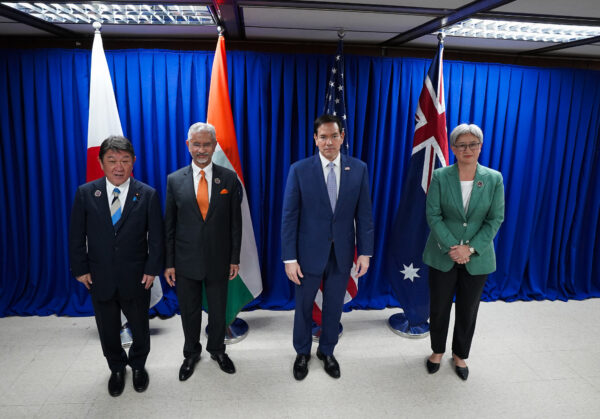
The East Asia Summit, a forum for strategic, political, and economic dialogue comprising 19 countries, convened its 16th Foreign Ministers’ Meeting in Manila on July 23. The summit, however, assumed significance because of events that occurred on its sidelines. To begin with, the Quad Foreign Ministers met again and reiterated their commitments unveiled at the 11th Quad Foreign Ministers’ Meeting in Delhi two months ago. But it wasn’t their mere gathering that caught attention. For the first time, the Quad issued a dedicated joint statement on cooperation with ASEAN, rather than just meeting alongside the regional grouping. The ministers framed themselves as “ASEAN Comprehensive Strategic Partners” and tied their agenda to “the practical implementation of the ASEAN Outlook on the Indo-Pacific.” The statement identified four broad areas of cooperation: “maritime and transnational security, economic prosperity and security, critical and emerging technologies, and humanitarian assistance and emergency response.” Reconvening in the same city where the Quad was revived in 2017, this time to issue a joint statement directly highlighting cooperation with ASEAN, is a response to critics who question the Quad’s lack of engagement with regional countries. The fact that this joint statement, even though quite vague, came at ASEAN’s premier politico-security forum, of which China is also a founding member, is suggestive of two things. On the one hand, it reflected the Quad’s willingness to overcome its appeasement of China. So far, despite being inherently a counterweight to China, the Quad has often resisted steps that can be seen as enraging Beijing. The meeting in Manila amounts to the shedding of that longstanding hesitation. For the Quad to hold its huddle there, in what is often described as China’s own strategic neighborhood, is a pointed signal aimed at Beijing. On the other hand, the fact that ASEAN accepted and enabled the Quad’s effort to insert itself as a stakeholder with a collective interest in the region is significant. Beijing has repeatedly described the Quad as an Asian NATO and has made its discomfort with the grouping known. Further, ASEAN has always sought to avoid becoming an arena for great power rivalry. Beijing is a full participant in the East Asia Summit and the ASEAN Regional Forum. Thus, the signal emerging from ASEAN is just as important, and arguably braver. The bloc communicated to Beijing that it is not afraid to engage the Quad, and that it might like to do more of that. The visible loosening of ASEAN’s reflex to keep the Quad at arm’s length will not be lost on Beijing. So, what now? It is worth recalling that the foreign ministers’ meetings of both the EAS and the Quad at Manila came days after a violent clash between Chinese and Filipino forces near the disputed Second Thomas Shoal. However, the Quad refrained from collectively condemning China’s actions. Japan was the only Quad country to call out China. It raises an uncomfortable question. If the grouping believes in “ASEAN Centrality” as the guiding principle of its Indo-Pacific policy, it cannot avoid commenting on China’s unilateral actions against the ASEAN member countries. The formulation that the Quad is “not an anti-China grouping” has been useful because of its ambiguity. But as cooperation deepens, both the Quad and ASEAN will confront a genuine dilemma over whether to explicitly name China and its actions. If the two sides want a proof of concept that sidesteps the more politically difficult questions, disaster response and maritime domain awareness are natural areas to begin with, given that a baseline level of cooperation already exists. After Typhoon Yagi struck Vietnam in 2024, the Quad pledged over $4 million in relief efforts, and after the 2025 Myanmar earthquake, it committed more than $30 million towards humanitarian assistance. Building on these precedents, the Quad and ASEAN could establish a regional rapid-response protocol covering coordination, logistics and emergency communications. A similar approach could be adopted in the maritime domain. Through the Indo-Pacific Partnership for Maritime Domain Awareness (IPMDA), launched in 2022, the Quad provides maritime tracking data to some ASEAN states. This could be expanded into a more formal arrangement for regular information-sharing across the bloc. ASEAN has opened the door to a more substantive relationship with the Quad, and that achievement should not be underestimated. Given that the group has spent much of the past year fielding questions about drift and division, the fact of another meeting itself has value.
The Quad and ASEAN’s First Step Off The Fence
Full Article
Original Source
Read the full article at Thediplomat →KhanList aggregates and links to publicly available news content. We do not host full articles from third-party sources. Always verify important information with original sources.