
As the old adage goes, “Amateurs talk strategy. Professionals talk logistics.” Military operations are utterly dependent on complex supply chains to move food, fuel, and other essential products across long distances and through contested environments to reach the warfighter. These vital supply lines are fragile at every stage: production concentrated in a single facility can be disrupted, key inputs may come from unreliable — or adversarial — foreign suppliers, and the ports, airfields, and roads that deliver goods the final mile are often the most vulnerable.The threat of this fragility eroding a modern force’s capabilities is very real. As the aircraft carrier USS Abraham Lincoln set a record for longest deployment during the ongoing conflict with Iran, it faced serious shortages of food and other supplies and reportedly struggled to maintain operational readiness. In looking ahead to larger-scale future conflicts, military leaders need new strategies to shore up this vulnerability. A powerful tool to do so is on the horizon: biology.Forward-deployed biomanufacturing offers military forces an opportunity to reduce their dependence on vulnerable supply chains by producing crucial materials closer to where they are needed. But, realizing this potential will require the Pentagon to move beyond funding individual technologies toward a coordinated strategy that integrates complementary capabilities. Specifically, it should bring together specialized companies, establish a dedicated program to develop and demonstrate deployable systems, and engage military customers early to create a clear pathway from prototype to procurement.We are deeply involved in biomanufacturing and have a commercial and policy interest in its success. Arye is a molecular biologist and entrepreneur, leading business development and government relations for Biosphere, a biomanufacturing infrastructure company. Lucas is a biochemist and a policy scholar in the Technology and International Affairs Program at the Carnegie Endowment for International Peace. However, our argument is not focused on promoting any one company’s technology, but rather advocating for a more serious strategy toward this emerging technology.Sign Up for Our NewsletterBiology Enables Flexible, Forward ProductionBiomanufacturing uses biology — often in the form of engineered microbes like yeast or bacteria — to transform sugar and other simple feedstocks into militarily valuable materials like fuels, chemicals, plastics, or food. This technology has the potential to dramatically shorten, diversify, simplify, and even relocate significant portions of a force’s supply chains.The key to biomanufacturing’s potential is its flexibility. A military’s conventional supply chains start with a dedicated chemical plant, farm, or refinery. These facilities are usually large, expensive, and built in a bespoke manner to house a fixed process making a single type of product. Biological processes aren’t as rigid. Because an organism can be genetically reprogrammed to make different end products from similar inputs, the same hardware can produce a range of materials by swapping out the cells that are grown in the tank. Rapid advances in synthetic biology and artificial intelligence are only broadening the scope further.This flexibility matters because a military’s needs are difficult to forecast and therefore challenging to supply. The private sector has no market incentive to support industrial facilities for every item the Pentagon could plausibly require surge capacity for, and military planners can’t indefinitely maintain a logistics network dedicated to bringing each of them to the front line. Therefore, strategists are obligated to operate against a frustrating backdrop that mixes fragile supply lines with a poorly incentivized industrial base.A biomanufacturing platform designed to pivot between products at short notice can begin to address these challenges. Because an individual facility can cover a wide swath of products, fewer are required to fill the gaps in a force’s logistical requirements — there’s no need to build something new for each item. This opens the door to the enticing possibility of cutting out much of the supply line entirely by constructing or shipping biomanufacturing facilities closer to the front lines, on ships, or in forward operating bases.This strategy, termed expeditionary manufacturing, is not new. But biomanufacturing’s ability to be reprogrammed to meet unpredictable demand across fuels, foods, or materials from a single platform is unique among expeditionary manufacturing technologies. Future biomanufacturing systems could be small enough to fit in a truck trailer or shipping container, depending on a force’s requirements. Such a platform would powerfully expand the suite of field-accessible products beyond what other technologies like 3D printing can provide. In short, this forward-deployed flexible biomanufacturing capacity would allow forces to grow the diverse materials they need, when and where they need them.Such applications will also avoid many of the pitfalls that have sidetracked earlier defense applications of industrial biotechnology. Previous bioindustrial booms have typically centered on substituting petrochemical processes to improve resilience or sustainability. However, achieving a competitive scale and cost was a major challenge. To sustain their growth, many initiatives relied on costly industrial policy from the Pentagon, leading to an atmosphere of skepticism around related technologies.Fortunately, forward-deployed biomanufacturing sits in a different position. Expeditionary manufacturing technologies and base resilience are already Department of Defense priorities, meaning advocates will not need to cultivate new political buy-in. The value proposition of forward-deployed biomanufacturing is also much clearer: Instead of competing with well-established supply lines on unit economics, these systems focus on the efficiency of on-demand, in-theater production.Technical Barriers Are Real but FallingEarly programs have already demonstrated this potential. The Naval Research Laboratory created a prototype for a portable biomanufacturing facility that fits inside a shipping container. Both the Army’s Small Business Innovation Research and Small Business Technology Transfer program and Defense Advanced Research Projects Agency have supported research towards field-deployable biomanufacturing systems that can generate food from nothing more than air, water, and energy. Another Defense Advanced Research Projects Agency program, Project Medusa, produced a specialized microbe that binds sandy beaches into combat-ready helipads and landing strips.But these research and development initiatives will not move these capabilities from specialized prototypes to a generalizable strategic asset. To achieve a militarily meaningful solution for the department’s needs, the private sector should be encouraged by the Pentagon to take up the task of technological improvement, scaling, and integration.The principal obstacle is that these systems are not yet mature enough to field. Achieving high production yield of biomanufactured products in austere environments will require synergistic advances in organism engineering to improve the biology’s ability to make a given product, control systems to carefully manage the manufacturing process, and hardware to house the process and shepherd material throughput. As milestones are slowly achieved, remaining limitations will undercut some of the technology’s long-term potential: For example, early facilities will likely still require a supply of sugar or other feedstocks, as opposed to using only those resources that are readily available on site, like air, water, or waste materials. Though the flexibility to grow multiple products on demand from these remaining imports will still represent a logistics simplification from today’s status quo, learning from how these early shortcomings affect military utility will be key to efficiently directing further support for capability refinement. Building the facilities that can overcome these technical barriers while maintaining flexibility and ease-of-use for non-specialists will take time, and leadership in the Pentagon should accept this reality upfront.Nevertheless, many companies are already investing to overcome these challenges. A new crop of biotechnology firms is optimizing bioprocesses that convert carbon dioxide into food, such as Air Protein and Solar Foods. Others are developing critical subsystems, including hydrogen generators and portable Haber-Bosch reactors that can supply auxiliary inputs on-site. Meanwhile, companies like Biosphere and Craft BioSolutions are advancing new types of bioreactors that are more lightweight, scalable, and flexible. Cell-free technologies are providing routes around fickle growth and storage requirements. In short, for each of the major technological barriers to deployable expeditionary biomanufacturing, a U.S. company is already crafting a relevant solution. Bringing them together is the key step to translate this potential into real-world capability.Moving from Prototypes to Deployment Requires a Shift in SupportIncentivizing this coalescence will require the Pentagon to modify its current support for biomanufacturing. Since 2020, the Department of Defense has invested nearly $1 billion in domestic biomanufacturing projects, and biomanufacturing is one of six prioritized critical technology areas, alongside technologies like artificial intelligence and hypersonic weapons. Initiatives like the Distributed Bioindustrial Manufacturing Program issued awards aimed at building the bioindustrial base, providing $60.2 million across 34 projects in the program’s first tranche.However, most funding for the myriad of defense applications of biotechnology has focused on developing new products or supporting the build-out of domestic infrastructure. Such efforts are valuable, but they are not targeted towards bringing new platform technologies, like forward-deployed biomanufacturing, online. These new capabilities require more than just money for research or infrastructure scaling. Instead, they require military leadership to play an active role in developing a vision and assembling the coalition of private actors that will make it a reality.The innovative technology underlying forward-deployed biomanufacturing is already being developed by small biotech and hardware companies, such as those mentioned above, that typically specialize in one part of the solution. Because these use cases are so nascent, companies that can integrate the entire portfolio — including specialized bioreactors, engineered microbes, sterilization systems, end product formulation, and other diverse components — do not exist. Therefore, the Pentagon cannot simply ask companies to supply bids for functional, end-to-end systems and expect the market will supply them. This is especially true when non-military demand for these integrated capabilities in, for example, biopharmaceutical production is very limited.More effectively coordinating the existing firms that can contribute to a forward-deployed biomanufacturing system is necessary to address military needs. Fortunately, there are precedents within the consortium and other transaction authority ecosystems. The System of Systems Security Consortium, for example, is explicitly structured to facilitate integration and interoperability across multiple contractors of varying sizes. These consortia enable more effective teaming by streamlining intellectual property issues and facilitating subsystem interoperability. They also ensure that, if a prototype is successfully built, the Pentagon can transition the entire group into a production contract.A new consortium is probably not needed. Existing programs, such as the Defense Industrial Base Consortium, would be well-suited to direct the innovative companies underpinning forward-deployed biomanufacturing towards a shared objective. If prioritized, these initiatives could provide the targeted alignment that, despite the $1 billion in previous expenditures, remains missing from the department’s biomanufacturing efforts.Another critical challenge facing firms in this space is the unclear path for technology transition: Who will be the buyer at the end of a prototyping effort? The Office of the Under Secretary of Defense for Research and Engineering has often played a critical role in early development of similarly complex technologies, and it is now funding several biomanufacturing efforts through the Manufacturing Science and Technology Program. Though initiatives focused on technology transition like the TREX program exist, work on expeditionary manufacturing technology has thus far been limited to the production of replacement parts in the field. To help forward-deployed biomanufacturing move from demonstration to capability, a targeted program within the Office of the Under Secretary of Defense for Research and Engineering should be established.Entities within the armed services that would act as validators or customers should also be engaged early. U.S. Transportation Command, which has recently been tasked with addressing contested logistics risks, is an obvious starting point for defining the forces’ needs. The Defense Logistics Agency and branch-specific services like Naval Supply Systems Command should be called upon to provide design input and commit to offtake. Without this well-defined path to procurement, projects will falter after the first prototype is delivered.An additional obstacle may be regulatory considerations under regimes like the Toxic Substances Control Act, which have historically been a major headache for new biotechnologies. Despite being mainly focused on commercial applications, such regulations certainly affect the Pentagon’s operations. However, the legal landscape for military applications is complicated and features mechanisms like national security exemptions from compliance or waivers for import requirements. As forward-deployed biomanufacturing matures, technology developers will need clarity on these questions. Pioneering offices like the Office of the Under Secretary of Defense for Research and Engineering should collaborate with regulators like the Environmental Protection Agency or the Food and Drug Administration to come up with answers.Don’t Wait Until the Next Logistics CrisisIndividually, a suite of biotech companies is currently optimizing the biomanufacturing technologies that can underpin a military logistics revolution. But market forces will not encourage these disparate commercial efforts to coalesce into the particular systems and capabilities the military needs. If U.S. leaders truly want the advantages that forward-deployed biomanufacturing can provide, they will need to take the decisive actions necessary to direct this constellation of fragmented firms towards a common vision.Biomanufacturing offers a unique capability: multiproduct flexibility from a single facility and the ability to leverage in situ inputs for expeditionary manufacturing. While the Department of Defense has made substantial investments in biomanufacturing, most have focused on creating new products or supporting centralized infrastructure rather than addressing the specific challenges faced by new platforms like forward-deployed biomanufacturing. Successful transition of this technology to operational use will require U.S. leaders to drive coordination across the private companies developing key subsystems while simultaneously building pathways to acquisition. Yes, the technological and operational challenges to this vision are substantial. But the Pentagon cannot afford to wait until the next logistics crisis to start addressing them.Write for Cogs of WarArye Lipman is co-founder and chief operating officer at Biosphere, where he oversees the company’s biomanufacturing platform and its work with the U.S. Army and other defense partners.Lucas Fluegel is a visiting scholar in the Technology and International Affairs Program at the Carnegie Endowment for International Peace, where he explores the implications of advanced biotechnologies for international governance and global stability.**Please note, as a matter of house style, War on the Rocks will not use a different name for the U.S. Department of Defense until and unless the name is changed by statute by the U.S. Congress.Image: Sarah Peterson via DVIDS.
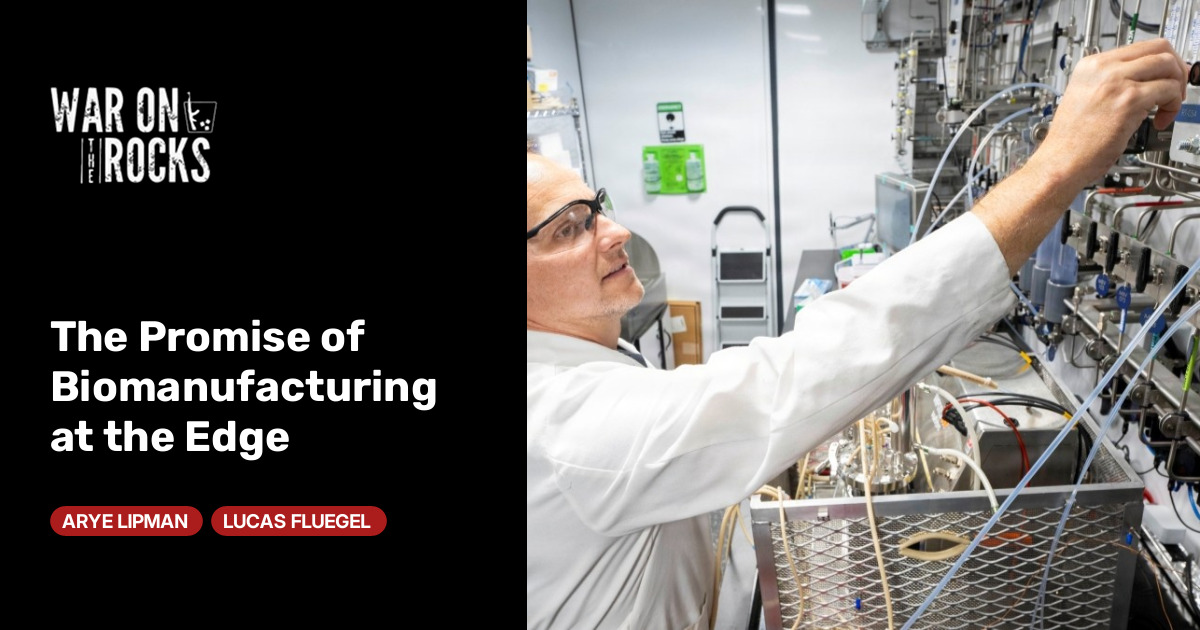
The Promise of Biomanufacturing at the Edge
Full Article
Original Source
Read the full article at Warontherocks →KhanList aggregates and links to publicly available news content. We do not host full articles from third-party sources. Always verify important information with original sources.