
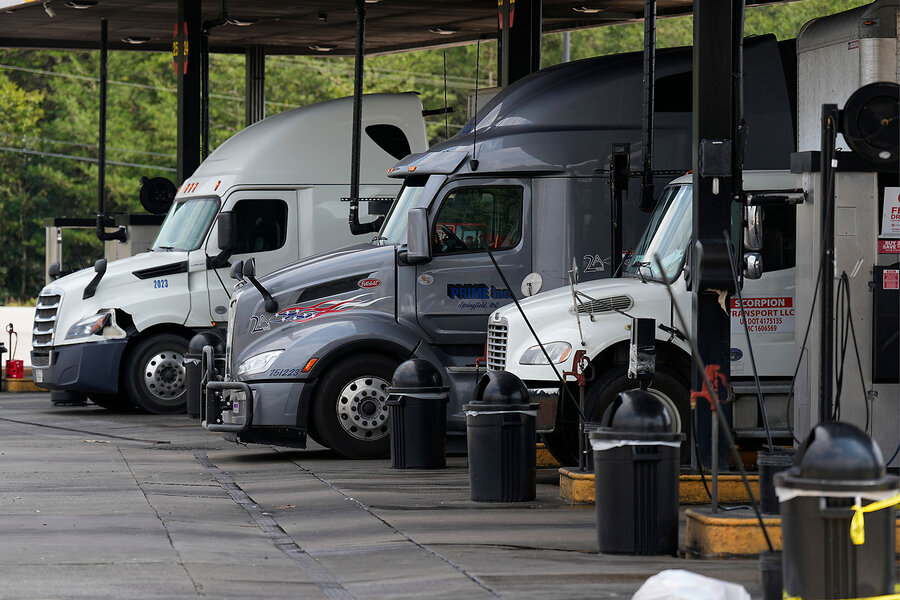
Americans have already absorbed sharp increases in gasoline prices since the war in Iran began this spring. Now, the rising price of diesel, which powers much of the freight network that keeps the U.S. economy flowing, is increasingly pinching Americans’ wallets as well.The average national cost of diesel, which had already surged in tandem with gasoline, hit a record high of $6.45 per gallon this week – a 74% increase over this time last year.Higher diesel prices are expected to ripple through industries such as agriculture and trucking, ultimately raising the cost of food and everyday goods. “Diesel is different than gasoline; it’s like the silent partner in this,” says Mark Finley, an energy fellow at the Baker Institute at Rice University in Houston.“It’s embedded in virtually everything that’s going on in our economy.”What factors are driving up the cost of diesel?The Russia-Ukraine war and the Iran war have slowed or, in some cases, halted oil flows through their respective regions, tightening the worldwide supply of diesel. Ellen Schmidt/APA pump displays the price of diesel at a gas station in Minneapolis, Sept. 4, 2026, as diesel prices in the U.S. continue to rise. The average gallon of diesel costs nearly 75 percent more than it did this time in September 2025. In 2023, Russia stiffened its supply of refined-product export controls.In the meantime, Russian attacks on Ukraine’s energy infrastructure targeted its refineries. Ukrainian counterattacks against Russian refineries have also sparked fuel shortages. In response to those attacks, Moscow banned diesel exports until October to stabilize its supply. Hoping to prevent an energy crisis, President Donald Trump last week urged Ukrainian President Volodymyr Zelenskyy to call off strikes against Russian oil refineries, saying they were “hurting the world.”Mr. Zelenskyy agreed, provided the Kremlin does not strike Ukrainian energy infrastructure or civilian areas. No agreement has been reached.But the war in Ukraine “is only a part of the story,” writes Benjamin L. Schmitt, a senior fellow at the University of Pennsylvania, in a recent energy analysis. He notes that the United States has also played a role in the energy crisis, striking Iran’s energy infrastructure repeatedly since its attack began in February. Amira Karaoud/Reuters/FileFarmers harvest a wheat field in Shelbyville, Kentucky, June 29, 2021. This year, sharp increases in the price of diesel fuel make it more expensive for farmers to operate, which leads to higher prices for food consumers. Market disruptions “have stemmed from Iran’s closure of the Strait of Hormuz for much of this year, which has led to rising global prices and market instability, including in the diesel market,” Dr. Schmitt writes.Last month, the International Energy Agency reported that 7.6 million barrels of oil per day were flowing through the Strait, 13.1 million barrels less than the average for August 2025.How does this affect the economy and national security?When gasoline prices rise, people try to limit how much they drive, reducing fuel demand. “We’ve never discovered that point with diesel,” says Thomas Kloza, Gulf Oil’s chief energy adviser.Diesel is the backbone of the nation’s economy, fueling things that range from construction machinery to school buses to backup generators for grocery stores. But experts, including Mr. Kloza, warn that spikes in the cost of diesel could lead also to higher prices for everyday goods and produce. Companies that rely on diesel to transport their products tend to pass those costs along to consumers through gradual price increases. Alfredo Sosa/Staff/FilePumpjacks draw oil from the Kern River oil field northeast of Bakersfield, California, Oct. 17, 2025. Industry experts say U.S. refineries are now operating at nearly 97% capacity to supply oil to make up for breaks in the supply chain. As much as three-fourths of the 17 million commercial trucks on the road, for example, rely on diesel, according to an analysis by the Engine Tech Forum.One specific market that relies heavily on diesel is farms and the agriculture industry.With the fall harvest already started, diesel is powering tractors, planters, and harvesters. When fuel prices rise, so do farmers’ operating costs.Mr. Finley of the Baker Institute says the impact in stores will take time to materialize. “It has to work through all of the suppliers raising their prices a little bit because of higher fuel charges.” That price then moves on to the shelves.In periods when fuel costs rise around 10% to 15%, retail food prices are expected to rise 2% to 4%, according to a report published this year by the Independent Grocers Alliance. The military is also affected by high diesel prices, because vehicles such as jets, ships, and tanks run on diesel. Some U.S. assets, such as nuclear-powered aircraft carriers, don’t use diesel – but the jets and other vehicles aboard them do, says Carey King, assistant director of the Energy Institute at the University of Texas at Austin.The U.S. Navy is already asking Congress for more money to make up for unexpected spending on the Iran war. Adm. Daryl Caudle told members of the House Armed Services Committee this month that the Navy faces impacts on “routine operations.” That includes putting limits on training exercises, flight-training hours, and training for new recruits, he said.Is there a shortage of diesel?While some experts say there is a global diesel shortage, others are avoiding that term so far when describing current supply levels.“The world has lost about 7 million barrels a day” since early 2026, says Mr. Kloza.As a result, U.S. refineries are now operating at nearly 97% capacity to supply oil where the supply chain has been disrupted, according to industry experts, including Mr. Kloza. Recent data from the U.S. Energy Information Administration (EIA) indicates that the U.S. is exporting about 4.1 million barrels of crude oil per day.What is the forecast for prices?Already, diesel prices have surpassed forecasts released by the EIA on Sept. 9. Analysts say that prices are likely to stay high throughout the fall. Mr. Kloza warned that winter could lead to higher costs and demands. “We’ve got probably about 60 days to figure this out,” he says.The holiday season normally brings even higher fuel demands, as more consumer products are being moved into and across the country.What, if anything, can be done or is being done to mitigate rising prices?In the short term, Mr. Kloza and Mr. Finley both agree, there’s little the U.S. government can do. Diesel is a global commodity. Even if the U.S. exports diesel in bulk, it remains part of a global marketplace. As supply constraints increase worldwide, prices will go up. Lawmakers have proposed restricting diesel exports. “If the United States has the supply and is exporting it,” then a diesel export ban might be one way to help hold down diesel prices, Republican Senate Majority Leader John Thune told reporters on Sept. 15. Deepen your worldviewwith Monitor Highlights.Politics with respectGet political stories with respectful analysis.There‘s a world of new ideas in everyBooks newsletter.There‘s more to life, enrich yours withCulture & Learning weekly.Follow humanity‘s discoveries withScience & Nature stories in your inbox.Gain a spiritual perspectivefrom the stories in your inbox.Want to understand the deeper impact of critical events? Learn the Monitor‘s insight.Already a subscriber? Log in to hide ads. But with export demand so high, the idea of a diesel export ban hasn’t moved forward in part because the Trump administration does not support limiting exports. Earlier this week, Interior Secretary Doug Burgum told reporters that if the administration thought a diesel export ban would bring down prices, it would have issued one already.Experts such as Mr. Finley and Mr. Kloza agree on one thing: The ongoing geopolitical conflicts are a big part of the problem. If global tensions were calmed, they say, the market could stabilize. If the Strait of Hormuz reopened and both Russian and Iranian refineries were repaired promptly, prices could decrease, easing the globe’s record-breaking diesel squeeze. ALREADY A SUBSCRIBER? LoginReal news can be honest, hopeful, credible, constructive.The Christian Science Monitor was founded in 1908 to lift the standard of journalism and uplift humanity. We aim to “speak the truth in love.” Our goal is not to tell you what to think, but to give you the essential knowledge and understanding to come to your own intelligent conclusions. Join us in this mission by subscribing.
The price of diesel keeps rising. Why it’s about to hit American consumers.
Full Article
Original Source
Read the full article at Csmonitor →KhanList aggregates and links to publicly available news content. We do not host full articles from third-party sources. Always verify important information with original sources.