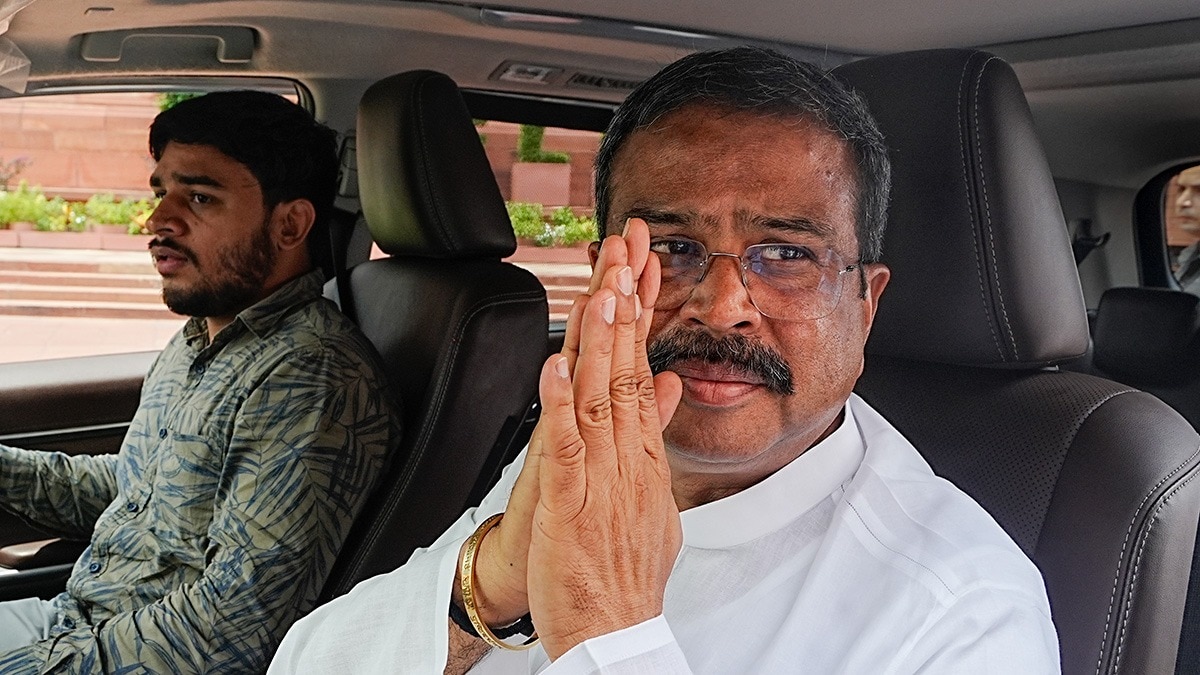
Minister Dharmendra Pradhan's exit has forced a BJP course correction spanning Parliament, Modi cabinet, bureaucracy, party machinery and its digital narrativeFor weeks, the BJP told itself the protests at New Delhi’s Jantar Mantar would fizzle out. The reasoning went that the young people on the streets in thousands would eventually go home. Instead, on July 25, Union education minister Dharmendra Pradhan had to bow out.Pradhan’s exit was not a concession the Narendra Modi government had planned to make. For a party whose self-image rests on discipline and staying power, on outlasting whatever is thrown at it, the exit of Pradhan was a sort of indirect admission that a street agitation had made the BJP blink.Pradhan was never just a minister. He was one of a handful of people in the government who carried real weight within the BJP as well: a former party general secretary trusted by both the BJP leadership and the Rashtriya Swayamsevak Sangh (RSS) because he had done years of the unglamorous work. In Haryana, Pradhan had worked alongside BJP and RSS volunteers to pull the party back up.In Bihar, he was handed organisational charge at a politically delicate moment and helped hold things together through the 2025 assembly elections. And before that, Pradhan had spent years expanding the BJP’s footprint in Odisha, taking it from a fringe player to main challenger and finally the party that ended decades of Biju Janata Dal rule. In fact, Pradhan has been a leader who could talk to the government, the BJP as well as RSS bosses without needing a mediator. This is why his resignation has hit the way it has. The BJP cadre is rattled, old questions about the government’s political ears have surfaced, and a set of weaknesses that a long run of election wins had comfortably buried lies suddenly exposed.The messaging did not help. Prime Minister Modi appealed to young Indians more than once, sharing his commitment to education reforms, taking exam paper leak culprits to task, asking young people to stay away from agitation politics and put their energy into building the country. The protests grew anyway on campuses and even among young professionals in cities. The turnaround the BJP expected never happened.This was the first time in long that BJP leaders realised things were getting out of hand. The party, which is ruling at the Centre for a third consecutive term and is part of the government in 20 states and two Union territories, suddenly seemed to have no control over the narrative among young voters.The Pradhan jolt is timed bad. The BJP is preparing for the Uttar Pradesh, Uttarakhand, Punjab, Goa and Manipur polls scheduled next year. Sections of the cadre are already demoralised by the donation theft row at the Ayodhya Ram Temple. Pradhan’s resignation has added salt to the wound.Through the Delhi agitation, Pradhan had offered to resign at least four times: first when Sonam Wangchuk was on a hunger strike, then on July 20 when the protests witnessed violence, later on the night of July 24 and eventually on July 25.What surprised many was the silence in the rest of Sangh Parivar. In earlier battles, RSS affiliates could be relied upon to push a counter-narrative or turn out numbers of their own. This time, almost nothing of the sort happened. The conclusion many BJP workers have drawn is that the government was left to take the hit on its own.On the morning of Pradhan's resignation, RSS sarsanghchalak Mohan Bhagwat said at an event that the younger generation wants reasonings and explanations to their questions, and it was our responsibility to help them find clarity—a good enough signal to the government.In the aftermath of Pradhan’s resignation, the Modi government is going ahead with its next leg of reforms in the National Testing Agency (NTA) by constituting a high-level committee under technology czar Nandan Nilekani. On July 27, Union minister Jitendra Singh tabled in the Lok Sabha amendments to tighten penal provisions in paper leak cases.So the problem has stopped being about the protest. The BJP must now show it is still the dominant political force and can reseize the national conversation. So what follows, according to people in both the government and the party, is a reset on six fronts.It starts in Parliament. Senior BJP leaders want a big constitutional win, something to put before the cadre and attractive enough to change the current national discourse. Two bills are in the conversation: the constitutional amendment bill to implement the ‘One Nation, One Election’ concept, and another attempt at making the women’s reservation law operational, which needs constitutional changes of its own to operationalise from 2029 onwards, with delimitation.The impatience goes back to April when the government could not muster majority in Parliament to get the 33 per cent women’s quota legislated. The numbers look different now. The BJP’s electoral sweep in West Bengal was followed by a split in the Trinamool Congress, which took about 20 Lok Sabha MPs and four Rajya Sabha members away from Mamata Banerjee. These Lok Sabha MPs merged into a separate grouping that has indicated support for the National Democratic Alliance (NDA) while the Rajya Sabha members joined the BJP.Six Lok Sabha MPs of the Uddhav Thackeray-led Shiv Sena faction have crossed over to Eknath Shinde’s Shiv Sena, and with it to the NDA. Talks with Sharad Pawar’s Nationalist Congress Party (NCP) faction are on to have its eight MPs join the rival NCP faction led by Sunetra Pawar. Beyond that, the NDA thinks it can pick up votes from MPs issue by issue.The Dravida Munnetra Kazhagam (DMK) has distanced itself from the INDIA bloc and, NDA leaders believe, could be persuaded on specific measures if Tamil Nadu gets something out of it. The DMK has 22 MPs in the Lok Sabha and eight in the Rajya Sabha.The Yuvajana Sramika Rythu Congress Party (YSRCP), with four Lok Sabha MPs, and Jharkhand Mukti Morcha (JMM), with three, are also on the list. None of this has been achieved yet. A special majority in both houses of Parliament still means weeks of hard bargaining. But BJP managers say they see possibilities that did not exist in April.The NDA has 318 members in the Lok Sabha. Even if it finds support from new constituents, the tally will be five-odd short of the numbers required for bills to sail through. However, in the Rajya Sabha, the NDA needs 11 MPs, something the alliance believes is achievable through the DMK and YSRCP.Then the Union cabinet reshuffle. Modi has been putting off a proper reorganisation of his council of ministers for a long time. The run of assembly election wins after the 2024 Lok Sabha poll victory was supposed to be the moment. But it never happened, and that delay is now a grievance.There are ministers who cannot face a camera without creating a problem of sorts. There are others who have overreached. Some have simply been in the same chair for years, with nobody looking closely at what they have achieved. Pradhan’s name too used to come up in the reshuffle speculation. That he resigned before any restructuring took place is the part that stings, and it has become evidence for everyone who argued that the hard decisions were postponed for too long. Whatever comes now is expected to be the biggest cabinet reorganisation of the Modi government’s third term.The third argument is about the bureaucracy, and it is older than this crisis. The transfers of K. Srinivas and Vineet Joshi, both senior IAS officers, came barely a day before Pradhan quit, and almost nobody in the establishment read them as routine.Joshi, as education secretary, had ended up with a remarkable amount of the education system in his hands: higher education policy, University Grants Commission, NTA, besides the Central Board of Secondary Education (CBSE) through additional charge.Srinivas, who was secretary, ministry of housing and urban affairs, had also collected work well outside his own department, running several autonomous bodies alongside his ex-officio roles, before being sent off to the ministry of development of north eastern region.But the two officers are only the occasion for the argument. Over the last decade, retired civil servants have taken over much of the institutional apparatus—the Reserve Bank of India (RBI), Securities and Exchange Board of India (SEBI), the Competition Commission, Insurance Regulatory and Development Authority (IRDAI)—and gone on to become governors, lieutenant governors and chairpersons of public and private bodies of every description. In addition, bureaucrats have faced criticism for allegedly taking decisions related to ministries and state governments without taking their political bosses on board.This has been bothering BJP and RSS leaders for a while. The complaint is that ministers have been reduced to signing off on what officials decide, and that a system run by generalists has no room left for anyone who actually understands a sector. The current mess will give that argument a great deal more force.The BJP organisation needs restructuring. Party president Nitin Nabin’s national team has been pending for months. States going to polls still have holes in them: no full-time in-charge in Uttar Pradesh, none in Punjab, a key organisational post of general secretary (organisation) vacant in Uttarakhand and eight other states. The view among senior leaders is that fixing the party now matters as much as fixing the government.State leaderships are being looked at as well. Chief ministers in Rajasthan, Madhya Pradesh and Uttarakhand have been the subject of the usual talk, and this time some of it may go somewhere. The timing will be a factor. But a change or two would make the point that accountability does not stop at Delhi.Lastly, how the BJP fights it online. First the controversy over Satluj movie being taken down, then the Jantar Mantar protests: in both cases the party lost the narrative early and never regained it. This is perhaps the hardest fix the party needs, and quickly. BJP and government insiders had highlighted these shortcomings during the 2024 Lok Sabha poll campaign. In private conversations, they acknowledge there is still no grip on this.The BJP is an outfit with one of the best campaign machines anywhere, yet it spent weeks being outrun on the internet by protesters with a fraction of its resources. The rivals set the frame. The government answered. Hence this whole talk of rebuilding the entire narrative operation; tightening the link between the ministries and the party, along with ideologies; putting more money, talent and mind into digital presence; and above all, developing a faster reflex when something blows up.None of this is being presented as panic. It is being described as course correction. But six fronts is clearly more than that. Pradhan’s resignation cost the BJP a minister; it also exposed a government leaning too hard on its officials, an organisation carrying vacancies in states it has to win, and a communication operation that can win elections but could not win an argument. The reset will be judged on whether any of that is fixed before the next round of voting, not on how many announcements it generates.Subscribe to India Today Magazine- EndsPublished By: Shyam BalasubramanianPublished On: Jul 27, 2026 17:57 IST
The Pradhan effect: A six-point reset the BJP cannot postpone
Full Article
Original Source
Read the full article at Indiatoday →KhanList aggregates and links to publicly available news content. We do not host full articles from third-party sources. Always verify important information with original sources.