
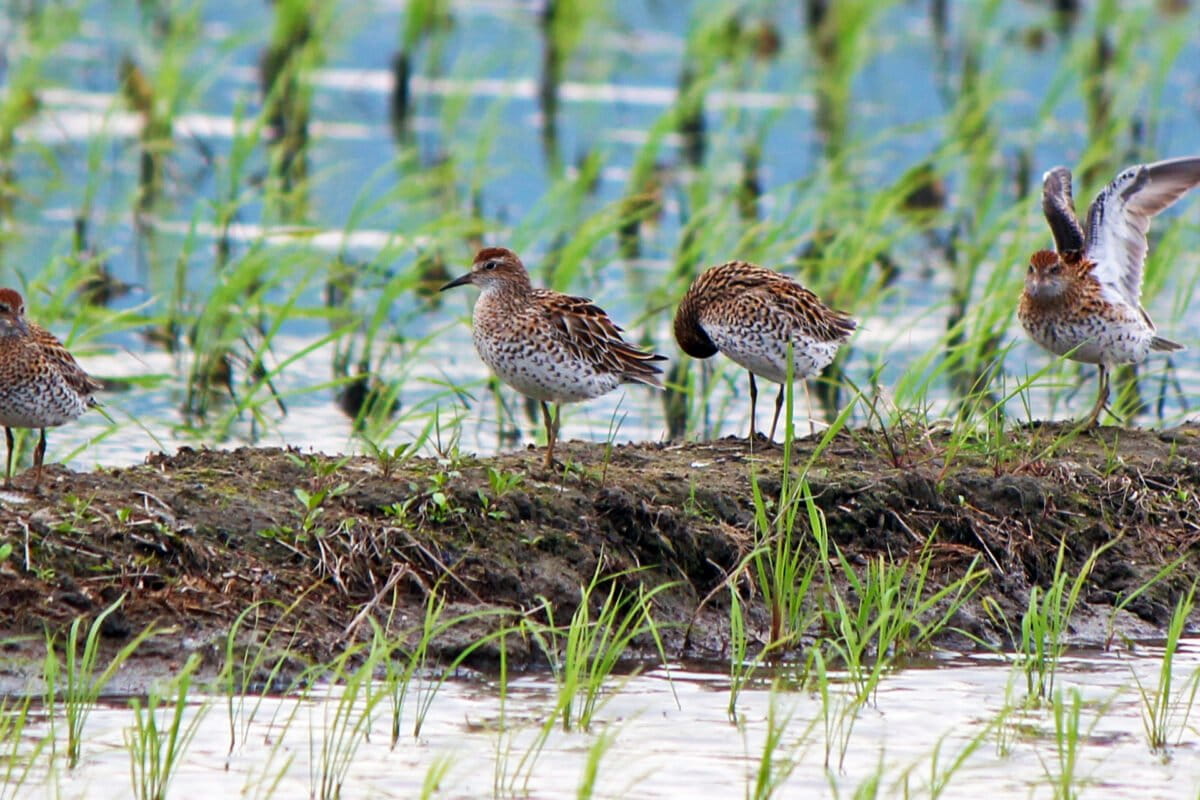
Heavy rainfall events, impacts of climate change, have increased in frequency and intensity in Japan.Researchers warn that “gray infrastructure” like large, concrete river dams and levees may not be enough to prevent flooding.In response, communities in flood-prone areas of Japan are installing small, earthen dams in rice paddies to help store excess water.In addition to flood mitigation and other ecosystem services, Japan’s rice paddies also provide habitat for an estimated 5,000 species. OSAKI, Japan — Osaki, an agricultural community in northeast Japan, has struggled with flooding in recent years. The area was inundated in 2015, 2019 and 2022, when heavy rains breached river embankments. In response, Osaki farmers and local government have installed more than 5,000 small, earthen dams in the rice paddies that surround the community, according to city officials. They say they hope the dams will mitigate flooding by keeping more water contained to the fields. Speaking to Mongabay, Osaki city officials attribute the uptick in floods, in part, to climate change. It’s a pattern seen across Japan, where climate change-fueled heavy rainfall events have increased in frequency and intensity, according to the Japan Meteorological Agency. In response, officials are rethinking their approach to flood control, with increased focus on “green infrastructure” solutions in rice paddies and other agricultural areas. Japan’s agricultural sector is in decline: The average age of a farmer was nearly 70 in 2026 and the country’s rural population is on a steady downward trend. Agricultural land near cities has been converted into suburbs and industrial zones; these low-lying urban areas can be particularly vulnerable to flooding. With declining agricultural land in mind, researchers have been assessing the flood mitigation potential of not only current agricultural land but also abandoned fields. They say that these assessments highlight the importance of understanding site-specific conditions and developing local countermeasures against flooding. “We need to look at the value of the remaining farmland from various perspectives, re-recognize it, and work to conserve it,” Yota Imai, an associate professor at Tokushima University who studies the flood mitigation function of agricultural land in Japan, told Mongabay during a video call. Osaki City, together with local farmers, have installed around 5,000 small dams in the region’s rice paddies in an effort to mitigate future flooding events, according to city officials. Image courtesy of Osaki City. The power of the paddy Rice paddies — constructed with raised ridges to store water as part of the cultivation process — can help mitigate flooding in two main ways: by temporarily trapping water and by absorbing it into the soil. “Of course, there is a limit to their capacity,” Takeshi Osawa, an assistant professor at Tokyo Metropolitan University who has studied green infrastructure and disaster mitigation, told Mongabay via video call. “But this temporary storage can slightly delay the inflow of water into irrigation canals and rivers, helping avoid peak flows that could result in flooding.” While the soil of dry fields can also retain water, dry-field crops such as soybeans are more likely to sustain damage from heavy rains compared with rice plants, Osawa adds. Many of Japan’s rice-producing regions have been gradually developed over hundreds, if not thousands, of years, with farming communities utilizing the low-lying topography of floodplains while endeavoring to control the flow of water. The Osaki plain, with mountains to its west and rivers flowing through it, is one such region. Although fertile, the area is susceptible to not only floods but also droughts and cold summers, making skillful water management essential for generations of farmers. A common greenshank (Tringa nebularia) hunts its next meal in a flooded rice paddy in Japan. Image by Alpsdake via Wikimedia Commons (CC BY-SA 3.0). Although the Osaki community has managed water resources through hardscape solutions, such as artificial river embankments, for roughly 300 years, farmers and city officials started utilizing the paddies themselves for flood control around the 1960s, according to city officials. “The community has utilized rice paddies as floodwater retention areas by temporarily diverting river water into them, to mitigate flood damage to settlements,” said Masahiro Ito, a member of Osaki City’s River Basin Flood Management Division, during an interview with Mongabay. “This helps prevent river embankments from being breached.” As of 2025, Japan contained roughly 4.2 million hectares (10.4 millions acres) of agricultural land, including roughly 2.3 million hectares (5.7 million acres) of rice paddies, according to government data. Total agricultural land has decreased by roughly 30% since the early 1960s. Agricultural abandonment is an ongoing issue particularly affecting hilly regions with less favorable farming conditions and is due, in part, to aging farmers and labor shortages, according to the Ministry of Agriculture, Forestry and Fisheries. Abandoned agricultural land in rural areas is often left as-is, according to Imai. Meanwhile, land near cities may be developed for housing, commercial facilities, or, in recent years, solar farms. Such land use changes “will generally cause the land’s flood mitigation function to decline,” he said. However, abandoned agricultural land left as is may not necessarily lose all flood mitigation potential. “Looking at common trends across a broad range, my current view is that as long as farmland [isn’t subject to land use change] — regardless of whether it is partially abandoned or not — it will likely provide a certain degree of disaster mitigation,” Tokyo Metropolitan University’s Osawa said. In Toyooka City, abandoned paddy fields have been restored as wetlands with the goal of providing habitat for the Oriental white stork (Ciconia boyciana), a bird once extinct in Japan. Image by Yota Imai. From gray to green With heavy rain events expected to increase in frequency in Japan due to climate change, researchers warn that “gray infrastructure” like large, concrete river dams and levees may not be enough to prevent flooding. “It’s generally acknowledged that we need to utilize rice paddies for flood mitigation more than ever before,” Tokushima University’s Imai said, noting that effectiveness may vary depending on factors such as location and rainfall patterns. In recent years, both the national government and various municipalities have incorporated a watershed-level approach to flood prevention. Shiga Prefecture, located in central Japan, has been a pioneer in incorporating rice paddies into local flood mitigation plans, according to Osawa. The prefectural government, which also positions its disaster mitigation measures as a climate change adaptation strategy, established a flood management office in 2006 and uses a “site safety level” system to assess and prepare for flood risks by location. Paddy dams are used to boost paddy fields’ flood mitigation potential. The dams, installed in paddy drainage holes, have a smaller-than-usual opening to slow the flow of water. Niigata Prefecture on the west coast of Honshu Island is Japan’s premier rice-producing region and has been a leader in paddy dam implementation for over 20 years. In Osaki, city officials have worked with agricultural groups and the prefectural government to implement paddy dams since 2021. The officials say they have installed dams across roughly 20% of Osaki’s paddy land so far, an area equivalent to about 1,700 hectares (4,200 acres). “That speaks to how bad the flooding can be!” Katsuyoshi Takahashi, a member of the city’s Rural Areas Development Division, told Mongabay in an interview. The dams work by constricting the flow of water out of the paddy. Image courtesy of Osaki City. A boost to biodiversity As artificial wetland habitats, Japan’s paddy fields also support biodiversity — provided agricultural chemicals aren’t used to excess. Research shows that in addition to ecosystem services, Japan’s rice paddies provide habitat for an estimated 5,000 species. Although there isn’t a direct correlation between biodiversity conservation and flood prevention, the two benefits can overlap, according to Imai. “Maintaining contiguous farmland and rice paddies without developing them is, of course, beneficial for flood retention, and since wildlife — especially birds — require extensive habitats for conservation, this can create a win-win scenario,” he said. Abandoned paddy fields can potentially open new doors to conservation. In a chapter of the 2022 research anthology Green Infrastructure and Climate Change Adaptation, Imai and co-authors assessed a conservation project in Toyooka City, Hyōgo Prefecture, where abandoned paddy fields were restored as wetlands with the goal of providing habitat for the Oriental white stork (Ciconia boyciana), an endangered bird once extinct in Japan. They found that the abandoned fields’ water storage capacity was improved through wetland restoration. Citizens and city officials removed vegetation and rebuilt levees to help water accumulate and create an environment where the storks’ prey could flourish, Imai told Mongabay. However, he cautioned against drawing broad conclusions about flood mitigation based on this single example. The Oriental white stork (Ciconia boyciana) is listed as endangered by the IUCN; its main threats are habitat loss and hunting. Research indicates rice paddies provide valuable foraging grounds for the species. Image by Christoph Moning via Wikimedia Commons (CC BY 4.0). Osaki City, too, is keen to preserve its paddy fields, wetlands and traditional farmsteads as wildlife habitats. The area contains two registered Ramsar Sites, wetlands of international importance — the Kabukuri-numa wetland and surrounding rice paddies, as well as the Kejo-numa reservoir — that provide habitat for migratory geese and other wildlife, and help to mitigate flooding. In 2017, the Osaki area was also recognized as a Globally Important Agricultural Heritage System (GIAHS), a framework run by the U.N. Food and Agriculture Organization (FAO). The city aims to use the designation to raise farmers’ income and draw people to the area, said Motoyuki Miyake, a member of Osaki’s GIAHS secretariat. “Maintaining paddy fields is crucial for the conservation of biodiversity, and it’s important to ensure farmers can make a living from them through various initiatives,” Miyake said in an interview with Mongabay. Installing paddy dams, in addition to boosting flood control, likewise “demonstrates a commitment to maintaining these areas as paddy environments for the foreseeable future, with the cooperation of farmers,” he added. Banner image:The sharp-tailed sandpipers (Calidris acuminata) rest on a berm in a rice paddy in Mie Prefecture, Japan. Image by Alpsdake via Wikimedia Commons (CC BY-SA 4.0). In coastal Japan, one project is planting forests to stand against tsunamis Citations: Imai, Y., Muto, Y., & Kamada, M. (2022). Change in floodwater retention function of a Paddy Field due to cultivation abandonment in a depopulating rural region in Japan. Ecological Research Monographs, 161-173. doi:10.1007/978-981-16-6791-6_10 Saha, D., Oki, K., Yoshida, K., Hanasaki, N., & Kamiya, H. (2023). Impact of Paddy Field reservoirs on flood management in a large river basin of Japan. Sustainability, 15(8), 6604. doi:10.3390/su15086604 Taki, K. (2022). Flood management policy in Shiga prefecture, Japan: Implementation approach of a risk-based flood management system at catchment scale. Ecological Research Monographs, 43-59. doi:10.1007/978-981-16-6791-6_4 FEEDBACK: Use this form to send a message to the editor of this post. If you want to post a public comment, you can do that at the bottom of the page. Credits Topics
The power of the paddy: Japan looks to rice fields to help mitigate flooding
Full Article
Original Source
Read the full article at News →KhanList aggregates and links to publicly available news content. We do not host full articles from third-party sources. Always verify important information with original sources.