
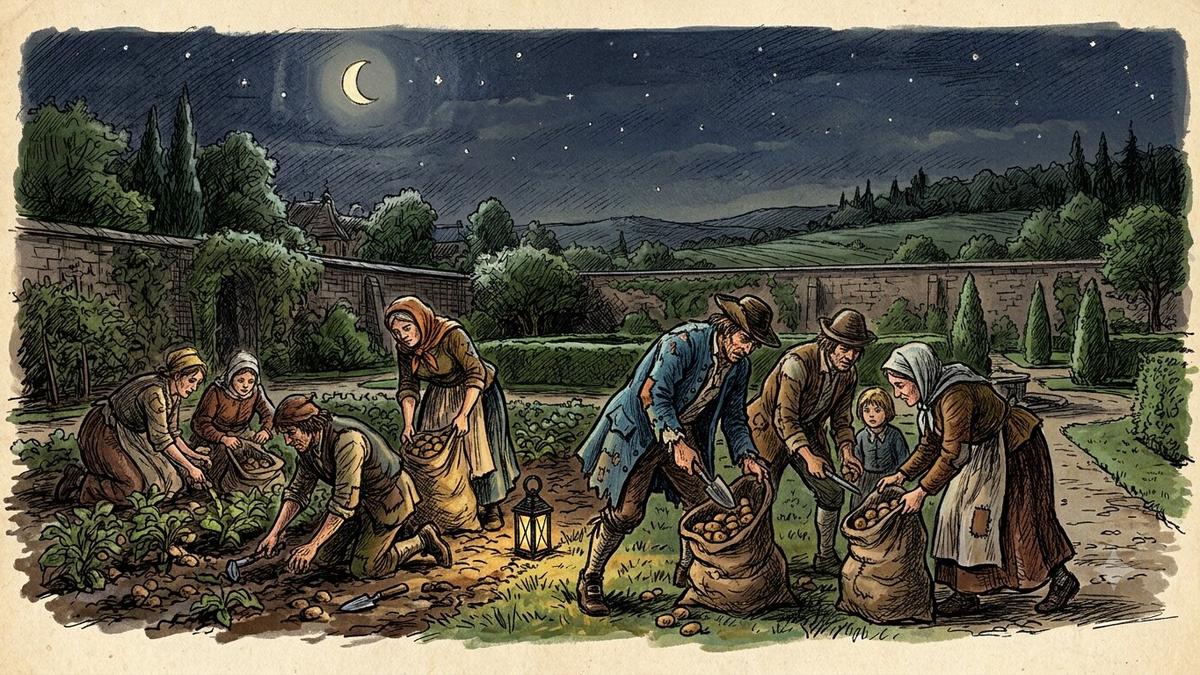
“Did the guards leave their post?” The young farmer hissed quietly at his brother, whom he had accompanied to sneak into the royal garden, which was usually protected by a bunch of guards under the king’s command. The farmer’s brother shook his head as he peeked from behind a tree, the two of them gazing at the vegetable which they heard was meant to be consumed only by royals. “It won’t be only theirs for long,” he chuckled quietly, as the farmer nodded. The two of them were curious by nature, and strongly believed that if a vegetable was forbidden to all with the exception of a single group, it had to be special. They were not leaving the palace garden without filling their basket with the brownish tuberous potato! Kartoffelsuppe, or potato soup | Photo Credit: WIKIMEDIA COMMONS Potatoes in GermanyIf you were to look up German cuisine, you would find many dishes that incorporate the use of potatoes into the recipe. These include not only fried potatoes (Bratkartoffeln), but also potato soup (Kartoffelsuppe), potato pancakes (Reibekuchen), potato dumplings (Knödel), potato noodles (Schupfnudeln), and so much more! A glance into the massive Potato Revolution, which took place in the year 1847 in Berlin, Prussia, should further emphasise just how important and valuable the potato was and still is to the people there. The amount of chaos and riots that occurred within the span of about three days of failed potato harvests and rising prices (as part of the European potato failure) cannot be described in words. Shops were stormed, people were attacked, stores were looted, schools were closed, etc. The country is also the largest producer of potatoes in the European Union. While this year may be showing a smaller harvest of the tuberous vegetable due to the heatwaves and rainfall, the country’s strong connection to potatoes cannot be overstated. (Pssst! A little extra information! Germany is also known for its famous Potato Hotel, called Deutsches Kartoffel Hotel Lüneburger Heide. The services include potato meals, potato spa treatments, potato picking, and cultivation activities!) Schupfnudeln, or potato noodles | Photo Credit: WIKIMEDIA COMMONS Rebranding and reverse psychologyKing Frederick II was known for many accomplishments during his reign over Prussia. However, one prominent story you may hear enthusiasts whisper about him is the tale of how he used reverse psychology to get the citizens of the country to add potatoes to their diet. However, much like Snow White’s apple and Alice in Wonderland’s Drink Me bottle, the citizens saw the potato as a vegetable that held the mixed factors of possible danger and mystery. They would not take a chance with an unfamiliar new plant which, out of nowhere, was added to their cultivation and nutrition list. The vegetables’ dirt-covered appearance did not help matters. There is an old German proverb that perfectly sums up this situation: “Was der Bauer nicht kennt, frisst er nicht”, or “What the farmer doesn’t know, he won’t eat.”To battle this growing dislike for the vegetable, Frederick is said to have resorted to a scheme that involved playing a bit with the minds of his subjects. This involved the use of the two R’s.These two R’s stand for rebranding and reverse psychology. The potato was believed to have been rebranded into a royal vegetable, fit only for aristocrats to consume. And Frederick was said to have made this known to the populace by having guards stationed along the edge of the palace garden. To those outside the palace, it looked like the potatoes were being protected from the common folk.Wanting what you can’t have is pretty common. Seeing the guards near the gardens is believed to have pushed people to “steal” the potatoes, when they were actually being given an open market for the vegetable.This is the story that became popular, and which many say gave Frederick the moniker of “The Potato King.” However, according to the words of a German historian, this story is not true in the slightest!An expert’s revelationYes, the story of how the then king of Prussia tricked the citizens into spreading the consumption and cultivation of potatoes sounds pretty fun and something you would want to read in a history book when learning about his reign. However, German historian Jürgen Luh, of the Prussian Palaces and Gardens Foundation, is well aware of the true history and is constantly on the tiring job of debunking the story. According to the archives that held the old royal menus, Frederick was quite the Italophile when it came to food, as he held a strong liking for Italian cuisine. But when it came to the potato, “He never ate it,” the historian had said in an interview with AP News, “Any potato. Not boiled, not fried.” He also explained how potatoes were already being cultivated in Germany’s Bavarian region in 1647, before Frederick’s reign had even begun. Almost an entire century! It was then introduced to Prussia by his great-grandfather, Elector Frederick William, because he liked the leafy greens that came with it. This picture shows Sanssouci, Frederick the Great's Summer Palace. Prussia was a major German state located in the North European Plain. It grew from a small medieval territory to the main driving force behind the unification of Germany. | Photo Credit: WIKIMEDIA COMMONS The Potato Kings’s true roleWhen Frederick became king, potato cultivation could already be found in gardens throughout Prussia. However, this was only on a small scale. The king did take action to promote the cultivation of potatoes on a broader scale on the land he governed. He issued the Potato Edict, or the Potato Order, which was a series of royal decrees (15 in total) that were created to ensure the spread of the vegetable. The year 1756 also saw a proclamation that mandated the cultivation of potatoes. However, according to Luh, potatoes did not grow popular in Prussia until after the end of the Napoleonic Wars in 1815. A statue of Frederick the Great in front of Schloss Charlottenburg in Berlin. | Photo Credit: WIKIMEDIA COMMONS Myth vs truthDespite the truth behind the alleged potato king’s role in spreading the vegetable’s cultivation, there are still so many who believe the story of trickery. While Luh had always tried to correct visitors and tourists about the truth, it has come to the point where he has mostly given up. Even after this revelation was made, to this day, people still honour Frederick II as “The Potato King”. They still leave raw potatoes and paper crowns by his grave at his summer palace, Sanssouci. The place also has a gift shop that sells potato merchandise like postcards and children’s books. According to Luh, the beauty and strong narrative of the legend hold more power on the curious minds of the people than the truth of Prussia’s connection to potatoes.
The potato king: Tales vs truths
Full Article
Original Source
Read the full article at Thehindu →KhanList aggregates and links to publicly available news content. We do not host full articles from third-party sources. Always verify important information with original sources.