
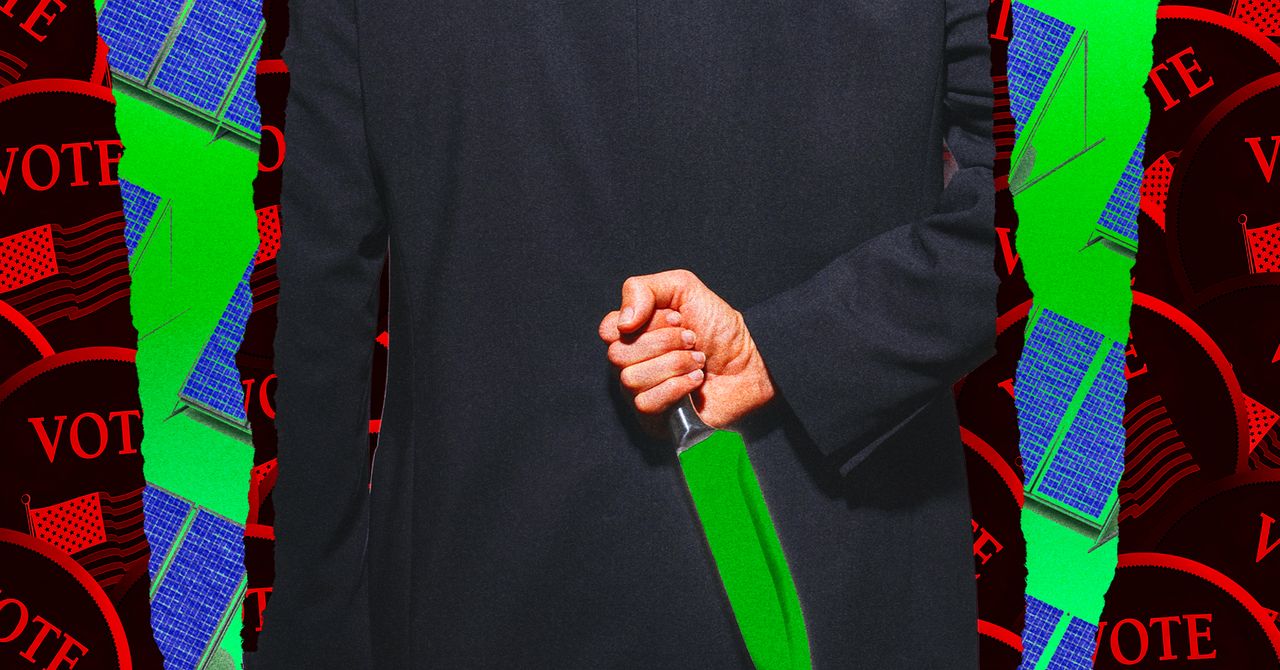
A mysterious super PAC that doubles as a pro-solar energy outfit is funding some of the most knives-out attack ads of the midterms season.Photo-Illustration: Jobanny Cabrera; Getty ImagesA mysteriously named political action committee has started running ads reminding voters in Colorado about that time GOP representative Lauren Boebert of Colorado and her date were caught on camera in 2023 getting handsy during a performance of the musical Beetlejuice.That same PAC is producing a spot hitting Anthony Constantino, a Trumpist congressional candidate in upstate New York, because someone used his sticker-printing company to briefly make stickers that read, “Kill the Police.”Attack ads are everywhere in the last month ahead of November’s election. But these spots are a little different. The semi-anonymous PAC that’s funding and making the ads, the Invest in Tomorrow Coalition, is a pro-solar-energy outfit. It’s funded in part by crypto billionaire Chris Larsen and run by a team of New York City political operatives.“Playing hardball politics, that's what our opponents do, right, in oil and gas? And I just think the solar industry has been—I don't know how to describe it—a little too nice,” says Larsen, the cofounder of the blockchain finance firm Ripple and a major backer of the Invest in Tomorrow Coalition.Green groups don’t usually act like this, with knives out, ready to stab opponents between the ribs. They tend to make appeals based on scientific consensus, or fears of what will happen to a warming planet without collective action. They’re also traditionally Democratic, but a few high-profile members of the MAGA movement are now speaking up for solar too. Texas, the home of the fossil fuel business, has quickly become a solar powerhouse. There are some signs that the Trump administration’s across-the-board opposition to solar may be starting to crack, at least a little, after years of slashing greentech subsidies and throwing up one roadblock after another to clean power projects.Some of Larsen’s natural allies in the renewables field aren’t too happy about the PAC’s efforts, arguing that they’re alienating the decisionmakers they need most. But the politics of energy, especially solar energy, are changing.Larsen’s PAC is devoting $15 million to go after seven of the more prominent opponents of renewable energy in this year’s congressional elections. That’s on top of roughly $5 million they’ve already spent in the primaries, cutting ads against Republican representatives Ralph Norman of South Carolina (whom the PAC called a “MAGA traitor”), Andy Ogles of Tennessee (“He doesn’t even bother going to work”), and Chip Roy (“chosen the side of powerful pedophiles”) of Texas. A PAC that received funding from Invest in Tomorrow has also gone after one Democrat, Rhode Island governor Dan McKee. All four lost their primary races.In Roy’s case, the Invest in Tomorrow Coalition spent almost $1.5 million to stop his run for Texas attorney general. Most of the money went to ads on right-wing platforms like Truth Social and Rumble. The word “solar” was never mentioned.“Don't talk about renewables. Don't talk about climate,” says Chris Coffey, the chief executive of the consultancy Tusk Strategies, which is running the PAC. “Pick the best issue that we can pick. And in a Republican primary, we should savage this guy for not being MAGA enough.”Roy received a 100 percent rating from Heritage Action, the political arm of the Trumpist think tank. Coffey said he got some pushback from a few Democratic operatives, who were concerned that replacements for Roy and other PAC targets might not be any less extreme—on climate or any other issue. Without their far-right track record, the argument went, those replacements might even be stronger candidates in the general election.“Who fucking cares? Who cares? Like, it can't be worse,” Coffey, a veteran of New York City mayor Michael Bloomberg’s City Hall, says in response. “At least we'll have extracted some payback.”The PAC is currently putting $2 million into ads blasting GOP representative Victoria Spartz of Indiana as allegedly corrupt; it’s aiming to target Texas Republican Brandon Herrera for his “abolish old people” jokes and his plan to get rid of Social Security. Then there is the $1.5 million ad campaign about Boebert and the Beetlejuice incident. “If Lauren Boebert can’t be trusted in a room full of kids, then she can’t be trusted in the halls of Congress,” the commercial’s narrator says.Other special-interest organizations have been running this playbook for decades. Groups supporting labor and opposing gun regulations regularly try to make examples of politicians who oppose their agenda. Green groups haven’t been as aggressive historically. That’s a problem, says Steph Bosh, the board chair of the Community Clean Energy Coalition. While her group has raised nearly $2 million to promote their favored hyperlocal candidates this cycle—and the League of Conservation Voters’ affiliated super PAC is spending another $50 million—Bosh says she appreciates that someone else is taking a less friendly approach.“As a broad renewable energy industry, we need to be loved, respected, and feared,” Bosh adds. “We need to have a carrot, and we need to have a stick.”James Carville, the Democratic pundit and former campaign manager, doubts the stick is big enough. “Twenty million—what the fuck do you think the carbon industry spends in a year?” he recently said to the Washington Monthly.Roy, for his part, insisted that the PAC’s spending had played “zero role” in his race (while his campaign staff put out statements denouncing the “radical California Marxists trying to buy Texas elections”). Ralph Norman, his fellow solar target, warned about the “elite” taking out “the $1 million attack ad against me,” while Ogles complained, “they literally are trying to make an example out of me.”“They were the difference maker,” Chris Burger, a Republican political consultant in Tennessee, says of the pro-solar group. “I don't think Charlie [Hatcher, Ogles’ primary opponent] wins if the PAC doesn't come in with $2 million.”The Trump White House and its allies in Congress have been beyond hostile to renewables, which they believe to be intermittent sources of energy, and dominated by China. The administration has done everything it can to promote the production of oil, gas, and coal, while kneecapping renewable alternatives, from tying green projects in bureaucratic knots to pulling billions of dollars’ worth of solar subsidies and paying companies billions more to stop offshore wind farm construction. Then the Trump team tried to get other countries to adopt similar attitudes. “If you don’t get away from the green energy scam, your country is going to fail,” the president told the United Nations General Assembly last year.But the Trumpists have been slightly less hostile to solar than to offshore wind farms, which, according to the president, cause cancer, “kill all your birds,” and drive whales “crazy.”“While wind is dead, solar is merely in the ICU,” Richard Goldberg, a former member of the administration's National Energy Dominance Council, tells WIRED.That has provided a small but real opening to promote solar to the America First set, especially with energy prices spiking at home, the war in Iran pushing up oil prices around the world, and the spread of AI data centers creating a borderline-insatiable need for more power.In February, the American Clean Power Association launched a campaign to do just that, releasing a poll from former Trump campaign manager Kellyanne Conway’s consulting company showing that 75 percent of MAGA voters in key states supported the idea of adding more solar energy to the national mix. According to an internal memo reviewed by Politico, soon to follow were “paid media partnerships with podcasts like the Katie Miller Pod” (hosted by the former DOGE spokesperson, who is married to White House deputy chief of staff for policy Stephen Miller) as well as “advertorials and sponsorships with right-of-center publications.”Katie Miller, once a consultant for Elon Musk, a renewable energy advocate, has repeatedly pushed for solar on social media since then. “Over 70 percent of the new utility-scale capacity went into states won by President Trump,” reads one of her posts. “Electricity generation is a national security issue—not a partisan one.” (Miller, who did not respond to requests to comment for this story, has previously denied receiving any funding from the clean power group.)There’s also the data center issue. China hasn’t had problems powering its data centers, thanks in part to its widespread deployment of renewables—315 gigawatts of solar added to the grid last year, about six times more than the United States added from all sources combined. The US is in an entirely different situation. MAGA-minded promoters of solar are trying to leverage that gap to make a Trumpy argument for renewable energy. Concerns about the climate are out; fears about losing the AI race to China are in.T1 Energy, which bills itself as one of the few truly all-American solar manufacturing companies, has hired Checkmate Government Relations, a lobbying firm led by Donald Trump Jr.’s old hunting buddy, and Tower Strategy, helmed by a former CIA operations officer, Rick De La Torre, to press its case in the administration. These lobbyists have tried to make the case that the administration’s beef isn’t with solar in general; it’s with Chinese solar. They’ve done it in the kind of pec-flexing language that’s become MAGA’s stock-in-trade.“American-made, utility-scale solar is one of the few technologies that can be deployed at the speed and scale required” for data centers, De La Torre posted on LinkedIn. “China knows this. That is why it continues to flood markets, compress margins, and keep U.S. manufacturers on the defensive. Undercut. Outscale. Outlast.”“Washington has a choice. Treat solar manufacturing as a strategic industry, the way we now treat semiconductors and critical minerals,” he added. Or only claim “to compete with Beijing.”There are some indications that the argument may be gaining traction. In August, the Trump administration added a new 15 percent tariff and price floors on foreign-made solar components. T1’s CEO hailed it as a victory for domestic supply chains and manufacturing. More recently, negotiations in Congress are continuing on a bipartisan permitting reform bill that would, among many other things, make it easier for solar providers to plug into the electric grid.Which led some solar executives to question whether it’s smart for the group to beat up on Republicans, right as a few of them seem to be creeping in solar’s direction.“We’ve been hard at work speaking to Republicans about why supporting solar and batteries helps with energy abundance and affordability. And we’ve been successful. If this [Invest in Tomorrow Coalition] becomes about going after Republicans and turns solar back into a partisan issue, that would be an epic blunder,” says Russell Gold, T1’s executive vice president for strategic communications.Tom Matzzie, the chief executive of solar company CleanChoice Energy, is serving as executive chair of the Invest in Tomorrow Coalition PAC. Cofounders include Peter Davidson, CEO of the investment firm Aligned Climate Capital, and Michael Brune, former executive director of the Sierra Club. But it’s Larsen who supplied the lion’s share of the early money for the PAC—$6 million of the initial $7 million or so it had raised through August 31, according to federal election commission records.He’s had an uneven record of political giving, of late. Earlier this year, Larsen spent $3.5 million to support congressional candidate Alex Bores, who was targeted by the AI industry and lost his race. Larsen’s company, Ripple Labs, has donated nearly $100 million to Fairshake, the pro-crypto PAC, which racked up electoral successes in 2024 but just lost a major fight when its preferred bill to regulate cryptocurrencies died in the Senate.The willingness to go on the attack isn’t the only way that Larsen’s PAC differs from others in the green movement. Not that long ago, renewable advocates talked about an “energy transition” away from old, dirty fossil fuels and toward newer, cleaner ones. Larsen is suggesting instead to red-district politicians that they embrace the idea of fossil and renewable energy sources existing side-by-side, even as the PAC he funds throws haymakers at solar’s enemies.“You could be pro oil and gas and pro solar,” he says.In your inbox: Go inside the world of digital security with Kernel PanicNoah Shachtman is a contributing editor at WIRED and a contributing writer for The New York Times’ opinion section. Shachtman previously served as editor in chief of Rolling Stone, where he led the storied outlet to a Polk Award and its first-ever Emmy nomination. Before that, he was the editor in ... Read More
The Politics of Solar Energy Are Getting Weird, Mean, and a Little MAGA
Full Article
Original Source
Read the full article at Wired →KhanList aggregates and links to publicly available news content. We do not host full articles from third-party sources. Always verify important information with original sources.