
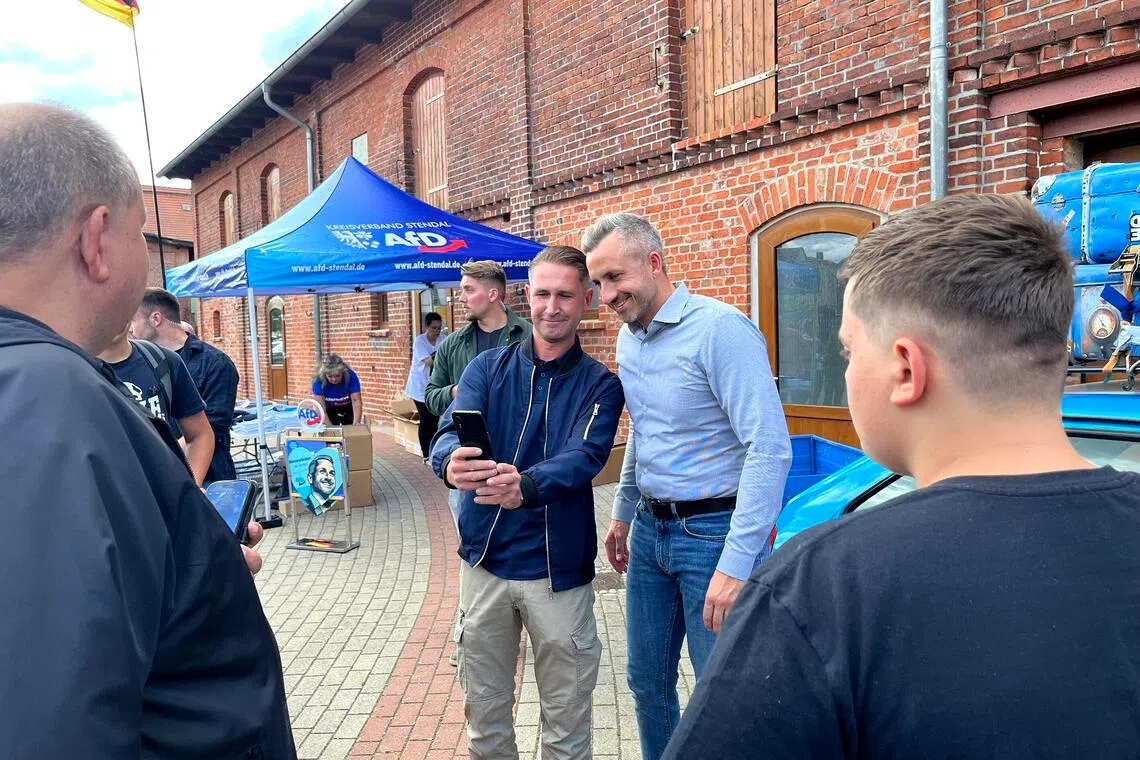
JERICHOW, Germany – On a warm afternoon in the small east German town of Jerichow, Ulrich Siegmund looked less like a political firebrand and more like a polite neighbour.Slender, with neatly parted hair, and wearing an approachable smile, the 35-year-old moved easily across the central square.He shook every hand and patted dozens of backs. He asked about family, remembered names and patiently posed for smartphone wefies with anyone who asked.By the time the town’s “AfD Barbecue” reached its peak, more than 300 locals had gathered under the blue-and-white banners of the Alternative fur Deutschland (AfD). They ate grilled sausages, drank beer and cheered.Yet, behind this staged picture of rural normalcy lies a profound political earthquake.Siegmund could soon become the first far-right state premier in post-World War II German history.In the eastern state of Saxony-Anhalt, elections are scheduled for Sept 6 – and the AfD is polling at over 40 per cent.Under favourable circumstances, even slightly more than 40 per cent could be enough for the party to secure an absolute majority of seats in the regional Parliament.It would allow the AfD to govern alone – without Chancellor Friedrich Merz’s Christian Democratic Union (CDU), the Social Democrats or any other traditional party that has governed Germany since 1949.Siegmund’s primary rival is Sven Schulze, the current prime minister of Saxony-Anhalt and leader of the state’s CDU. However, in the opinion polls, the CDU garners only between 22 and 24 per cent.Eighty-one years after the fall of Adolf Hitler’s Nazi regime in 1945, a party whose Saxony-Anhalt state organisation is classified by the state’s domestic intelligence service as a confirmed right-wing extremist organisation stands on the precipice of real state power.Siegmund’s speech that afternoon in Jerichow lasted barely five minutes. But the audience were not there for policy details. They were there to rub shoulders with him. He merely repeated well-worn populist tropes.He claims that free speech no longer exists in Germany, demands the abolition of public broadcasting accused of ideological and political bias, calls for mass deportations of immigrants and condemns German aid to Ukraine.Siegmund has cultivated the image of a political pop star. In July, he led a roaring convoy of 400 vintage East German Simson mopeds through the countryside, invoking nostalgia for a vanished socialist state. When Der Spiegel, Germany’s leading news magazine, put his face on its cover with the headline, The Most Dangerous Man In Germany, Siegmund did not hide.He autographed copies of the magazine on camera and broadcast the video on Instagram as a badge of honour.Gone are the days when voting for the AfD was a source of shame. Today, people openly flaunt it.However, beneath the polished social media presence lies an apparatus deeply rooted in radical networks. Investigative reports reveal that Siegmund’s parliamentary staff includes former leaders of the Heimattreue Deutsche Jugend, a neo-nazi youth organisation banned by the German government in 2009.Key strategic positions in a potential AfD administration – including the chief of the state chancery and senior justice officials – have been discussed for candidates with ties to banned right-wing groups.Siegmund’s campaign operation also has links to activists and entrepreneurs from the Identitarian milieu. The Identitarian movement is a far-right European network that promotes the idea that white, European cultures are under threat from mass immigration and globalisation.What would an AfD government look like?Ronald Glaser, a prominent AfD lawmaker in Berlin, leaves little doubt about the party’s radical ambitions.“A mildew has hung over Germany, essentially since the days of Helmut Kohl,” he said in an interview with The Straits Times, referring to the chancellor of Germany from 1982 to 1998.The late Kohl was also former chancellor Angela Merkel’s mentor.“Nothing has changed for the better, everything just kept getting worse”, Glaser, 52, said.“There are far too many checks and balances in Germany that produce a reform backlog. Now a new party needs to step in and push things through.”The AfD’s priorities reflect a fundamental overhaul of German domestic and foreign policy: ending subsidies for renewable energy in favour of nuclear power; reducing public broadcasting to a drastically scaled-down, tax-funded Grundfunk – or basic – broadcasting; arguing that Germany has already fulfilled its humanitarian obligation to Ukraine by taking in refugees, and restoring cheap Russian gas imports.“Countries have interests, not friends,” Glaser argued. “We want to do business with the Russians because they have cheap gas and are an important, powerful neighbour.”He does not deny Russia’s responsibility for the invasion of Ukraine. “Of course the invasion was wrong,” he said. “But if we’re going to talk about it, then we also have to talk about the whole history leading up to it.”He was echoing the Russian narrative that the country was encircled by NATO and had no other choice but to invade Ukraine.On immigration, the AfD’s stance is uncompromising. Glaser, who was a staff writer for the right-wing weekly Junge Freiheit, called for a “wave of deportations”.Siegmund himself openly uses the term “remigration”, which is a far-right political concept that advocates for the forced removal of migrants and, in some formulations, even citizens with a migration background.Why right-wing populism resonates in eastern GermanyTo understand why this message resonates so strongly in eastern Germany, one must look at the political and social legacy of the past.When the Berlin Wall fell in 1989 and East Germany was integrated into the Federal Republic, millions expected rapid prosperity.Decades later, despite vast economic investments, many formerly from East Germany still feel disenfranchised.“The feeling of political powerlessness is widespread in the east, as is the feeling of being second-class citizens,” Benjamin Hohne, a political science professor at the University of Chemnitz, explained to ST.“East Germans remain vastly underrepresented in the civil service, universities, the judiciary and the media. Right-wing populist parties specialise in unearthing deep-seated resentments that other parties try to overcome.”Hohne noted that in rural eastern provinces, civil society is fragile. “In rural areas, civil society structures are often weak or barely existent,” he said. “In some places, there may be little more than the volunteer fire brigade or a football club. The AfD exploits these gaps, including through its so-called citizens’ forums, which can attract considerable numbers of people.”“For quite a few East Germans, this was never their Federal Republic, never their Constitution,” he added. “It came from the outside. It was the political order of West Germans. Many have turned away from democracy altogether, drawn towards a strong leader who will finally clean things up.”Hohne does not reject Germany’s political firewall against the AfD. Rather, he argued that it has often been too unstable.Established parties on the centre-right, like CDU, have at times adopted AfD positions on issues such as migration and security, while local politicians have occasionally cooperated with the AfD in municipal councils.The aim, he said, is often to win back voters who drifted to the AfD.But the strategy can backfire by making the AfD’s positions appear more legitimate and familiar, and “in the end, people vote for the original”, he explained.AfD’s rise has become a national phenomenonThe AfD’s appeal is by no means confined to eastern Germany. The party has become a nationwide political force, drawing support from voters across the country and from different social groups.This authoritarian pull alarms historians like Ilko-Sascha Kowalczuk, author of the book Fascism Is Not An Opinion.The real fear was that Germans may no longer be able to maintain the high level of prosperity they have become accustomed to, Kowalczuk recently said in an interview with Super Illu, founded in 1990 after the fall of the Berlin Wall as a “magazine of unity”.However, he rejects the idea that Germany’s problems justify the AfD’s increasingly radical politics. To him, the mild explanations offered by political analysts fail to grasp the severity of the moment.“I have no time for the soft interpretation that while the AfD is far-right, its voters are not,” Kowalczuk said.“The AfD strives for authoritarian state structures based on racist ideas. That makes it a fascist movement, and its electorate a fascist electorate. Whoever votes for fascists is a fascist.”Kowalczuk, who grew up in East Germany, dismisses the AfD’s claim that it represents the legacy of the 1989 Peaceful Revolution that brought down the Berlin Wall.“The 1989 revolution was a revolution for freedom, an uprising for an open society and human rights,” he said. “The AfD seeks the exact opposite: exclusion and disintegration. It is a travesty for the AfD to invoke the values of 1989.”Far-right forces are growing globallyKowalczuk also sees the rise of radical right-wing populism as a global phenomenon stretching from Washington to Rome.“There is an extreme sense of insecurity caused by rapid digitalisation and globalisation. Extremists offer one simple promise: security through a romanticised, fake past.“I fear we are standing on the threshold of a new authoritarian era worldwide.”The AfD has also gained an international network of supporters. US President Donald Trump and his administration have openly embraced the party. The richest man in the world, Elon Musk, also publicly endorsed the AfD.Still, there is little evidence that American support has directly translated into additional votes. Even among many AfD voters, the erratic Trump is highly unpopular.The AfD is meanwhile attracting more younger voters, particularly young men. At the 2025 federal election, roughly one in five voters under 35 backed the party.Still, the AfD’s strongest support comes from middle-aged voters, while younger Germans remain divided between the far right and the far left.Some economists warn that a victory by the AfD in Saxony-Anhalt could inflict serious economic damage on the state.A study by the Halle Institute for Economic Research estimated that the AfD’s fiscal proposals for the state would create an annual financing gap of €2.2 billion (S$3.3 billion).The party proposes an expansion of costly public benefits and infrastructure spending, while pledging to lower taxes and reject any new government borrowing.Furthermore, in a country suffering from acute demographic decline, anti-immigrant rhetoric threatens to cut off the inflow of skilled foreign labour essential for high-tech industries, green energy transformation, and healthcare.German business organisations and economic leaders have increasingly warned that the AfD’s policies could undermine international cooperation, investment and access to skilled labour.In Jerichow, as the afternoon sun began to dip, Siegmund posed for his final batch of wefies. Before doing so, he made sure that no one is left without a picture.Across from the barbecue party, a group of protesters had gathered, holding anti-AfD signs.Siegmund approached them and asked: “Is there anything I can do to change your mind?” Minutes later, he was seen engaging in a conversation with them.When asked if she was worried about the AfD’s rise, 44-year-old Franziska, who was standing nearby, said: “I have a young child, and of course I’m worried.“The AfD is growing more and more. And if they actually get into power, we have no idea what’s in store for us,” she added, declining to provide her full name for fear of reprisal.
The ‘polite’ face of Germany’s far right: Where can he take the AfD?
Full Article
Original Source
Read the full article at Straitstimes →KhanList aggregates and links to publicly available news content. We do not host full articles from third-party sources. Always verify important information with original sources.