
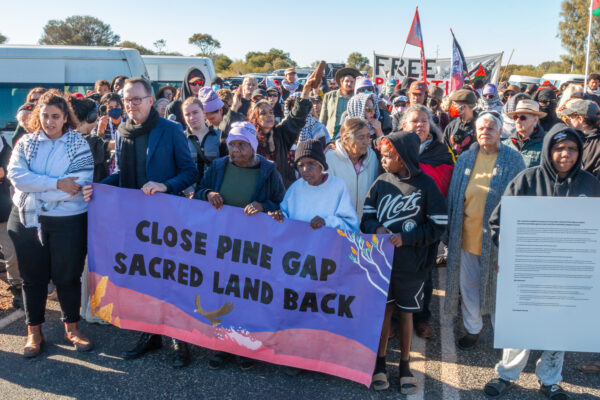
“In 1962, they took my grandfather, the Americans,” said Arrerente Elder Aunty Felicity while standing outside of Pine Gap, the largest U.S. spy base in Australia. She handed a printed letter to the Australian Federal Police Inspector Ken Napier at the gates of Pine Gap. The contrast was stark. Three generations of the Hayes family, the traditional owners of Kuyunba, stood next to the land occupied for 60 years by the largest Australia-U.S. joint defense facility in Australia. Aunty Felicity gives a letter to AFP commissioner Ken Napier during a protest outside Pine Gap, July 20, 2026. Photo by Anisha Pillariset Established in 1966, without the consent of traditional owners, the Pine Gap signals intelligence facility sits roughly 15 kilometers from Alice Springs. The access road leading to the base is lined with ominous signs warning, “NO THROUGH ROAD, GO BACK.” Percolated by the hum of drones overhead, the perimeter has all the markings of a spy base: high impenetrable gates marked by the strategic placement of surveillance apparatus. Access to sacred sites has been restricted for decades, hemmed in by Pine Gap’s edges. And on July 20, Aunty Felicity was joined by hundreds of activists to challenge the continued existence of the U.S. spy facility. Anti-militarist activists, academics and Traditional Owners traveled across the country, some from as far as 2,000km away, to reach the desert in the heart of Australia. It was the largest protest against Pine Gap since 1987, where some 300 people were arrested. AFP inspector Ken Napier greeted the Hayes family as they walked up to the gate to deliver the letter. “Welcome,” he said. Wyonna Hayes, the daughter of Aunty Felicity looked angry as she responded, “You’re welcome to my country.” Aunty Felicity delivered a speech, asking for the land, the Kuyunba, to be returned to the traditional owners. Many of Pine Gap’s custodians, including Aunty Felicity herself, live just a few kilometers away at Irrkerlantye, also known as White Gate, in conditions that stand in glaring contrast to the base’s heavily resourced compound. The White Gate community lacks basic services that much of Australia takes for granted: water is trucked in, power comes from a small set of solar panels, and there is no sewerage. “We want people to support us to close down Pine Gap,” Aunty Felicity said, standing beside her sister Wyona, and daughter Jaquita. “We want them to know it’s a sacred site.” But she is also concerned about people she has never met. Among her requests is compensation for families in Gaza who have lost relatives in a war she said the base has helped enable. “We don’t want to be feeling guilty all the time,” she said, “when bad things are happening overseas to the little ones.” “We’re not the ones controlling that facility,” she continued, “but we feel guilty that it’s coming from our land.” Protesters are met by a police presence outside Pine Gap, July 20, 2026. Photo by Eleni Kupe. The police had set up two checkpoints before the march had even reached the base: one several kilometers out on the highway to check identification, and a second closer to the gate to stop the march on foot. The protesters were undeterred. Chanting and banging on drums they cried, “Close Pine Gap,” “Shut it down,” and “Always was, always will be Aboriginal land.” Later that morning, a lone protester, Aahana Nag, locked herself to the steering wheel of a car blocking the base’s only access road, closing it for just over an hour before her arrest. “The United States has displaced the custodians of these lands and has built an intelligence facility that provides critical intelligence for their illegal military operations,” Nag said afterwards. “This base is material proof of the federal government’s investment in U.S. wars that do not serve us.” The action was the climax of a three-day convergence devoted to the history of U.S. militarism in the Northern Territory, organized by activist groups Mparntwe for Falastin and the Anti-Militarism Action Network. With over 600 in attendance, it focused on the history of Pine Gap and the resistance to it. Convergence organizer Jorgen Doyle attributed the action’s success to a growing unease in Australia over the U.S. alliance. Jorgen Doyle, the convergence organizer, speaks during the event. Photo by Sarah Dalgeish. “It’s a really compelling geopolitical moment,” he said, “to contest Pine Gap and everything that it represents.” “Northern Australia is the top overseas location for US Air Force and Navy construction spending,” he added, referring to a report in Reuters published in 2024. According to the report, more than $300 million was set aside over several years under U.S. congressional defense authorizations to fund the construction. “It’s Not One Base. It’s Three in One.” According to Dr. Richard Tanter, Pine Gap is as secretive as it is misunderstood. Widely considered Australia’s leading expert on Pine Gap, Tanter is a senior research associate at the Nautilus Institute for Security and Sustainability, where he has tracked the base’s expansion for over a decade, building on research alongside the late Des Ball and fellow researcher Bill Robinson. He told the convergence that the government’s habit of describing Pine Gap as a single facility is misleading. “The government likes to say one base. It’s not. It’s three in one,” he said. The site combines a ground station receiving data from geostationary satellites, a separate operation intercepting the satellite communications of other countries (including Indonesia, China, and India), and a relay station that sends data automatically to Buckley Space Force Base in the U.S. state of Colorado. The Pine Gap facility as it appeared in 2008. Satellite image via Skyring. Since its inception, the Pine Gap facility has grown steadily. Tanter and his colleagues counted 36 antennas when they last surveyed the base in 2015 and 2016. They now count 45, many enclosed in radomes; a protective dome over an antenna that also hides which way it’s pointing. Tanter says Pine Gap is intentionally designed like this to conceal scrutiny. “This is to make sure that people like you and me and other interested parties don’t look at what they are actually focusing on,” he explained. “Three of the satellites at Pine Gap controls all cover the Middle East,” he continued. “All cover Gaza. All cover Iran.” Tanter cited documents leaked by Edward Snowden in 2013 that showed that the data collected through the arrangement is passed onto Israeli intelligence, “without explicit filter.” Despite that, he said, there is no record of an Australian government ever telling Washington that intelligence sharing should stop while Gaza and Iran remain active conflict zones. According to Tanter, half the workforce at the base are Australian, yet they have no veto power over what it does. “Pine Gap puts Australia in great peril,” he told the convergence. “It makes us a nuclear target. It makes us a conventional missile target. It entraps us in complicity in genocide in Gaza.” Tanter described the base as “the poisoned heart of the Australia-US alliance.” A U.S. Air Force B-52 Stratofortress opens its drag chute during its arrival at Royal Air Force Base Darwin, Australia, March 29, 2018. U.S. Air Force photo by Staff Sgt. Alexander W. Riedel. Bombers Heading to Tindal However, Pine Gap is not the only flashpoint. At the convergence, defense researcher Vince Scappatura outlined the build-up underway at Royal Australian Air Force (RAAF) Base Tindal, near Katherine, where up to six U.S. B-52 bombers are expected to be forward-based by the end of the year under the “Enhanced Air Cooperation Initiative.” Katherine is the third largest town in the Northern Territory, with a meager population of 10,000. Scapputara said that the aircraft themselves matter less than the infrastructure being built to support them, including a squadron operations facility, fuel reserves, munitions bunkers, and an extended apron. “These bombers are credibly postured for possible real-world operations, not just training exercises,” he said. “Each B-52 can carry up to 20 nuclear-armed cruise missiles” he said. With “up to six aircraft” coming to Base Tindal, in Scapputara’s estimation this would represent a combined explosive yield of roughly 1,200 Hiroshima bombs. He pointed to a possible precedent. In October 2024, U.S. B-2 bombers used Australian airspace and were refueled by tankers pre-positioned at Cairns Airport to support a strike in Yemen. It was the first time since World War II that Australian territory had directly supported a U.S. bomber operation. The incident was little known to the public and attracted little attention, much less furor. Under Washington’s longstanding policy of neither confirming nor denying the presence of nuclear weapons on its aircraft, Australians may simply never know if the B-52s rotating through Base Tindal are carrying nuclear bombs on board. “It may very well be the case that the Australian government also wouldn’t know,” Scapputara said, “because they’d agree not to ask.” Doyle, the convergence organizer, said this is part of a growing pattern, punctuated by the size of the last war rehearsal held in Darwin last year. “They’re stationed in Darwin, they practice in these fields… Last year there was a massive war rehearsal called Talisman Sabre, it’s one of the largest war rehearsals anywhere in the world. It involved 35,000 troops,” he said. “It was about 20,000 US troops and 10,000 Australian troops and another 5,000 from 19 other allied nations.” He’s not blind to the semantics either, pointing to how carefully the U.S. military chooses its language: “They call it a rotation because it sounds less like an occupation if you call it a rotation.” Protesters demand the closure of Pine Gap during a march to the base, July 20, 2026. Photo by Anisha Pillariset. Growing Dissent The action culminating in the march on Pine Gap was timely, representing growing discontent with the long-held Australia-U.S. alliance. Last year, one of Australia’s leading think tanks, the Australia Institute, released a poll following U.S. President Donald Trump’s 10 percent tariffs on Australian exports (a figure that has since jumped up to 12.5 percent). The poll found that 46 percent of Australians now support a more independent foreign policy. The same survey of 1,500 voters found 50 percent believe Trump’s election was bad for Australia, and 47 percent of Australians believe the United States is an unreliable security ally, versus just 44 percent who see the U.S. as reliable. During the action, NSW Greens Senator David Shoebridge, a vocal critic of the U.S. alliance, stood beside the Hayes family, assuring his support. Shoebridge said the Australian government is out of touch with the sentiment on the ground. “If ever there was a message to end the world, it would come through Pine Gap. We would be the handmaidens of that,” he said. “U.S. bases have never made us safe, but right now they are especially making us a target.” The Australian government was contacted for comment. A spokesperson said the government does not comment on intelligence matters or the operation of joint or collaborative facilities, including Pine Gap, “in accordance with longstanding practice by successive governments.”
The ‘Poisonous Heart’: Australia’s Most Secretive Base Draws New Scrutiny
Full Article
Original Source
Read the full article at Thediplomat →KhanList aggregates and links to publicly available news content. We do not host full articles from third-party sources. Always verify important information with original sources.