
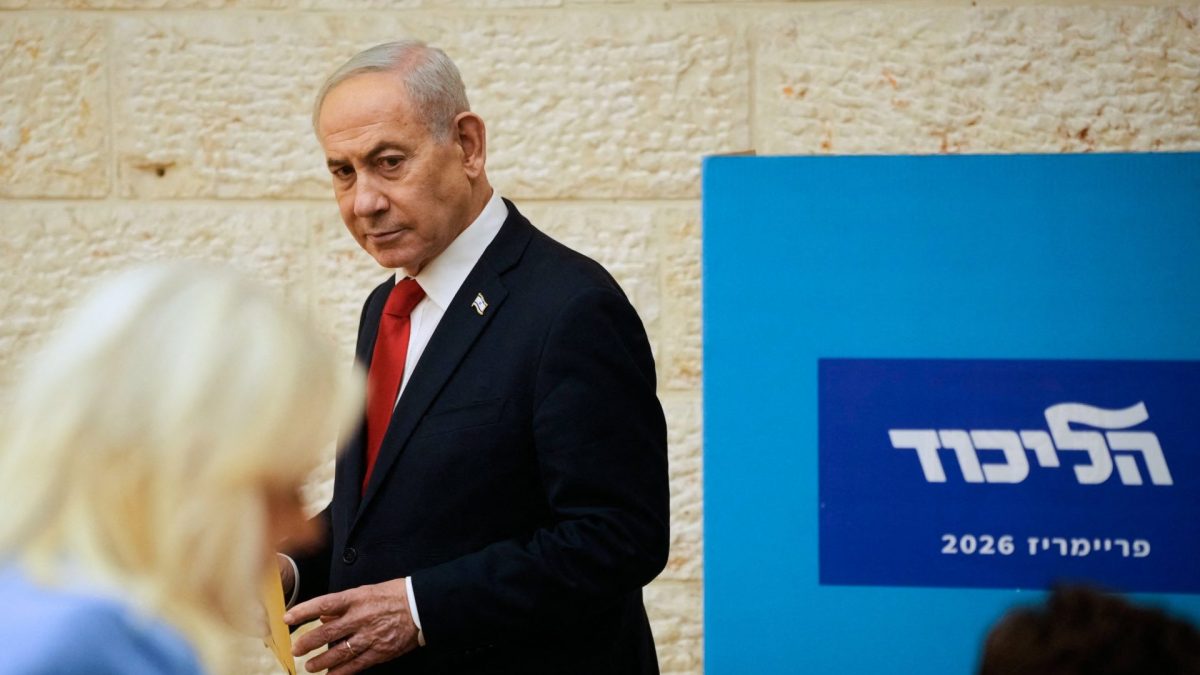
Jared Kushner, Donald Trump’s son-in-law and special envoy, says that a “crazy election” in Israel has made its leaders “a little irrational”. Kushner was talking about the rejection by Israel’s Prime Minister Benjamin Netanyahu of the deal the US thought it had brokered to disarm Hamas. But he’s also right about the election campaign ahead of next month’s voting. It has been marked by poisonous personal attacks, extreme rhetoric and wild claims and allegations. For many in Israel, it is a depressing reality, at a time when their country seems more adrift and isolated than ever. Trump, their ally in the White House, is distancing himself from what is happening in the Middle East. Shorts The vote could result in a government of national unity, a caretaker government led by Netanyahu followed by another election, or Netanyahu’s triumphant return at the head of a new coalition. Opinion polls suggest that the largest party will belong to Gadi Eisenkot, the former head of Israel’s armed forces. What this means for the rest of the world is hard to predict. Israeli governments are formed by coalitions: no single party can expect enough votes to win a majority in the Knesset, which would require 61 seats. Opinion polls give around 23 to 25 seats to Eisenkot’s party, Yashar (which means “Honest” or “Straight”), and 20 to 22 to Netanyahu’s Likud. Add up the smaller parties and the two blocs are within a few seats of each other but with neither reaching the magic number. This isn’t a good look for a country still caught up in three lingering conflicts: one in Gaza, a second in Lebanon and the third with Iran. There is now increasing speculation around a national unity government. Aluf Benn, editor-in-chief of Haaretz, said that Netanyahu and Eisenkot would never broach the subject publicly in an election campaign, but they were clearly sending “signals” that they would be open to a deal. “Netanyahu will say anything to survive and, if he needs to, form a coalition with his rivals as he has done in the past,” he wrote. Gadi Eisenkot, leader of the Yashar party, is seen as Benjamin Netanyahu’s main rival ahead of next month’s elections (Photo: Erik Marmor/Getty Images) But a unity government would have to be formed after what has been a bitter campaign, which kicked off with an attack ad from Netanyahu using an AI-generated image that appeared to resemble Eisenkot’s son, who was killed fighting in Gaza. One of Netanyahu’s aides also posted a video mocking Eisenkot’s poor English. Eisenkot’s barbed retort was to ask where Netanyahu’s excellent English had been on October 7, 2023. In fact, the election has been dominated by what happened on Israel’s worst-ever day, when more than 1,200 people were killed and 251 captured and taken to the Gaza Strip. For many, this election is primarily about that day and is a referendum on what Netanyahu did or failed to do. Earlier this week, there was a dramatic new allegation that could play a decisive role in an election already on a knife-edge. Haaretz published a report claiming that Netanyahu was personally warned about the attack 10 days before it happened – but chose to do nothing. The report – taken from a forthcoming book – said that the warning came from the leader of the United Arab Emirates, Mohammed bin Zayed. In a 45-minute phone call, he is said to have told Netanyahu that the leader of Hamas, Yahya Sinwar, was planning a “formidable” operation – Sinwar supposedly spoke of an “earthquake” that would shake the entire region. A visitor prays at the Nova memorial site, the location where 364 young people were murdered, and dozens more were kidnapped on October 7, 2023 (Photo: Eli Basri/SOPA Images/Getty Images) Haaretz said the UAE leader was surprised by Netanyahu’s response, which was “sanguine”. The Israeli Prime Minister allegedly said that they were on top of things in Gaza and prepared for any scenario. Naftali Bennett, a former Israeli prime minister, posted on X to ask: “Why did he not inform the security establishment, and why did he not act to protect Israeli citizens?” He wrote: “Netanyahu bears personal and direct responsibility for the failure that led to the deaths of thousands of Israelis on his watch.” Eisenkot, in turn, posted: “Netanyahu received dozens of warnings for 7 October and ignored them all. He is unfit.” Netanyahu has vehemently denied the claims and was already on the offensive about the events leading up to 7 October. He claims that Israel’s military and intelligence chiefs deliberately chose not to wake him in the early hours, when there were signs of an imminent attack. “They knew that, as prime minister of Israel, I would have immediately given the order to put the entire military on alert,” he said. His explanation for this odd behaviour: army and intelligence chiefs were not sure what Hamas intended and did not want to provoke a conflict by over-reacting. Netanyahu’s wife has added fuel to this fire with a personal attack on General Yair Golan, a former army deputy chief of staff now leading a left-wing party in the elections. Golan was a genuine hero on 7 October. He got a phone call from his sister about shooting at the Nova festival, put on his uniform, grabbed a weapon and drove south in his own car. He saved many lives. But Sara Netanyahu insinuated that Golan must have known about the attack in advance to be able to react so quickly. “You, a military man of such a senior rank, were already there early in the morning, dressed and ready, at a very, very early hour, when others didn’t know, such as the prime minister.” Sara Netanyahu, alongside her husband Prime Minister Benjamin Netanyahu (Photo: Ilia Yefimovich/Getty Images) Golan has said he will sue for libel unless Sara apologises, but she has threatened to countersue. The first family’s public statements play into a conspiracy theory popular among Likud supporters, which has been circulating on social media. The theory is that commanders in the military and Shin Bet, the domestic intelligence service, wanted to bring down Netanyahu at any cost. They arranged for Hamas to breach the border fence and seize a few Israeli communities. The supposed aim was an attack that would shock the country and force Netanyahu to resign. Writing about this in The Times of Israel, the commentator Shalom Yerushalmi said that such “spurious claims will only grow stronger as the election approaches”. This is especially the case as the vote happens just weeks after the three-year anniversary of the attack. Netanyahu’s own office has said that he was woken – or woke up – at 6:29 am, arrived at his office nearly two hours later and waited some three hours in total before he spoke to the head of the Israel Defense Forces (IDF) about how to respond to the attack. Regardless of the exact sequence of events, Netanyahu was the steward of the policy that for years enabled Hamas, allowing it to control hundreds of millions of dollars in aid from Qatar, while concrete allowed in for aid projects ended up building Hamas’ tunnel network. Netanyahu’s aim was to split Hamas in Gaza and Fatah in the West Bank, to stop the emergence of a Palestinian state. In promoting Islamists as a counterweight to Palestinian nationalists, he maintained an Israeli policy that had been in force since the 1970s. Much of Gaza lies in ruins after years of fighting (Photo: Bashar Taleb/Getty) The far-right members of Netanyahu’s coalition believe they have an answer to this, one that will likely appeal to many of their voters: expel the Palestinians. Itamar Ben-Gvir, the national security minister, said last month that Israel should be killing “30 to 40” Gazans every night with targeted assassinations, adding: “There are people there who are not worthy of life. They shouldn’t live. They’re not even people.” Last week, Ben-Gvir unveiled a plan for the “voluntary emigration” of Gazans, 1.86 million of the 2.3 million population over the next seven years. “Instead of Gazans digging tunnels, it’s time to pack suitcases,” he said. That is one future: Netanyahu back in office propped up by the far right, a Palestinian exodus as government policy and Israel an international pariah. If Israel implemented such a policy, it would be condemned as ethnic cleansing. Another option could be a minority government under Eisenkot, kept alive by Arab votes. Or there’s the shaky coalition deal, with Netanyahu and Eisenkot in one cabinet, the man who “wasn’t woken” and the man who calls him “unfit”. After a campaign of such poisonous rhetoric, that would be the strangest result of all, and one that would leave many Israelis profoundly disillusioned.
The ‘poisonous’ election that’s placed Trump’s closest ally on a cliff edge
Full Article
Original Source
Read the full article at Inews →KhanList aggregates and links to publicly available news content. We do not host full articles from third-party sources. Always verify important information with original sources.