
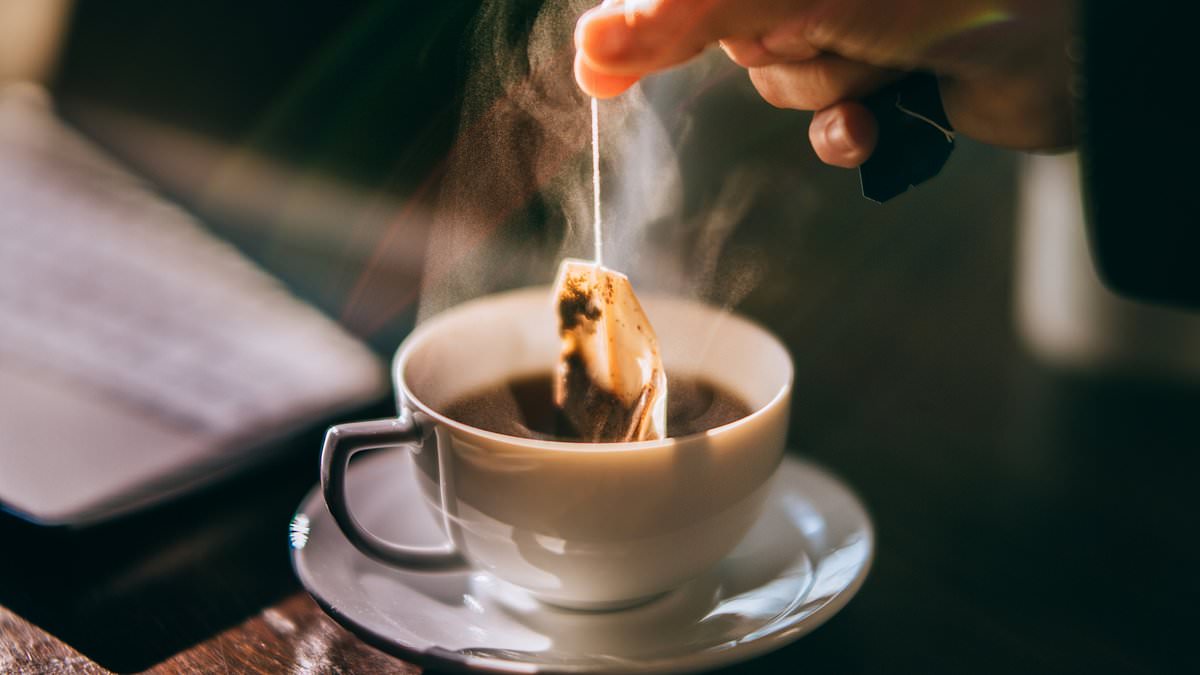
A piping hot cup of tea might be a comforting start to the day, but scientists have issued a 'critical warning' that your brew could be bursting with plastics.Researchers from Recep Tayyip Erdogan University discovered that a single tea bag can release up to 2,500 microplastic particles into your drink.However, their methods only captured particles bigger than 100 micrometres across, so the true number of plastic pieces could be significantly higher.The researchers also discovered that plastic bags leak toxic forever chemicals like BPA and plasticisers into your drink.Loose-leaf tea, on the other hand, was found to contain considerably lower levels of microplastic pollution.A single two-gram serving of loose tea contained just 0.3-2.4 particles, which mostly came from the plastic packaging used during farming and atmospheric dust.The researchers therefore suggest that people should make the switch from plastic-containing tea bags to less contaminated loose tea.In their paper, published in the journal npj Science of Food, the authors write: 'On the basis of the particulate data, consumers may reduce brewing-related microplastic exposure by favouring loose-leaf over plastic-bagged tea.' Scientists have found that tea bags release toxic forever chemicals including BPA (dark blue) and the cancer-causing plasticiser DEHP (red) A piping hot cup of tea might be a comforting start to the day, but scientists have issued a 'critical warning' that your brew could be bursting with plastics (stock image)While many tea bags are now made of a plastic-free cellulose material, some brands still use a plastic mesh to keep the tea leaves contained.This is despite a growing body of evidence that these plastics break down and leach chemicals when submerged in hot water.However, previous studies haven't directly compared the polluting potential of a tea bag against the tea alone.The researchers looked at four popular Turkish bagged tea brands and 14 different types of 'bulk' loose-leaf tea.They analysed their average microplastic release, the types of microplastics they contain, and the concentrations of BPA and PAE plasticisers that were released.Each bag was placed in 95°C (203°F) water for three minutes, and the researchers then used microscopes, spectroscopy and chromatography to measure the resulting brew.The results revealed an alarming number of microplastic particles left behind by the brewing process.However, their results were far lower than some of the measurements obtained by other researchers. Researchers from Recep Tayyip Erdogan University discovered that a single tea bag could release up to 2,500 microplastic particles into your drink, far more than loose-leaf tea. Left: microplastics per cup brewed with a tea bag. Right: Microplastics per kilogram of loose-leaf tea One study, published by scientists from the Universitat Autònoma de Barcelona, found that a single tea bag could release billions of microplastic particles.The worst offenders were tea bags made from the plastic polypropylene, releasing approximately 1.2 billion particles per millilitre, with an average size of 136.7 nanometres.In fact, scientists have found microplastic contamination at almost every stage of the tea brewing process.One study estimated that the first boil in a new kettle can release around 12 million nanoparticles per millilitre, or almost three billion particles in an average 250ml cup of tea.Meanwhile, researchers found that single-use takeaway cups release millions of microplastic and even smaller 'nanoplastic' particles when exposed to hot liquid.However, the Turkish research team were especially concerned about these particles because they can absorb and transport toxic chemicals into the body.In particular, they focused on two types of so-called 'forever chemicals' – Bisphenol A (BPA) and phthalate esters (PAEs) – that are often used as plasticisers to make plastics more flexible and durable.BPA is a type of chemical known as an endocrine disruptor, which can be absorbed into the blood through the digestive system. The microplastics in tea bags were all fibres, which suggests that they come from the plastic mesh bags themselves rather than the outside contamination found in loose tea This comes after scientists found that the first boil in a new kettle (a) can release around 12 million nanoparticles per millilitre. After 150 boils (d), there are still 820,000 nanoparticles detected per millilitre, which equates to 205 million particles per 250ml cup of teaBy disrupting the hormonal system, BPA interferes with normal development, leading to a weakened immune system, an increased risk of obesity and diabetes, low sperm count and infertility later in life, and a heightened risk of cardiovascular disease.Studies have also shown that there is substantial evidence that BPA impairs brain development, leading to an increased risk of conditions such as ADHD and autism spectrum disorder.The researchers found that drinking just 500ml of tea means you are consuming 4.55 to 21.7 per cent of the safe daily limit of BPA.They add that this should be taken as a 'critical warning, particularly for vulnerable groups such as pregnant women and children'.However, while these concentrations typically remained below toxic levels, the researchers are more concerned about the long-term cancer risks.These concerns were prompted by the unusually high level of the PAE plasticiser di(2-ethylhexyl) phthalate (DEHP).Studies have shown that animals exposed to DEHP in their diets develop cancers at a higher than average rate over long periods of time but its effect on humans is poorly understood.In their paper, published in the journal npj science of food, the authors write: 'The carcinogenic risk potential due to DEHP exposure may pose a public health concern, particularly under scenarios of long-term/high-volume consumption.'Even though the concentration from these teabags remains below official limits, the researchers say their findings support 'a shift toward bulk tea consumption'.They suggest ditching the tea bags in favour of loose-leaf tea, and washing your tea under cold water before brewing to further limit microplastic exposure.
The plastics lurking in your cuppa: Tea bags release BPA, plasticisers and up to 2,500 microplastic particles into your brew, study warns
Full Article
Original Source
Read the full article at Dailymail →KhanList aggregates and links to publicly available news content. We do not host full articles from third-party sources. Always verify important information with original sources.