
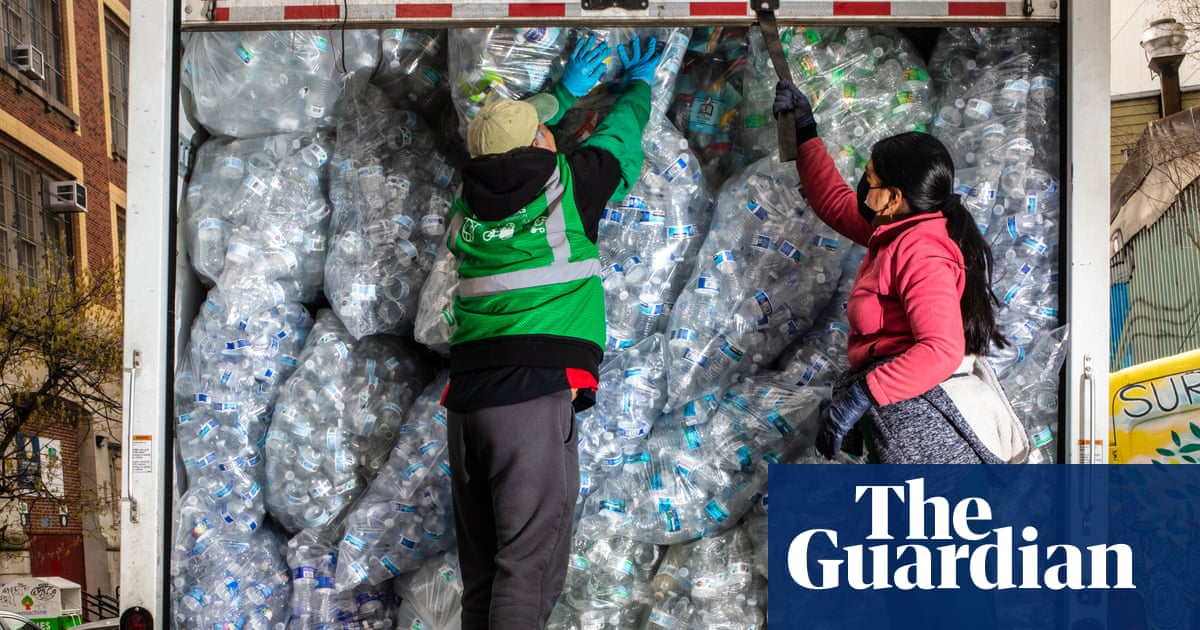
In New York City, the plastic we discard has a way of remaining in plain sight. There are few alleys to hide residents’ refuse, and the clear recycling bags leave their contents on full display. In a city built on a dense grid, lightweight wrappers, bags and bottles spill from overflowing bins and skitter down sidewalks, collecting in gutters and corners before the wind carries them on.All that plastic is a layer of the urban landscape, as familiar as subway grates and fire escapes, revealing a messy and unflattering aspect of city life. “Garbage is not what we cast out, but the prime locus of meaning in our lives,” the character Nick Shay says in Don DeLillo’s Underworld.It was not always this way: plastic production has ballooned in recent decades. In 1950, the world produced just 2m metric tons annually – that amount doubled by 1955. Since then, producers and lobbyists worked to advocate for their interests, steamrolling environmental concerns, research shows. By 2019, the world produced 450m metric tons of plastic, and that number is expected to continue growing rapidly.All that growth has reshaped industries from shipping to medicine. It has also taken a huge toll on the planet. Every day, the equivalent of 2,000 truckloads of the material is dumped into the world’s water bodies. And even when it is landfilled or incinerated, it spews toxic and planet-heating emissions into the atmosphere. (Less than a tenth of all plastic globally is recycled, and in the US, only about 5% of plastic waste generated by households is recycled.)What kind of world are we making with all this plastic? What do all these changes mean for our environment, our health and our wellbeing? Are we locked into a future jam-packed with the material, or is there anything we can do to reverse course?A worker sorts and counts plastic bottles at Sure We Can’s recycling redemption center in Brooklyn on 16 April 2025.Rebekah Tiffany with her sons Javonta Green, 10, (center) and Jaden Green, eight, (right) outside their home in Marcus Hook, Pennsylvania, on 6 June 2025. A truck moves a pile of recyclable materials to be sorted at Circular Services’ Material Recovery Facility in Sunset Park, Brooklyn, on 25 April 2025.Protesters gather before a march organized by the Chester Residents Concerned for Quality Living protesting against the local incinerator which burns trash from New York in Chester, Pennsylvania, on 3 May 2025.Photographer Bryan Anselm took a look at how plastic is shaping environments in New York City – celebrations, workplaces, research centers, neighborhoods.“It’s wild to see how after events the plastic, the garbage, can just pile up and pile up,” he told me.He pursued the photo project because it is “important for all of us to understand what happens to the plastics we use”.“Since it’s so prevalent and available in our daily lives, most people just toss it in the recycling bin or trash and never think of it again,” he mused. “Chances are the yogurt cup you threw out this morning will outlive you, decomposing in a landfill over several decades.”Look ahead to see what he found.There is plastic everywhereIn the United States, the average person generated 60lbs of plastic waste per year in 1980. By 2018, that number was up to 218lbs per person, marking a 263% increase, according to federal data. Ordinary people never pushed for that increase, said Judith Enck, a former Environmental Protection Agency (EPA) regional administrator who now heads up the anti-plastic advocacy group Beyond Plastics.“No one voted for more plastic, but we don’t have much choice when we enter a modern American store,” she said.Plastics are made largely from oil and gas. In the US, the fracking boom created a glut of cheap natural gas, including ethane, a key ingredient in plastic production. As gas prices fell, the plastics industry became a lucrative outlet for the oil and gas sector, helping absorb the oversupply and spurring investment in new plastic manufacturing facilities.“We’ve seen that increase because this is where fossil fuel companies are making really big investments, aided by enormous taxpayer subsidies,” Enck said. “That’s had a huge effect on how much plastic we consume.”Department of sanitation workers clean up trash after the Mermaid Parade in Coney Island, Brooklyn, on 21 June 2025.Women drink from plastic cups during the Mermaid Parade in Coney Island, Brooklyn, on 21 June 2025.A woman walks by a garbage truck in Washington Square Park as it’s littered with plastic and other trash the morning after 4/20 during Earth Week in Manhattan on 21 April 2025. Photograph: Bryan Anselm/Bryan Anselm for The GuardianNew York is no exception. About 15% of municipal solid waste in New York is made of the material, data shows. When people gather at street fairs or head to the beach during the summer, they are often sold food, beverages and souvenirs wrapped in plastic. All that packaging tends to overwhelm the city’s trash cans.Some of those things get a second life when they are picked up by collectors with Sure We Can, the city’s last remaining non-profit waste redemption center. Members of the organization take to the streets to collect garbage, which is then recycled in Brooklyn.For plastic waste generated at home, New York City also has a mandatory recycling program: the city’s department of sanitation provides free curbside pickup, and residents must sort their trash themselves or risk being fined. Curbside plastics are processed at the Sims Municipal Recycling Facility in Sunset Park, Brooklyn – the largest sorting plant in North America – or at PQ Recycling in Farmingdale, New York, which focuses on converting used bottles into reusable materials.Despite these efforts, huge masses of plastic waste still end up as litter. Scientists across the country and world are working to better understand the effects of all of it, including researchers at the Rochester Institute of Technology who regularly collect waste from storm drains, some of which had been discarded years ago.We’re all feeling the impactsPublic concern about the plastic crisis is growing. Nearly 90% of Americans, for instance, are worried about microplastics – tiny particles which come from the breakdown of larger plastic – a June survey showed. A 2021 poll also found that more than four in five people globally reported worry about plastic litter in the ocean.Organizer Milana Bekbulatova poses for a portrait during a beach cleanup organized by A Tribe Called Earth in celebration of Earth Day at Coney Island Creek Park in Brooklyn on 19 April 2025.One New York City group working to remove plastic from our ecosystems is the community organization A Tribe Called Earth. On Earth Day in 2025, they hosted a cleanup in Brooklyn’s Coney Island Creek Park, where they collected 287lbs of garbage. But even after volunteers’ all-day efforts, the sand remained stippled with plastic fragments in all different shapes, sizes and colors.Litter is among the most visible impacts plastic has on our environment, but the material has ecological impacts when it’s disposed of in sanctioned ways, too. When it is burned in garbage incinerators, for instance, it emits toxic compounds such as dioxins and mercury, which damage people’s respiratory health.Volunteers Sasha Filippova (left) and Mohammad Ghouse Syed (right) clean litter from a beach during a cleanup.Plastics broken by the tide on the sand during a beach cleanup.Rebekah Tiffany poses for a portrait with her son Javonta Green, 10, (left) in their home in Marcus Hook, Pennsylvania, on 6 June 2025. A view of the Wheelabrator Westchester incinerator in Peekskill, New York, on 17 April 2025.Courtney Williams, co-founder of the Westchester Alliance for Sustainable Solutions (Wass), poses for a portrait while handing out information to members of the community about the negative health effects caused to Peekskill residents due to living in close vicinity to the Wheelabrator trash incinerator during the Hudson River music festival in Croton, New York, on 14 June 2025.Rochelle Bonner, a resident of Peekskill, New York, believes she has seen those effects first-hand. She lives near the city’s Win Waste trash incinerating plant, the largest toxic polluter in Westchester county. Both she and her daughter have seen their asthma flare due to fumes from the plant, she said. Nearly 80% of all garbage incinerators are located in low-income communities, a 2019 analysis found.It’s a kind of inequality seen across plastic’s life cycle, said Enck.“Plastic is largely produced in low-income communities and communities of color in Louisiana, Texas and Appalachia,” said Enck. “Then it ends up in landfills and incinerators which are also disproportionately sited in low-income communities and communities of color.”Rochelle Bonner demonstrates how her asthma machine works at her home in Peekskill, New York, on 21 August 2025.What about recycling? New York City is home to the Sunset Park Material Recovery Facility, a recycling facility at the South Brooklyn Marine Terminal in the Sunset Park neighborhood. At the 11-acre facility, workers unload hundreds of tons of recyclable material – metal, glass and plastic – each day to be sorted.These kinds of scenes – workers handling hulking towers of discarded trash – are common in efforts to take on plastic waste. Hundreds of miles north, photographer Bryan Anselm captured another one at plastic recycling company Ced-Lo in Farnham, Quebec. In the photo, an employee is dealing with a giant mass of plastic “bladder”-style bags from the inside of boxed wine containers. They were collected by TerraCycle, a company that works to recycle plastic garbage that you can’t put in your curbside bin.But plastic is notoriously expensive and difficult to recycle, because the process requires meticulous sorting since most of the thousands of chemically distinct varieties of the material cannot be recycled together. Plastic also degrades each time it is reused, meaning it can generally only be reused once or twice. Critics say even companies like TerraCycle, which work to process hard-to-recycle plastics, can give companies license to keep producing plastic waste. Real solutions to the plastic waste issue would require cutting production, said Enck.“I can say after all these years of attempts at plastics recycling that plastics recycling is a dead end,” Enck said. “It’s never gotten to double digits – right now, we have just 5% to 6% recycling rate for plastic in the US. It’s just not a viable solution.”A worker rearranged pellets of recycled plastic in a box at the Ced-Lo plastic recycling facility in Farnham, Quebec, Canada, on 15 October 2025. Bailed plastic bottles before they are shredded at the Ced-Lo plastic recycling facility in Farnham, Quebec, Canada, on 15 October 2025. TerraCycle is working with Ced-Lo to shred and reprocess multiple forms of collected and sorted plastic waste.Melted plastic in a machine that repurposes it into pellets at the Ced-Lo plastic recycling facility in Farnham, Quebec, Canada, on 15 October 2025. Proposed solutionsAt the aforementioned non-profit Sure We Can’s redemption center in East Williamsburg, Brooklyn, bags of discarded cans and bottles are stacked from floor to ceiling. Founded in 2007, the organization serves canners – people who collect redeemable containers from the streets and exchange them for cash in a practice made possible by New York’s 1982 Returnable Container Act.In recent years, the organization has also pushed for broader reforms to curb packaging waste, including New York’s Packaging Reduction and Recycling Infrastructure Act. The bill would have required companies to reduce packaging and improve recyclability, but despite passing the state senate, the measure stalled in the state assembly for the third time this year amid intense lobbying from industry groups.Workers load plastic bottles into a truck so they can be returned to distributors at Sure We Can’s recycling redemption center in Brooklyn on 16 April 2025. In communities in which plastic waste is processed or disposed of, residents have spent decades battling the health and environmental consequences of the country’s throwaway economy. Among them is Chester Residents Concerned for Quality Living, an environmental justice organization in Chester, Pennsylvania, that has long opposed the concentration of waste facilities in the predominantly Black city. Below, they are pictured protesting against a garbage incinerator commonly known as Covanta, though it was rebranded Reworld in 2024.Growing concernAs workers sort through the plastic waste we create, advocates push to reduce the amount of plastic entering the waste stream, and communities work to check the harms of disposal, scientists are working to understand the scale of the plastic crisis and its effects.Existing research makes clear that chemicals such as hormone-disrupting phthalates can leach out of plastics and get into people’s bodies through food contact, skin absorption and inhalation, said Katrina Korfmacher, professor of environmental medicine at the University of Rochester Medical Center. “Many of these chemicals are particularly harmful for children and the developing fetus,” she said. But many questions about plastics’ impacts are still open.Protesters chant and carry signs during a march organized by the Chester Residents Concerned for Quality Living protesting against the local incinerator which burns trash from New York in Chester, Pennsylvania, on 3 May 2025. A woman wears an anti-plastic cap during a People over Plastic rally organized by Beyond Plastics to encourage state lawmakers to pass, the New York Packaging Reduction and Recycling Infrastructure Act, a plastic packaging reduction bill at the New York state capital in Albany, New York, on 7 May 2025.Lawmakers walk past an anti-plastic display during a People over Plastic rally organized by Beyond Plastics to encourage state lawmakers to pass the New York Packaging Reduction and Recycling Infrastructure Act in Albany, New York.“There are so many questions remaining about how different plastics get into, move through, and change in the environment and what this means for the amounts, sizes, and types of microplastics in the environment that people might be exposed to,” Korfmacher said. “It’s important to figure out what kinds of micro- and nanoplastics get into the human body and how so we can focus our research on realistic exposures.”At the University of Rochester, researchers are studying how microplastics move through ecosystems and what they may mean for our bodies and ecosystems. One of those scientists, Dr Jacques Robert, observes frogs to do so.By examining how microplastic exposure affects the creatures’ immune systems, Robert is hoping to better understand their impacts on humans.Other researchers are following plastic after it disappears from view. At the Rochester Institute of Technology’s (RIT) Tait Preserve, sustainability PhD candidate Sydney VanWinkle studies how plastics break down in freshwater under different temperatures and pH levels. Her experiments aim to create a better understanding of how long plastics persist and how environmental conditions may influence their spread. Other RIT researchers are tracing another part of the journey, collecting debris from storm drains to investigate how plastics move from streets into waterways and eventually drinking water supplies.Environmental science student, Alonso Ponce, (left) and RIT research technician, Jayson Kucharek, (right) examine debris collected from a storm drain as part of a study to understand how plastics are entering the water supply at the Rochester Institute of Technology in Rochester, New York, on 7 October 2025.Various plastic debris collected from a single storm drain as part of a study to understand how macroplastics are entering the water supply at the Rochester Institute of Technology in Rochester, New York.Sustainability PhD candidate, Sydney VanWinkle, (left) and environmental science student, Sophie Routenberg (right) pump water from the bay as part of a study to understand how plastics are entering the water supply at the Port of Rochester in Rochester, New York, on 7 October 2025. Dr Jacques Robert monitoring frogs which are being used in microplastics research at the Jacques Robert Vivarium at the University of Rochester in Rochester, New York, on 6 October 2025.A customer’s basket filled with refilled jars and bottles at Maison Jar in Brooklyn on 23 August 2025.A customer refills a plastic bottle with dish detergent at Maison Jar in Brooklyn on 23 August 2025.Some scientists are looking for ways to address the problem after plastics have already entered the environment. At the University of Rochester’s Anne Meyer Lab, researchers are experimenting with engineered bacteria biofilms, using 3D-printed structures to explore whether biological systems could one day help break down plastic waste.Others are trying to avoid creating the waste in the first place. In Brooklyn, refill shops like Maison Jar are part of a growing movement focused on reuse, allowing customers to bring their own containers and refill household products like dish detergent instead of buying new plastic packaging each time.The next step for people looking to curb their own plastic consumption is to push for systemic change, said Enck.“It’s a very, very slow process, but I think the public sees the severity of the problem, and we just need more people getting into the political arena,” she said. This photo essay was supported by funding from the Center for Contemporary Documentation.
The plastic waste overtaking New York – and the people trying to curb it
Full Article
Original Source
Read the full article at Theguardian →KhanList aggregates and links to publicly available news content. We do not host full articles from third-party sources. Always verify important information with original sources.