
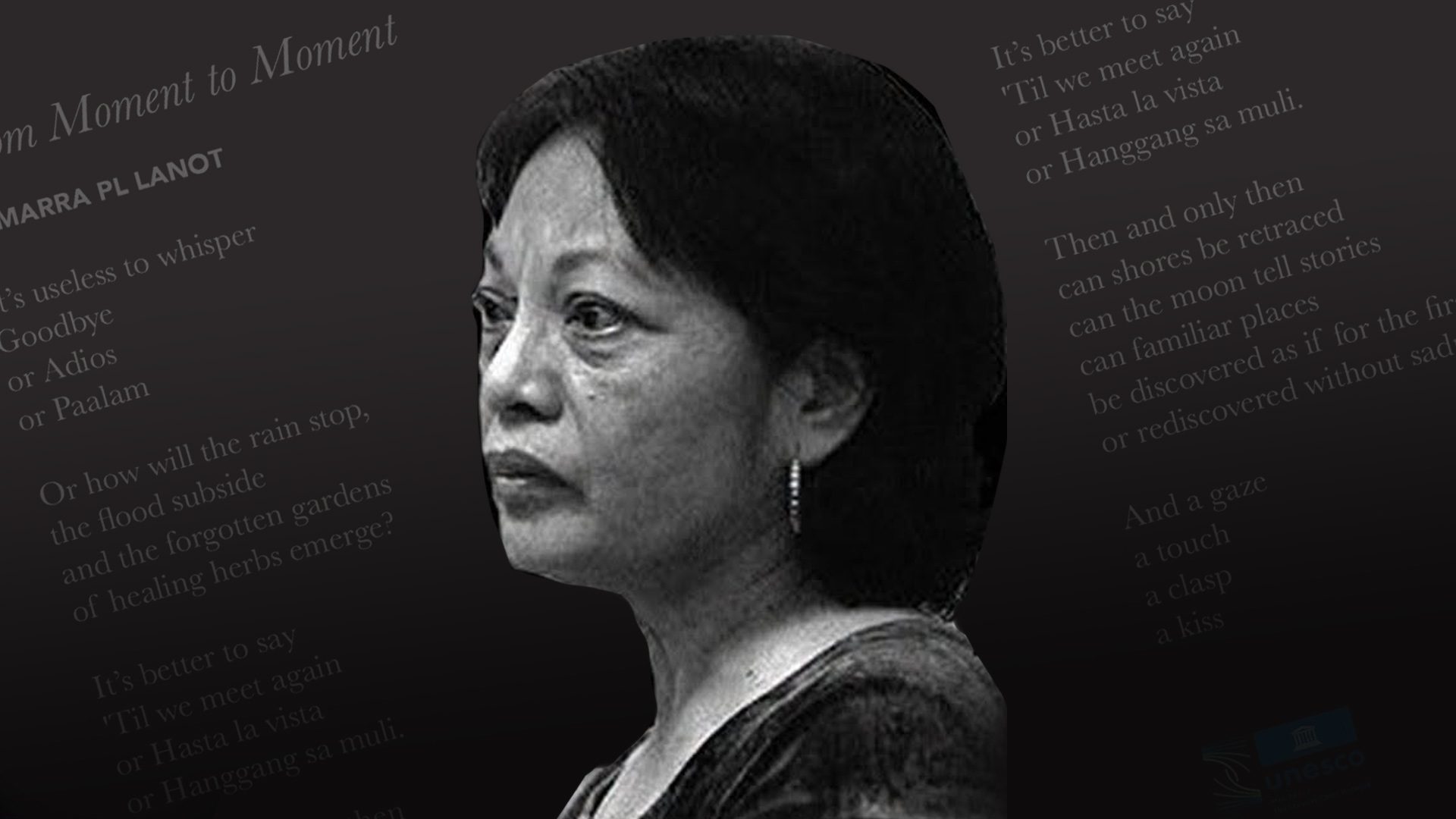
'My conversations with Marra became part of my own deeper discovery of myself as a woman activist. They were liberating.' The author reflects on her relationship with Marra Lanot, who was initially distant but became a significant influence in her understanding of feminism and women's issues in the arts. Through conversations with Marra, the author gained insights into the disconnect between progressive artistic ideals and the realities faced by women, including issues of representation, agency, and exploitation. Despite not being close friends, the author acknowledges the lasting impact Marra had on their personal and activist journey, emphasizing the importance of their discussions and the feminist lens Marra provided. This is AI-generated. Read the article for full context. Report any errors. “I exist in two places: here, and where you are.”— Margaret Atwood I was not part of Marra Lanot’s closely knit circle of friends. I came to know her through her husband, Pete Lacaba. Pete and I, together with Lino Brocka, Mike de Leon, Behn Cervantes, Ishmael Bernal, Lito Tiongson, Mel Chionglo, and several others, set up the film and audio visual committee of the Concerned Artists of the Philippines (CAP). That was the height of people’s resistance against Marcos Sr. Martial Law and the assassination of Ninoy Aquino. I headed the secretariat, Pete was convenor, with Lino and Mike as lead convenors. I would often go to Pete and Marra’s home for consultations and preparations for our activities. And I remember feeling a little awkward about occupying their family space without really knowing Marra. Marra herself was active in CAP. She co-founded its women’s desk — at a time when the idea was met with plenty of jokes and, perhaps more tellingly, the unspoken question: Was such a desk really necessary? I wanted to know her beyond being “Pete’s wife.” But Marra seemed distant to me at first, and so I decided that I would have to find my own way of reaching out to her. Eventually, it happened. We did not have many conversations. But the conversations we had opened a floodgate for me. It was partly through Marra that I began to understand, at a much more personal level, the feminist proposition that the personal is political. She spoke about the machismo prevalent in film and, more broadly, in artistic circles. She made me see the uncomfortable disconnect between the social realism professed by many progressive artists and their attitudes toward women — the women artists struggling for recognition alongside them, and the women who were their wives, partners, and companions. From Marra I learned to look more critically at the art world itself: Who gets seen? Who gets heard? Whose work is celebrated? Whose body becomes the subject of art, and who gets to decide what that body means? She helped me understand why women’s circles and women artists needed spaces of their own — not as an act of separation, but because the supposedly progressive spaces we inhabited were not necessarily free of sexism. Our conversations also ventured into more difficult terrain: pornography, prostitution, sexuality, artistic representations of women’s bodies, and the tension between sexual exploitation and women’s agency. How do women reclaim their bodies and their narratives without denying the realities of exploitation? Where does artistic appreciation end and objectification begin? These were not abstract questions for Marra. And because of her, they ceased to be abstract questions for me. When Alex and I hosted Pete and Marra during their visit to Europe in the latter part of the 1980s, I made sure we went to the sex shops in Amsterdam. In a way, we were continuing a conversation we had begun in Manila — this time surrounded by the very images, commerce, and contradictions we had been talking about. We could look, question, laugh, disagree, and think together about women’s agency, sexuality, and the prostitution industry. Over the years, Marra and I saw less and less of each other. Life took us into different spaces. But some encounters do not need to be frequent to be consequential. My conversations with Marra became part of my own deeper discovery of myself as a woman activist. They were liberating. She gave me a fresher feminist lens and helped fill gaps that my encounters with more mainstream feminist spaces had not quite reached. She taught me to bring feminism home — to relationships, sexuality, art, friendship, and the everyday exercise of power. And I am grateful that, before either of us left this world, I was able to tell her that. Perhaps that is why Margaret Atwood’s words speak to me now: “I exist in two places: here, and where you are.” Marra is no longer here. But something of her remains in that other place — the place within us occupied by people who changed the way we see. I was not one of Marra’s closest friends. But she changed something in me. And that is where Marra continues to be. There is no goodbye from me to you, Marra. – Rappler.com Edna Aquino is a political activist, a feminist, and an advocate for the rights of senior citizens. She also engages with overseas Filipinos to help them with financial literacy. How does this make you feel? Loading
The personal is political: Honoring Marra PL Lanot
Full Article
Original Source
Read the full article at Rappler →KhanList aggregates and links to publicly available news content. We do not host full articles from third-party sources. Always verify important information with original sources.