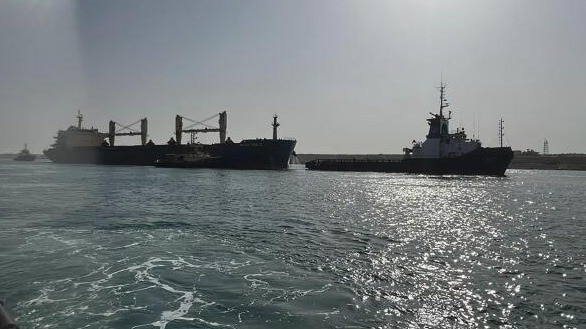
An unidentified drone struck a US-owned ship at Egypt's Damietta port, setting off a major fire. The attack is being read as a signal of Iran's ability to threaten a third strategic chokepoint, the Suez Canal.Attacks on the Suez canal could paralyse one of the world’s important waterways.On July 29, an unidentified drone hit a US-owned vessel Energos Winter, sparking a fire that spread to a Greek-owned LNG tanker GasLog Salem. Both ships were berthed at Damietta, an Egyptian port and key natural gas hub. This is the first attack on Egypt since the US-Iran conflict broke out in February.No country has claimed responsibility, but the strike has Iranian fingerprints on it. Precision targeting at long ranges -- knowing which vessel to strike -- is a skill Iran has repeatedly demonstrated when it escalated the five-month conflict both horizontally and vertically using drones and ballistic missiles, striking targets in a broad swathe across the Mediterranean Sea, the Red Sea, the Persian Gulf and the Arabian Sea.The strike on the US-owned vessel came just hours after US and Saudi attacks on Iraqi militias which reportedly killed 20 members of Iran backed proxies Popular Mobilisation Front.Egypt is now part of a steadily widening arc of West Asian conflict which has, over the past few days, seen Ukraine striking Iranian ships in the Caspian Sea, the US intensifying attacks on Iran, the Houthis shutting the Bab el-Mandeb Strait to Saudi shipping, and Iraqi militias lauching drones and missiles at Saudi oil facilities. A bigger takeaway is a new layer to Iran’s chokepoint warfare strategy. Iran now controls two of the Arabian Peninsula’s straits through surveillance and precision fire. A third of the world’s seaborne crude oil trade and 20% of its gas supply passes through the Strait of Hormuz, 12% of the seaborne trade passes through the Bab el-Mandeb. The strike on Egypt points to Iran’s ability to strike at a third chokepoint on the Arabian Peninsula—the Suez Canal.Damietta Port is 70 km away from the 190-kilometre canal connecting the Mediterranean Sea to the Red Sea. The Suez is the shortest maritime route between Europe and Asia and handles roughly 12 per cent of global trade. The Suez has been untouched by the conflict so far, but the July 29 strike is a signal that Iran has the ability to dial up strikes on the Canal, 2000 kilometres away from its borders. Attacks on the Suez could paralyse one of the world’s important waterways.This was seen during a peacetime incident in 2021, where a 400-metre long container ship was wedged diagonally across the Suez Canal, causing a maritime traffic jam over six days and billions in economic disruption. The vessel was lodged in the canal because it was buffeted by winds but such an effect could also be achieved by an anti-ship ballistic missile or long-range drone swarms.This strike has implications for West Asia’s petro-powers are racing bypass the Persian Gulf by building oil and gas pipelines to the Mediterranean.Through the five months of the Iran-US war, Saudi Arabia reduced its dependence on the Strait by pumping its oil through the East-West Pipeline running from the Abqaiq oil field, to Yanbu on the Red Sea. Iran counter strategy is to use proxies and long-range projectiles for a ‘Persian Engulf’, to demonstrate that it has the entire Arabian Peninsula (roughly the size of India at 3.25 million square kilometres) under what militaries call ‘precision guidance, married to pervasive surveillance and targeting abilities’.On July 26, the Iran-allied Houthis attacked Saudi Aramco facilities in Jizan and the Red Sea port of Yanbu, disrupting Saudi oil exports.The message is not lost on the US, which operates the world’s most powerful navy with 11 nuclear-powered aircraft carriers. These 100,000-ton behemoths can run at speeds in excess of 30 knots and are protected by missile-armed escorts and fast attack submarines. But in narrow chokepoints, large warships are vulnerable to shore-based ballistic missiles, cruise missiles and drone swarms guided by real-time satellite data.At the start of Operation Epic Fury in February, satellite images showed the USS Gerald Ford wedged in the 200-metre Suez Canal doing the strictly enforced slow speed of 8 knots (14-15 kmph). A lesson was learnt. In April, the Nimitz class carrier USS George W Bush, took the longer route around the Cape of Good Hope, completely bypassing the Suez and the Red Sea.When the carriers launched their fighter jets, they did so from a great distance, staying far away, the first conflict in the 21st century when US super carriers have stayed far away from enemy shores. This meant US Navy fighter jets had to refuel multiple times in the air to target Iran, which has consequently resulted in fewer bombing sorties. Iran’s Persian Engulf is something even the world’s most powerful military doesn’t have an answer to just yet.- EndsPublished By: Radhika VermaPublished On: Jul 31, 2026 15:45 IST
The Persian engulf: Is the Suez Canal Iran's next pressure point?
Full Article
Original Source
Read the full article at Indiatoday →KhanList aggregates and links to publicly available news content. We do not host full articles from third-party sources. Always verify important information with original sources.