
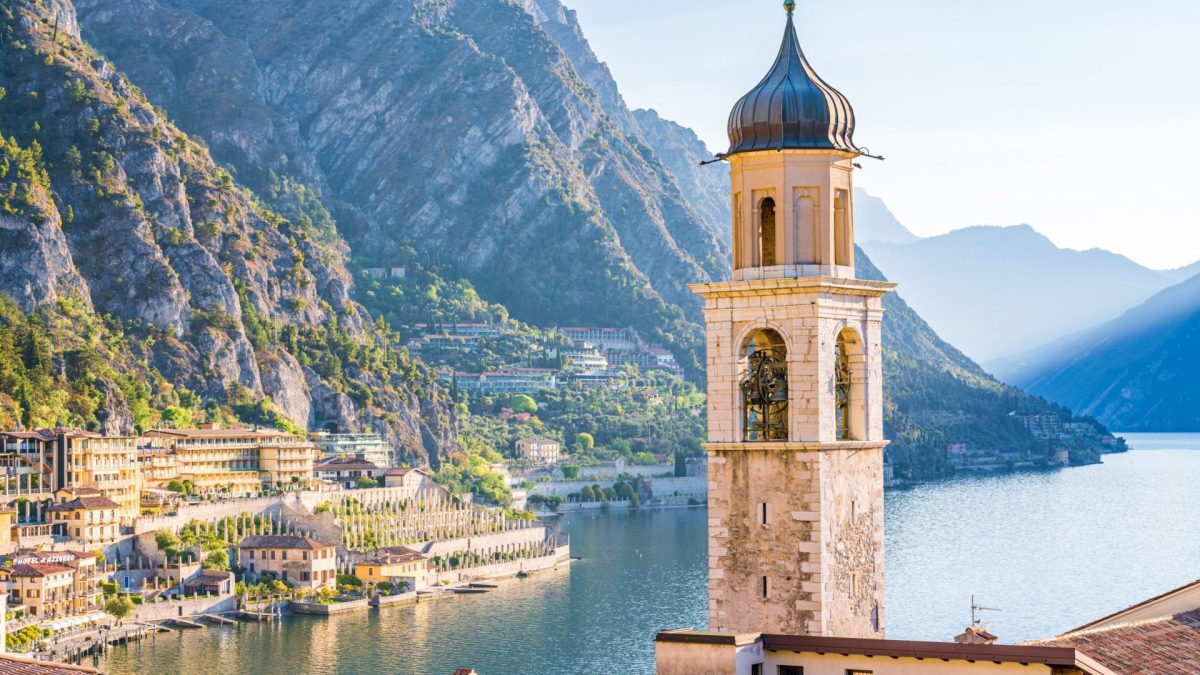
Approaching the town of Limone sul Garda on Lake Garda by boat or along the coast road, the shoreline comes into view, lined with a clutch of red-roofed, pastel-painted houses. But just above, backed by a cliff, rise strange-looking structures made up of rows of stone pillars arranged in tiers. These are historic lemon houses, the produce of which once connected this isolated community to the rest of Italy and Europe. I’ve lived in Italy for 12 years, and the town draws me back annually for languorous days breathing in the perfume of the groves, sipping limoncello spritz and walking by the breezy lake shore. I’ve road-tripped several times around Lake Garda and visited around a dozen towns, but Limone sul Garda’s history, and the fact that I love anything lemon-flavoured makes it one of my favourites. One of Italy’s most beautiful villages Last December, Limone sul Garda – towards the north of the lake, on its western shore – was recognised as one of the Borghi più belli d’Italia (the most beautiful villages in Italy). Suspended between the lake water and the mountains, it feels both Mediterranean and Alpine. September (with high temperatures in the mid 20°Cs) and October (up to 18°C) are pleasant months to visit. It’s also less crowded in shoulder season, as Lake Garda is still favoured as a summer resort for Italian and international tourists. That makes parking easier, as you have to leave your vehicle in car parks above the town or a very busy one by the shore, the historic centre being pedestrianised. To arrive by public transport, the nearest railway stations are in Desenzano del Garda and Peschiera del Garda (both with direct train connections to Verona Porta Nuova station, useful if you’re flying into Verona airport) at the base of the lake. I would then choose to take the direct ferry – even though it can take up to 4.5 hours – as the bus takes the windy coastal road, which is notoriously clogged with traffic. There’s a Mediterranean feel to the town, including around its small harbour (Photo: Marco Bottigelli/ Moment RF /Getty) In the lower part of town, there’s a dinky harbour for a few dozen colourful fishing boats. The town’s fishing industry dates back more than a thousand years, before the wealth from the cultivation of lemon groves helped it swell in size. Visitors can learn about its fishing heritage at the tiny Fishermen’s Museum (free to enter) in the historic centre, with stories told through old photos, nets and other tools donated by local families. Species fished from the lake, such as rainbow trout and pike – drizzled with the local, delicate olive oil – can still be sampled in many of the town’s restaurants. Look out for sisàm (usually available at Ristorante alla Noce, with lake views), a dish of preserved fish in a marinade of onions, vinegar and aromatic herbs. Reflecting the town’s mountainous character – it’s something you’d want to come back to after a bracing hike – is the dish polenta cunsa, hot cornmeal smothered in butter and Garda cheese, available at the rustic Bar Campaldo just out of town, high on the hillside. Around the water’s edge, the alleyways (adorned in bougainvillea in spring and summer) are a riot of bright, kitschy souvenir shops. The town then rises sharply in a series of labyrinthine twists. I like to walk up to the town’s northern end to the 17th-century church of San Rocco and sit in the little terrace before it, surveying the shimmering lake below. For a reasonable and reliable accommodation option, stay at Hotel Ristorante Montebaldo, right on the harbour. Rooms (from €115/£98.50 a night) are homely, and most have dreamy balcony views over the lake. For a little more luxury and outdoor space, just outside the town is Hotel Atilius (adults only, four-star, rooms from €108/£92.50) with huge grounds, a big pool and sunloungers overlooking the lake. Lake Garda’s town of lemons The name Limone – which means lemon in Italian – doesn’t actually derive from the fruit, but from the Latin “limen”, meaning border, or the Celtic word “limo”, meaning elm. But clearly, nominative determinism was at play, because lemons have defined the history of the town and remain its best-known product. The area is favoured with a temperate microclimate that allowed it to become one of the most northerly places in Europe to cultivate lemons, first arriving in the 13th century, and becoming a widespread industry by the 17th century with the construction of vast greenhouses called “limonaie” in the 18th. Tourism has overtaken lemons as the dominant industry, but visitors still want a taste of the town’s crop (Photo: estivillml/ iStock/Getty) During his voyages in the late 18th century, German polymath J W Goethe passed by Limone and was struck by the sight of these limonaie with their “terraced gardens up the mountainside, a spectacle of richness and grace”. Lemons from Garda were exported as far as Germany, Poland and Russia. Commerce really took off after 1840 when a society uniting hundreds of small producers was established, with around five to six million fruits reaching the markets each year. The area’s citrus bonanza began to fizzle out from 1855 with the arrival of a plant-destroying disease, competition from southern Italian lemons after unification in 1861, improved transport, and, later, the discovery of synthetic citric acid. The construction of the Western Gardesana Road in 1931 (previously Limone had only been accessible via the lake and footpaths) brought a tourism boom that established a new dominant industry. But lemons remain the town’s pride and joy. The 18th-century lemon conservatories that rise directly above Limone sul Garda are now a museum, Limonaia del Castèl (entrance €2, free for under-10s). The terraces have been restored and replanted with more than one hundred citrus trees (citron, lemon, sweet and bitter orange, chinotto, grapefruit, mandarin and kumquat) so visitors can learn about the historic production while breathing in the heady perfume from the flowers. Lemon houses are still a feature of the town, which treasures its heritage (Photo: Roberto Nencini/Moment Unreleased RF/Getty) There are also a few farms such as Limonaia La Malora and the Ecomuseum Pra de la Fam further south on the lake that still grow lemons and are open for visits and tastings. After visiting the museums and wandering the town’s winsome alleys, I like to end a day in Limone by tasting its lemon-growing prowess in the limoncello spritz that are the speciality of the town’s lakeside bars, a tangy, tart take on an Aperol spritz.
The perfect Lake Garda town for autumn, from a local who knows
Full Article
Original Source
Read the full article at Inews →KhanList aggregates and links to publicly available news content. We do not host full articles from third-party sources. Always verify important information with original sources.