
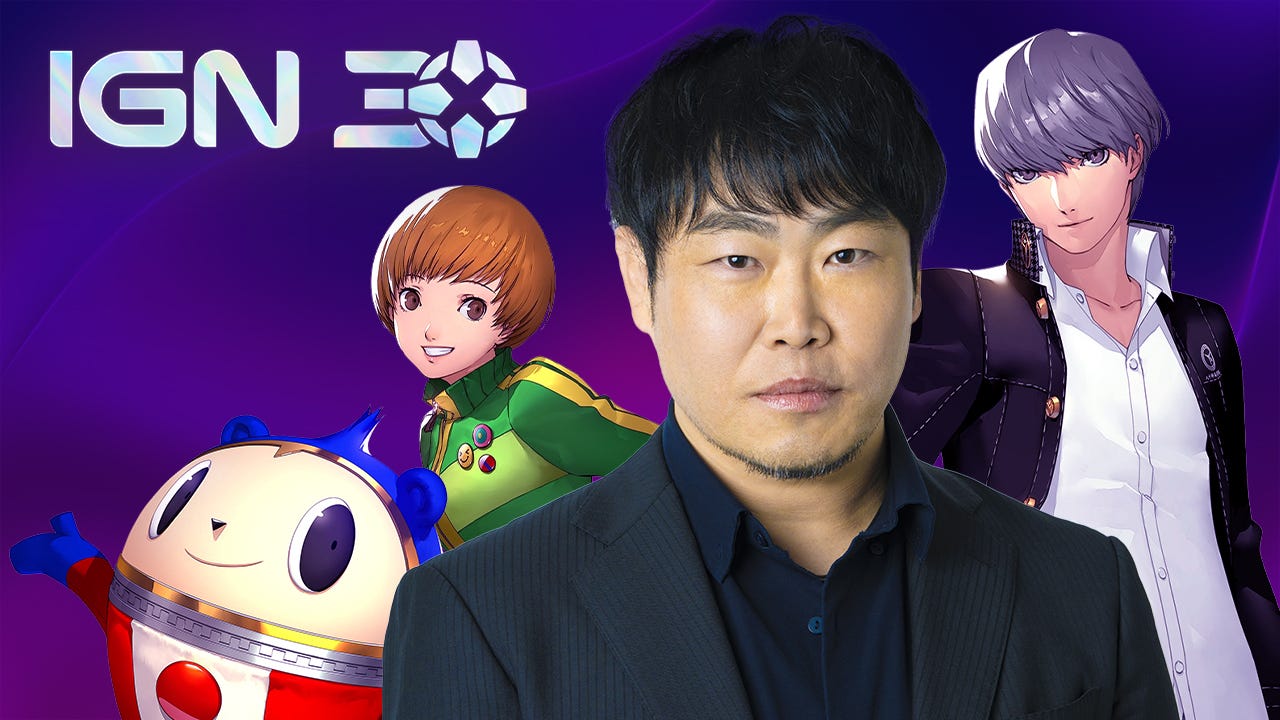
From Persona 2: Eternal Punishment to the upcoming Persona 6, creative producer and chief director of P-Studio with Atlus Kazuhisa Wada has had a hand in shaping the spinoff-turned-mainline series. And with the career spanning over 30 years, we're excited to see how he and his team continue to shape the beloved RPG series. As part of our IGN30 series where we have open conversations with storied developers about their careers from the early days to where they are today, I talked with Wada-san and he shared anecdotes of coming up through Atlus' ranks and what he envisions for the future of the franchise. The advent of 3D graphics and making in-game events got him a jumpstart with games such as Maken X and the beloved Shin Megami Tensei 3: Nocturne – however, he explained that Atlus' fate hung in the balance of Persona 3's success back in the mid-2000s. The series' rise in popularity led to spinoffs as well, which sparked by spending lunch breaks playing fighting games with Shigenori Soejima, eventually leading to Persona 4 Arena. But now with a new numbered entry on the horizon and leading the development team, Wada-san says that giving younger developers a say in the direction and identity of Persona is important for carrying its legacy for generations to come. Here's our conversation about all that and more.This interview was conducted with Sega interpreter Gavin Green and was edited for clarity and readability. You can watch the video version of this interview above.IGN: I want to go back to your origins – tell me about the early years of being a game developer and working with Atlus.Kazuhisa Wada: One of the reasons I wanted to join the games industry was that I grew up with games, I was there to watch the evolution. When I was in elementary school, there were things like Game & Watch, and as I grew older, eventually the Famicom, the NES, and then the Super NES and Super Famicom came out. And when I hit university, the PlayStation and the Saga Saturn came out. For me, that was a really big inspiration and throughout the entire time I stayed a gamer, it was kind of what made me want to join the game industry eventually. And one of the things that really hit the hardest for me was Shin Megami Tensei. It was because I encountered Shin Megami Tensei that I wanted to join Atlus. I was like, 'wow, this could be so cool.' Shin Megami Tensei really, really wowed me when I first saw it and said it had such a cool visual. And when I finally played the game, I was thinking it was really different in so many ways from so many games that I played before. The choices that you made really took you down all these very interesting paths and you got to explore this really fascinating story. So, it really inspired me and made me want to join Atlus. Eventually, I was able to join Atlus and the very first game I was involved in was a game for the Dreamcast called Maken X. One of the things that actually got me into Atlus was the fact that it was the period where 3D graphics were just starting to come into vogue. I had never actually studied 3D graphics or graphic design, but it was this kind of new thing that had so much possibility. And I had essentially made my own 3D movie and I brought it to Atlus and said, 'Hey, here, this is what I can do. You want to hire me?' And they're like, 'Okay!" And Maken X was actually the very first game that [Katsura] Hashino-san was the director on. Group photo with Kazuyuki Yamai, Katsura Hashino, Kazuhisa Wada, and Eiji Ishida.Back then, I was part of the event team making cutscenes and the various things that were going to be in the [in-game] events, but we were not very big back then and the event team was very, very small. It was not like you could just only make events and that was all you needed to focus on. The era that we lived in was that, if you were a part of the event team, you didn't just make the events, you made every asset that went into the events. So it was a very, very stringent, tough situation. Yes, it was hard and they made me do all sorts of different things, but it taught me so much about game development. I got my hands on and did 3D models, character models, camera work with the events. It was really an incredible learning experience for me and Maken X really helped me grow as a creator overall.IGN: Part of that journey was working with Katsura Hashino, Shoji Meguro, and Shigenori Soejima. With characters, music, art style, and stories that these games tell, I want to get your thoughts and your history working with them and pulling all these different pieces together to form a full game and what it was like to work with them.KW: When I joined the company, Hashino-san and Meguro-san were like these senpais. They had been there for so long and I was starry-eyed within the company. Soejima-san was also kind of like that, but he's also much closer to me in age and we were much closer in terms of the work we did. We were both working on graphics and talking about how we wanted to realize various aspects of the art. We felt like we were working [together], we had a closer relationship to start with. This is kind of the era before he was focused on being a character designer. He was working on all aspects of game design, and as we mentioned before, it was the era where games were shifting into 3D.Obviously he's an incredibly talented 2D artist, but he was doing less and less 2D art and focusing more on all sorts of other aspects of art and graphic design for games. Around this period, we had a chance to work on Shin Megami Tensei 3 together and we both actually worked on the opening sequences. I was in charge of the primary opening sequence and Soejima-san worked on the sub-opening sequence. We had a really close relationship, so we were kind of like, 'Okay, how do we want to develop differences between them? How do we want to make them different but similar?' It was very fun.From left to right: Daisuke Kanada, Kazuhisa Wada, and Masayuki DoiOutside of the opening, I worked on a lot of different aspects of that game with Meguro-san and everybody else as well. Some of the things I did was making the protagonist character model and working on a number of cutscenes and events. And there's this one event where when you died, [the camera] came overhead and angels swirled around you and brought you back to life. That was me. But it was also a really great opportunity to work with Meguro-san and hear his music first hand. My relationship with Meguro started when I was working on that opening movie I talked about. I got really cheeky and I was like, 'Hey, Meguro-san, this is the sort of music I want you to make. Make it for me.' Then probably one of the major evolutions in my work at Atlus came with the creation of Persona 3. It was the first game where I worked in design and direction, and it was because Hashino-san had actually asked for me by name. And so it was with Persona 3 that we really hit upon this overall team setup where Soejima-san was working on character design and I was in charge leading the design of the game itself. Meguro-san was the sound composer and Hashino-san was the overall director. When we made Persona 3, it was not the best time for Atlus. There was a lot of talk that, 'Hey, if Persona 3 isn't a success, Atlus itself might no longer be able to continue game development.' Because we were in that situation, we all rolled up our sleeves and were like, 'Alright, we're going to try all sorts of crazy stuff to really make this game the best it could possibly be.'If Persona 3 wasn't a success, Atlus itself might no longer be able to continue game development.“The overall theme of the game, Hashino came up with the initial concept of it, but as a team, we all got together like, 'Alright, how do we want to work this? Where do we want to go with it?' It was really fun and way in the beginning, when we had the initial design of the game, we said, 'Okay, let's go work on the character design, let's come up with an image board.' So, I worked really closely with Soejima-san and we came up with a bunch of various images that would represent the feeling and the direction of the game. Then I remember we went to show it to Meguro-san to see what sort of music he'll come up with. And he got really inspired by it. He was like, "Okay, if you're going to bring this, I'm going to bring that,' so there's this amazing almost session quality to it where one of us would do something that would inspire the next thing, and that would then inspire the next thing. It was like a stack of dominoes falling over. And that was the story of how Persona 3 came to be.IGN: I always tell people that Persona 3 in my heart is my favorite, and that story really hits me really hard. And of course, Persona 4 Revival is coming soon which speaks to the popularity of Persona 4. But I kind of want to go back to Persona 5 and the moment that game came out, because that felt like the moment the series hit mass appeal and exploded in popularity. What was it like inside Atlus when Persona 5 first hit and took the world by storm?KW: So for Persona 5, it wasn't a simultaneous release. We'd released the Japanese version initially and then there was a bit of a time gap between that and the worldwide edition. After we released the domestic [Japanese] edition, we actually got this feeling of, 'Oh wow, this game is getting popular. It seems to be well-received!' And then we had the worldwide release and the same thing happened, like, 'Wow, this is being very well-received!' But it wasn't really a surprise when it hit because we had this feeling, we had this inkling that maybe we got something here.IGN: Persona 5 has had a lot of spinoffs, and the same thing goes for Persona 3 and 4. You've worked on a lot of the spinoffs in the Persona series, so I want to get an idea of the role of spinoffs play and why they're important and the philosophy behind doing spinoff games at Atlus.KW: So, our very first spinoff was for Persona 4 – Persona 4 Arena. It was the first time we'd ever made a fighting game, it was the first time we'd ever worked with Arc System Works, and it was the first time we ever made a game for the arcade. A lot of new challenges, right? The success of that and the doing that really inspires us to then make more spinoffs in the future. But really, the reason why we did that was because we just wanted to try it. It just seemed like it would be really fun. The initial inspiration for making a fighting game spinoff of the Persona series was because at that time, Soejima-san and I were sitting next to each other in the office, and every day during lunch breaks, we'd just be like, 'Hey, you want to play some fighting games?' Then we'd just go battle each other. And so I was like, 'Hey man, what if we made Persona a fighting game? Would that be really interesting? That'd fit well.' And that was the entire impetus for it.Of course, there were tons of other reasons why we ended up making spinoffs, but one of the major things that eventually became a consideration was the fact that between each numbered Persona, there ended up being several years between them. Games take a long time to make, so we wanted to make something that would keep the Persona momentum going and give fans something to do. We did this as a way to release Persona stuff regularly. One of the other advantages that we had when working on the spinoffs was that it gave us a chance to revisit a lot of the characters we loved from previous games and explore them and their personalities a little bit more. For both us and for the fans of those characters, it let us explore the world of Persona in a deeper and meaningful way.IGN: Remasters and re-releases are also an important part of the Persona franchise. I want to get a little bit of the philosophy behind doing them and the role they have at Atlus. People love Persona 1 and Persona 2 and would love to see those stories modernized as well. How do you feel about working on remasters and why they're important?KW: For me, I think remasters and remakes are really important just in general. I think they're a form of cultural preservation, right? We have these incredible games that, unless you bring to the modern day onto modern systems, might disappear from the world. And these are wonderful games. There are wonderful stories out there that can touch so many people's hearts, and we want to give them a chance to reach new players as well. So, this way of preserving them and giving them to another generation is really the importance of having remasters.IGN: Now, I want to talk about the future of Persona. You have Persona 6 coming sometime in the future, but in your eyes, now that you are in charge of the direction of the series at P-Studio within Atlus: What do you feel like the series needs to do in order to keep growing and evolving?KW: As you're all probably aware, games in the modern age take a long time to make. There are usually many years between games in a series, and games in general are on larger scales. It's kind of gotten to the point where you can no longer just have one or two people or a small team make a game at a major studio. So, one thing we really need to think about is, since this is no longer an individual kind of process and is more of a team situation, we want to make sure everybody at our company shares the basic vision for the future of Persona. Everybody gets to have a say. We get to share the direction we want to go in, get feedback, have conversations with everybody we're working with. And we want to make sure we bring in the younger generations of game developers into the process as well so that they have a voice and they have a way to show their own creative incredible-ness to the world.We want to make sure we bring in the younger generations of game developers into the process as well so that they have a voice.“Of course the Persona series that exists today is in thanks to many people who came before me, to people of my generation, and to people who are coming in the next generation as well. So, we really hope that the future of the Persona series is something that can continue onwards and that we can work with creators of the past, present, and future to continue making amazing games. The Persona that we've established, the identity of it, we hope to pass that identity to the next generation; let them understand the identity of it, but then let them give it their own spin and their own flavor and then pass that flame onto the next generation and keep it going so that the Persona series lasts for forever.Michael is reviews editor at IGN and regularly contributes with previews, interviews, live events coverage, and news all in written and video form. He's usually entrusted with covering long RPGs and tech products, but he's got range when it comes to games. You'll also catch him at conventions and hosting video content, including IGN's weekly podcast Unlocked.
The Past, Present, and Future of Persona with P-Studio Head Kazuhisa Wada | IGN30 Interview
Full Article
Original Source
Read the full article at Ign →KhanList aggregates and links to publicly available news content. We do not host full articles from third-party sources. Always verify important information with original sources.