
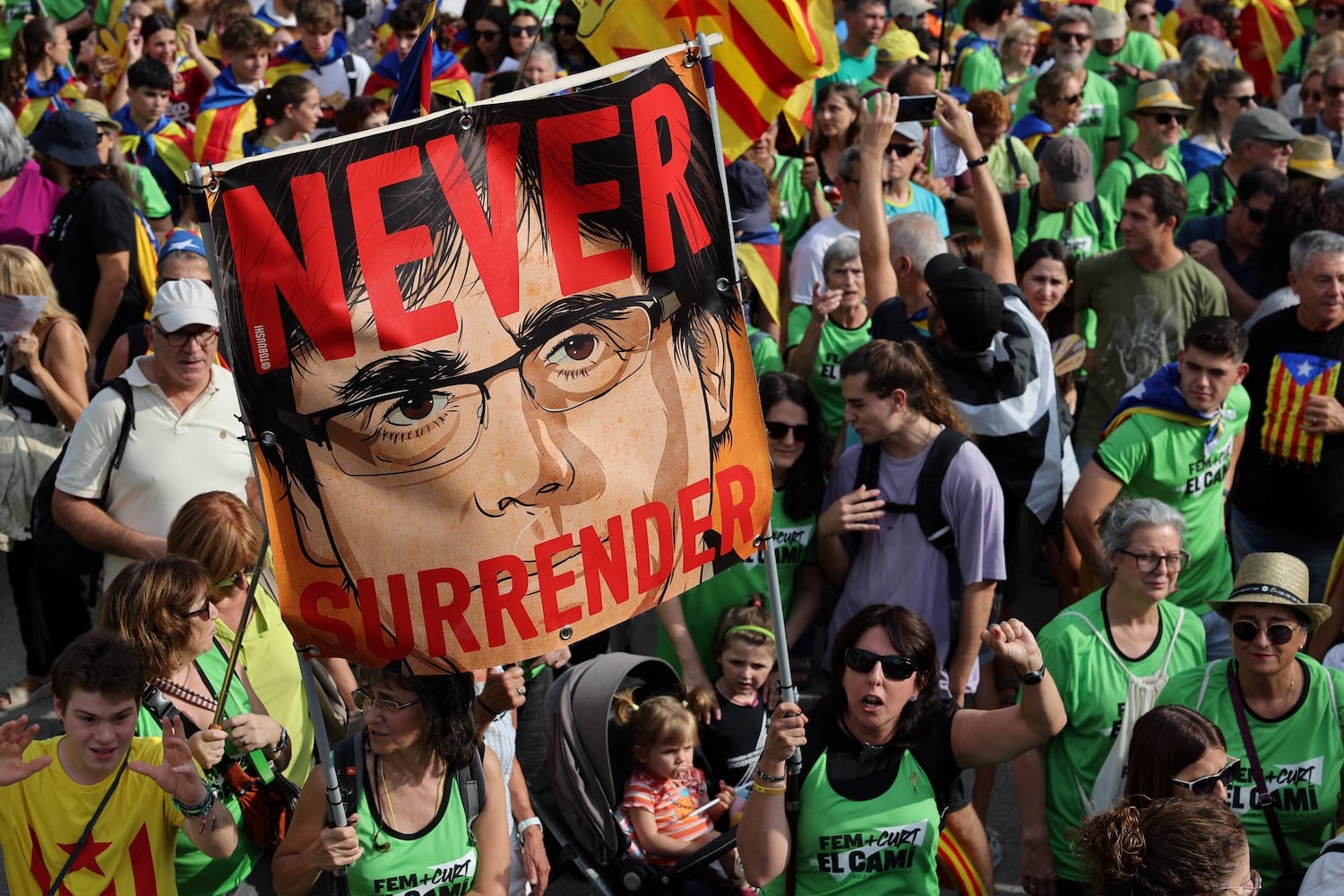
Catalonia’s independence movement is moving to the right, and Spanish Prime Minister Pedro Sánchez might pay the price in snap parliamentary elections on Nov. 29. Junts per Catalunya, the separatist party that supported Sánchez to form a minority government in 2023, turned against him last year to fend off a new far-right rival—ultimately forcing the early vote. Sánchez called elections after failing to get emergency legislation aimed at tackling Spain’s housing crisis through parliament in October. The conservative People’s Party (PP), the far-right Vox party, and the center-right Junts all voted against the package. It was the latest example of Junts going against the minority government’s initiatives. When party head Carles Puigdemont announced that Junts would revoke its backing and move into the opposition last year, he blamed Sánchez’s Socialist Workers’ Party for broken promises. But the pro-independence party is also facing a growing threat at home in Catalonia. That threat is Aliança Catalana—a far-right, separatist party led by Sílvia Orriols, the mayor of the small town of Ripoll. Orriols founded Aliança in 2020 after breaking with another separatist party; its platform combines a demand for Catalan independence with hard-line hostility toward immigration and Islam. She pushed for a tougher approach to immigration after the 2017 Barcelona attacks, carried out by a terror cell based in Ripoll. Unlike Junts, Aliança has elected not to stand in the Nov. 29 national elections, refusing to take part based on its Catalonian separatism. “We are not thinking about influencing Madrid, and that’s part of the foundation of Aliança,” said the party’s press chief, Eduard Berraondo. Polling currently points to a right-wing majority. The PP leads with 31.2 percent of the vote, with the Socialists at 29.3 percent, and Vox at 18 percent as of Nov. 24, according to newspaper Ara’s polling average. Together, the PP and Vox are projected to win around 190 seats, above the 176 needed for a majority in the 350-seat Congress of Deputies. Only the state-run Center for Sociological Studies pollster, which critics say favors the government, puts the Socialists ahead. So, although Aliança isn’t on the ballot, its rapid rise is reshaping Spanish politics. The party’s hard line on immigration and Islam has pushed Junts to the right, making the party ever less likely to partner with the Socialists. Aliança’s voters could help decide where Catalonia’s right-wing vote goes: back to Junts, across to Vox, or nowhere at all. Finally, the party’s growing popularity suggests a deeper shift among Catalan independence supporters, away from progressivism and toward a more exclusionary view of who counts as Catalan. Aliança has risen rapidly in Catalonia. The far-right party won just two of 135 seats in the Catalan parliamentary elections in 2024, but the latest survey from the Catalan government’s polling agency, the Centre d’Estudis d’Opinió (CEO), projects that the party would capture between 23 and 25 seats if regional elections were held now. Junts, which holds 35 seats, would fall to between 18 and 20. Catalonia’s next regional elections must be held by late June 2028. Almost 1 in 5 people who voted for Junts in 2024 now say they would back Aliança—but a majority of those wavering respondents still ranked Junts as their second choice. Aliança’s message lands with voters anxious about rapid population growth, crime, and stretched public services. Around 18 percent of its supporters say they would vote for Vox on Nov. 29, according to the CEO. This matters in Madrid, where each seat that Junts loses weakens the leverage that once made it a kingmaker. Junts is responding to Aliança’s rise by shifting to the right. The party has demanded that Madrid hand Catalonia control over immigration, backed bans on the burqa and niqab in public spaces, and pushed for tougher rules on repeat criminal offenders. The party has also proposed making immigrants wait 10 years after registering as residents before they can apply for subsidized housing, more than three times the current maximum. Catalonia elects 48 members of Spain’s national parliament; Junts holds seven of those seats. In return for the party’s support after the 2023 election, the Socialists pushed through an amnesty law covering those involved in the 2017 Catalan independence push, including Puigdemont, who at the time served as Catalonia’s president and fled to Belgium to avoid arrest. The Supreme Court lifted his arrest warrant in October, clearing the way for his return. Junts has ruled out backing either Sánchez or the PP’s party leader for prime minister, though it has left the door open to supporting a different Socialist candidate. Competing with Aliança for allegiance in Catalonia, it has little room to prop up a left-wing government. With a PP-Vox majority, that might not matter. But if the right-wing vote falls short, Spain’s government could once again hang on a handful of Catalan votes. The CEO expects Junts to win just four or five parliamentary seats in the snap elections, while Vox could more than double its share of Catalonia’s seats—from two seats to five or six. Some of those votes might come from Aliança supporters. “From Nov. 29, a dual voter will emerge: someone who votes Aliança in municipal and Catalan elections, and Vox in Spanish ones,” said Xavier Torrens, a professor of political science at the University of Barcelona. Vox and Aliança are opposed when it comes to the question of Catalonia’s independence, but on immigration, they speak the same language. “Many people vote Vox because they reject immigration, feel unsafe, or believe immigrants take a large share of public benefits. Aliança says the same,” said Xavier Rius, a Catalan journalist and the author of a book on Aliança. Berraondo rejected a direct comparison between his party and Vox, insisting that their positions overlap only on immigration and law and order and that Aliança does not share Vox’s opposition to abortion and gay rights. Still, Aliança might see a PP-Vox victory as good news for its future. “Imagine you think that if the PP and Vox win the elections in November, they could start the dirty job of changing the immigration rules,” Berraondo said. “Then you can take advantage of it if you are in government in Catalonia in 2028.” This political convergence would once have been unthinkable. The Catalan independence movement defined itself against the Spanish nationalism that Vox represents and long prided itself on being progressive, inclusive, and pro-European. Center-right parties joined the independence push in the 2010s, but Aliança is the first far-right separatist party to gain traction in Catalonia. So, how did a far-right party emerge from the movement, and why now? Part of the answer lies in 2017. That October, Catalonia’s pro-independence government held a referendum that Spain’s Constitutional Court had declared illegal. Puigdemont signed a declaration of independence and then days later announced that he asked parliament to suspended it. Weeks later, Madrid suspended Catalonia’s autonomy, and the movement’s leaders were jailed or fled abroad. For many Junts supporters, the promise that independence was within reach proved hollow. Puigdemont’s about-face and rush to negotiate with Madrid seemed to reveal that the party prioritized its political leverage over independence—a perception later reinforced when Junts backed Sanchez’s government and demanded amnesty for its leaders rather than any move toward independence. Orriols, the Aliança leader, has built her appeal on that sense of betrayal, casting the referendum moment as a deception and Puigdemont as a leader who lost his nerve. Voters who have switched allegiance from Junts to Aliança are, on average, around 56 years old, with nearly 89 percent supporting independence, according to the CEO. Their top concerns are immigration and insecurity. These are disappointed separatists—not newcomers to the cause. “Part of Junts’s electorate realized that the whole narrative about independence was just fluff, that they weren’t serious about it,” said Massimo Maoret, a professor at IESE Business School in Barcelona and a longtime observer of Catalan politics. Aliança, he added, has tapped into that feeling “together with anti-immigrant, and especially anti-Islamic, sentiment.” Further, as the cost of living rises, the concerns over affordable housing that brought down Sánchez’s government have also boosted the far-right party. Aliança “is winning an anti-system, anti-establishment vote, driven by people being fed up with the rising cost of living, the high cost of housing, and the poor functioning of public services such as rail transport,” Torrens said. Aliança has drawn a connection between those issues and immigration, from pushing a debate over who counts as Catalan. For decades, the independence movement embraced a slogan popularized by Jordi Pujol, a former Catalan president: “Anyone who lives and works in Catalonia is Catalan.” Aliança takes a different line. “Aliança considers that only some of Catalonia’s inhabitants are Catalan, while the rest are immigrants settled in Catalonia but not Catalan,” Torrens said. Orriols has said that Muslims could not be Catalan because “they don’t integrate with the country’s culture and values.” The question is the extent to which Aliança is shaping the independence movement. Junts has already shifted toward some of Aliança’s positions on immigration—but Jordi Turull, Junts’s secretary-general, has warned that the far right “will do nothing but take us further from our goal of a prosperous and complete Catalan republic.” Josep Vila, the president of the Catalan National Assembly, a grassroots pro-independence organization, declined to say whether Aliança belonged to the movement. The group was “not concerned by the diversity of political options,” Vila wrote in an email, as long as they shared a strategy for independence. Meanwhile, Aliança’s base is broadening beyond the independence movement. According to the CEO, only 53 percent of its supporters now back independence, down from 62 percent late last year. Taken together, the data suggest a shift in priorities. For disillusioned separatists and newcomers alike, concerns about immigration, security, and the cost of living increasingly outweigh the question of independence. In some ways, Catalonia seems to be following a familiar European script of an emergent far right—this time from within a separatist movement. Torrens makes a distinction between national-populist parties that took decades to break through, such as France’s National Rally, and those that do so within a few years, such as Italian Prime Minister Giorgia Meloni’s Brothers of Italy, Portugal’s Chega, and Vox itself. Aliança, he said, is on the fast track. The party’s first test comes in this week’s snap elections, when its supporters could shape the outcome. The bigger tests come later: municipal elections in May 2027 and the regional election by 2028. For now, Aliança seems to have shifted the Catalan independence movement’s center of gravity, as a movement that prided itself on building a Catalonia for all has absorbed an us-versus-them view of who belongs. The Nov. 29 vote will offer the first signs of how far that shift reaches beyond Catalonia. If Junts loses seats in Madrid, and especially if the PP and Vox win a majority on their own, then Catalan separatists could lose their leverage over Spain’s government for the first time in years. The irony is that some of Aliança’s own supporters might help sweep the nationalists in.
The Party Shaping Spain’s Election Isn’t Even on the Ballot
Full Article
Original Source
Read the full article at Foreignpolicy →KhanList aggregates and links to publicly available news content. We do not host full articles from third-party sources. Always verify important information with original sources.