
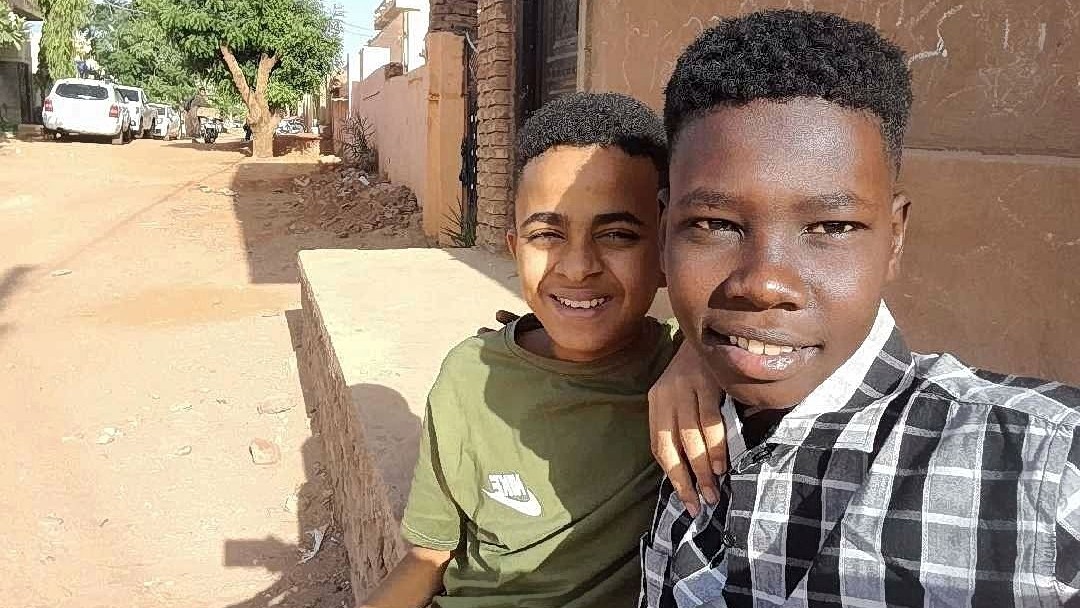
Osama was my younger brother’s best friend. He was 12. The Rapid Support Forces killed him when they attacked a town in al-Jazira state, Sudan, in 2023. The two of them used to share the same bicycle - one pedalling, the other running beside it, hand on the seat. Then one of them simply stopped existing. After the Khartoum sit-in was broken in the spring of 2019 and the resistance committees - nationwide groups of local activists of which I was a part - moved into the neighbourhoods, a few of us found ourselves guarding wool. Eid was coming. Families who could still afford it had bought sheep. When the slaughtering was done, the wool was left in the open lot where we used to meet. Someone said it was a waste to sell it in small piles for almost nothing. Someone else said the locality had not touched the streetlights on our main road in months. Children fell when it rained. Old people stopped walking to the mosque after dark because they could not see the path. New MEE newsletter: Jerusalem Dispatch Sign up to get the latest insights and analysis on Israel-Palestine, alongside Turkey Unpacked and other MEE newsletters We gathered the wool and took turns sitting with it at night. When the money came - folded, counted twice - we sat down and wrote it into a cheap notebook with a blue cover. I learned early that there are two kinds of paperwork. They do not answer to the same people Different hands. The wool money. The cost of the generator. Who had counted. The names of the boys who brought something. The phone numbers of mothers to call if something went wrong. Nobody set out to make an archive. It became one because no other archive had space for us. We used the money to fix the streetlights. History will not cite that notebook. But it is the only place where the fact that our street was lit again was written down correctly, by people who had to explain every pound to each other the next morning over tea. A ledger for Osama I learned early that there are two kinds of paperwork. They do not answer to the same people. One kind has to answer. The other is the paperwork of governments that still need other governments to believe them. Press releases. Treaties. Licences that other capitals accept as ordinary, even when the documents make plundering look like regular business. Purely humanitarian, they will tell you. It is one of the oldest lines in that second ledger. Read the record in the order it happened, not the order it was announced. On 5 December 2022, the Sudanese military and the civilian political bloc signed a Framework Agreement. This agreement said that the RSF, a paramilitary created in 2013 out of the Janjaweed militias that had killed hundreds of thousands in Darfur, would be folded into the Sudanese Armed Forces (SAF). The Amdjarass airbase in Chad with an Ilyushin Il-76D aircraft on the tarmac, on 30 August 2023 (CreditHandout/2025 Planet Labs PBC/AFP) Three weeks later, on 28 December, Chad inaugurated a 3km-long paved runway in Amdjarass, a town 50km from the Sudanese border. The Chadian ministry’s own papers show the runway had been under construction since 2016 and was already 93 percent finished before anyone had agreed to call what was coming to Sudan a war. No public record names the United Arab Emirates as the runway’s builder. What the Emirates needed was only that the strip already be there - long enough and strong enough for the heavy cargo aircraft that leave from Al Dhafra, the Abu Dhabi airbase. Gold leaving Africa for the UAE (Swissaid) Through the whole of 2022, the UAE had already taken close to 40 tonnes of Sudanese gold. More than $2bn. None of it passed through a budget any Sudanese civilian had ever voted on. In March 2023, weeks before the fighting started, Sudan’s own central bank put $50m into Alkhaleej Bank. The United States Treasury later confirmed the bank was controlled by the RSF. Companies tied to the family of Mohamed Hamdan Dagalo, the RSF chief better known as Hemedti, hold more than 60 percent of the shares. The bank did not need a stolen signature. It needed one man willing to work both sides of the ledger before the rest of the world agreed to call it a war. Supplying a war By the time the first shot was fired in Khartoum on 15 April 2023, the RSF already had an airstrip the army did not share, a bank account the army’s own central bank had just finished refilling, a company that had been buying its vehicles for four years, and a gold trade larger than most of the ministries in the Sudanese capital put together. A flag is not power. A ministry is not power. Power is the money, the weapons, and the roads that carry both. By December 2022, that power had already changed hands. When Amdjarass began to draw attention, the airbridge did not stop. It moved. Kufra in southern Libya became the new node. Ethiopia the eastern blade. The thing was never a single pipeline that could be cut. It was a system that could be copied. The Ethiopian army base at Asosa providing support for Sudan's Rapid Support Forces, shown on 29 March 2026 (Imagery © 2026 Planet Labs/Analysis Yale HRL/MEE) I know something about denial. In September 2024, months after a UN panel of experts had set out a credible case that the UAE was arming the RSF, Emirati diplomat Lana Nusseibeh wrote to a magazine under her own name and said it was not true. The Emirates, she wrote, had supplied no weapons at all. Nusseibeh had been her country’s ambassador to the United Nations from 2013 to 2024. Eleven years in that room teach a particular skill: not when to look away, but how much looking away a career can absorb before someone notices the pattern. A year after the letter, sources in the European Parliament said that Nusseibeh went to Strasbourg and lobbied them to take the words “United Arab Emirates” out of a resolution on what was being done to Sudan. Leaked UN report 'establishes conclusively' that UAE hired Colombian mercenaries for Sudan's RSF Read More » Done in daylight. Over coffee. A massacre going unsigned. Reassured governments doing nothing. The flights did not stop. On 1 March 2026, three drones left Bahir Dar in Ethiopia and flew into White Nile, Blue Nile, North Kordofan and South Kordofan states. Sudanese air defences brought one down north of el-Obeid. The technicians did the ordinary work with a serial number. Brigadier General Asim Awad Abdelwahab said that a drone attack on 17 March enabled the SAF to conclude that the drone number S-88 belonged to the UAE, and that its flight data ran back to a hangar at Bahir Dar. That is Khartoum speaking, on the record, about a machine its own people picked up off the ground. A claim. Not yet a verdict. I want the distinction kept. Mercenaries and security guards The same ground that trained Sudanese men as “security guards” in 2019 and 2020 trained Colombians five years later. Abdul Rahman Alzaki was teaching in Khartoum when he read the advertisement. The agency was called Amanda. He paid 80,000 Sudanese pounds ($950) and left on 19 January 2020, expecting a security job in Abu Dhabi. At the airport, the company men took the passports. They were driven to a compound at Ghiyathi in Abu Dhabi, given military uniforms and placed under men who introduced themselves as Emirati armed forces. Weapons. Battlefield exercises. Around 270 Sudanese accepted an offer to continue after a company man spoke to them. More than 100 refused. Those who continued were flown to a desert airbase in Libya. Four sites in Libya believed to be RSF training camps (© 2026 MapTiler/OpenStreetMap contributors via Avaaz/Lighthouse Reports/Evident/Sudan War Monitor) Five years later, Colombian contractors trained at the same compound. The company tied to the later recruitment was Global Security Services Group (GSSG), named in a recent confidential UN Panel of Experts report leaked to Middle East Eye. The Sentry investigative organisation traced the company’s founding to Ahmed Mohamed al-Humairi, secretary general of the UAE’s Presidential Court. In 2017, he transferred his shares to Mohamed Hamdan Alzaabi. GSSG called itself the UAE government’s only armed private security services provider. 'Mayfair means money': A walk through the Gulf elite's favourite part of London Read More » The UAE's foreign ministry denies the charges relating to GSSG, just as it denies that its involvement in the Sudan war is anything other than "humanitarian". On 24 August 2024, 26 men signed contracts in Benghazi. In the rendered sentence a man authorises GSSG to transfer the money corresponding to his salary to a separate company called Global Staffing, which will be responsible for making the corresponding deposit to his account. One company, the employer. Another company in Panama, the one allowed to touch the wage. The man signs, in a city that is not his, so the distance can be called his consent. The language is the calm language of a salary. It does not say humanitarian. It does not say denial. It says: let the other company put the money in my account. Keeping a record I knew a woman at the gate of the medical campus in Khartoum who understood a debt better than any of these forms. She sold tea. If I had nothing, she let the cup stand and said the money could wait until I came back. The waiting was not kindness the way a speech means kindness. It was an account. It worked because both of us would be at the same gate in the morning, and because the money, when it moved, would move from my hand to hers and stop. Those men in Benghazi signed a paper whose whole purpose was to make that closeness impossible. There are six pages. Protocol number 2 of 2024. The date at the top is 4 January. The date in the footer is 5 January. Three men signed. Buried in the minister’s duties is a line I read twice: the ministry is to develop alternatives to cash transfers for commodity transactions. Not a secret. A procedure. When money should not move as money, move it as sugar, as flour, as metal, as a balance that never has to become a wire with two names on it. We used to think the crime was the hiding. The crime is also the form - the form that lets everyone in the room say they were only trading. Mohammed, the author's brother, and Osama (r) (Ahmed Ismat Ahmed/MEE) I do most of this looking late, after the street under my window in Cairo has thinned enough that the fan is the loudest thing in the room. I do not recommend it. It does not end in sleep. What keeps coming back is the sense that I have seen this shape before. The British decided early that Darfur had nothing the empire needed directly, so they governed it from a distance. Sudanese governments kept the arrangement for 60 years after the British left. For the state, Darfur became closer to a laboratory than a province. Amdjarass and Kufra accumulated. Then Bahir Dar and Asosa accumulated in the same way. The laboratory became a machine. The machine runs on rented ground. How the UAE continued supporting Sudan's RSF through Haftar and Libya Read More » Osama does not have a file. He has a phone call that lasted maybe 40 seconds, repeated to a dozen people, including me. A man from the old neighbourhood called. His voice was flat. I asked how it happened. He said: “They came.” That was all. I am giving Osama a file anyway. This is his. I am not writing this because I believe a government will read it and change its mind about a loan. I am writing it because somebody has to keep the record for a 12-year-old boy who never got one, and because the only revenge the powerless are ever actually allowed is to refuse to let the powerful finish the forgetting for us. The blue notebook we filled with wool money could not save our street from this war. It could only record what a few of us tried to do for each other before the lights went out. I still trust that record, and the one I have just written for Osama, more than every document that leads to Abu Dhabi, every document the rest of the world has agreed to call ordinary business, purely humanitarian, nothing more. Osama, this one is yours. I kept it. I am still keeping it. I am not going to stop.
The paper trail that leads from the UAE to a dead boy in Sudan
Full Article
Original Source
Read the full article at Middleeasteye →KhanList aggregates and links to publicly available news content. We do not host full articles from third-party sources. Always verify important information with original sources.