
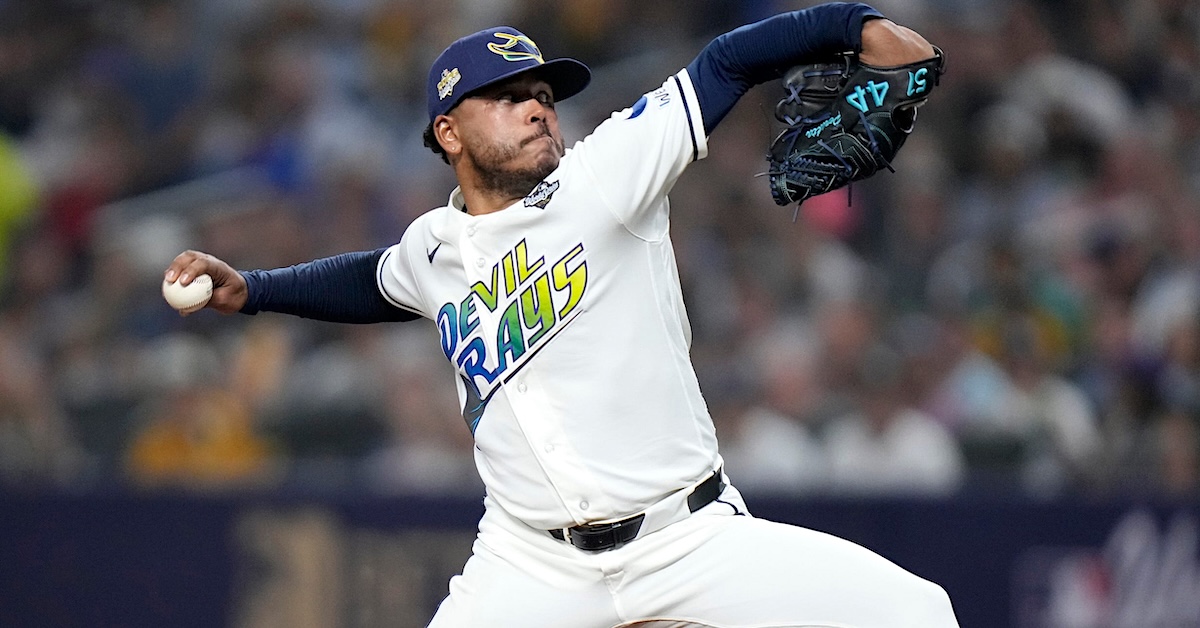
Jovanny Hernandez / Milwaukee Journal Sentinel / USA TODAY NETWORK via Imagn Images With Tarik Skubal signing with the Mets on Sunday and Trevor Rogers inking a deal with the Cubs on Monday, the top free agent pitchers are coming off the board as the Thanksgiving holiday — and beyond that, the likely lockout — approaches. On Tuesday, the Orioles got in on the act, agreeing to terms with Freddy Peralta on a five-year, $125 million deal. For the 30-year-old righty, this is the third change of address within this calendar year, an uneven one for him in terms of performance. He was dealt from the Brewers to the Mets in January and then from the Mets to the Rays in August, just ahead of the trade deadline. While Peralta struggled mightily for two-thirds of the season in Queens, he salvaged the campaign with a solid stretch run in Tampa Bay that included his winning ALCS MVP honors. Peralta’s deal is the largest contract ever for an Orioles pitcher, and the third-largest for any player in Orioles history, after those of first basemen Chris Davis (seven years, $161 million for 2016–22) and Pete Alonso (five years, $155 million for 2026–30). Superficially, the deal is almost a ringer for what Rogers — who spent the past two-plus seasons with the Orioles — received from the Cubs, though his five-year, $120 million contract reportedly includes an undisclosed amount of deferred money that will lower the average annual value, as well as escalator clauses that could make his deal more lucrative. Peralta’s deal has neither of those bells and whistles, but he will receive a $10 million signing bonus and then annual salaries of $23 million per year. I’ll get back to Rogers below, but first, Peralta. The six-foot, 198-pound righty spent eight seasons with the Brewers (2018–25), during which he helped them to five playoff berths while making a pair of All-Star teams. The 2025 season was the second of those; he placed fifth in the National League Cy Young voting while setting career bests in innings (176.2) and ERA (2.70). That ERA ranked fourth in the NL, while his 28.2% strikeout rate ranked fifth, his 3.6 WAR eighth, and his 3.64 FIP 10th. That FIP, while certainly respectable, was 0.94 runs per nine higher than his ERA, the majors’ third-largest difference in that direction among qualifiers, with the gap owing plenty to a .243 BABIP, second lowest among qualifiers. Peralta’s FIP was right in line with his 3.67 FIP from 2018–24, and not far off his 3.42 xERA from 2025. In other words, it was probably a better indicator of his abilities than that career-best ERA. When the Mets traded a pair of Top 100 prospects (Jett Williams and Brandon Sproat) to the Brewers — president of baseball operations David Stearns’ former team — for Peralta and righty swingman Tobias Myers, the deal was oversold as providing the team with the no. 1 starter it had lacked. Regardless of expectations, Peralta was a major disappointment during his four-plus month with the Mets, during which he posted a 4.95 ERA and 4.45 FIP in 113.2 innings. On August 2, the Mets cut bait, trading him to the Rays for a trio of prospects in the 40-45 FV range, pitcher Gary Gill Hill, second baseman Émilien Pitre, and outfielder Aidan Smith. Peralta pitched much more effectively after the trade, putting up a 3.25 ERA and 3.93 FIP in 55.1 innings. Peralta was especially good during his four postseason appearances prior to the World Series, allowing just a solo homer and two other hits in 4.2 innings against the Yankees in Game 2 of the Division Series, and following that with six shutout innings against the Guardians in Game 2 of the ALCS. He came out of the bullpen to record two key outs against the top of the lineup in relief of Nick Martinez in Game 4 of the ALCS, stranding a runner and protecting what was at that point just a one-run lead in a series the Rays were trailing, two games to one. Two days later, he threw 5.2 innings of one-run ball in Game 6, setting up the Rays to clinch the pennant; for allowing one run in 12 innings while striking out nine in his three appearances, he was named the series MVP. Peralta’s World Series start in Game 3 against his former team didn’t go as well, as he was charged with five runs in 4.2 innings. To be fair, he departed with two outs and the bases loaded, down 2-0, and reliever Cam Booser allowed all three runners to score by yielding back-to-back singles to Brice Turang and Garrett Mitchell. When Peralta went to Tampa Bay after the trade, Rays pitching coach Kyle Snyder and bullpen coach Jorge Moncada reviewed video footage of him at his best with the Brewers and at his worst with the Mets, then helped him implement some changes that “were towards what he has been in the past,” as Moncada told ESPN’s Jorge Castillo in October. They had him return to pitching out of the stretch instead of from a more elaborate windup, use a wider stance and a more overhand delivery, and move towards the third base side of the rubber. In the aggregate, the changes weren’t massive: Freddy Peralta Release Point Changes, 2024–6 Team Season Vert Rel Hor Rel Ext Arm Angle FA Velo Brewers 2024 5.28 -2.83 6.7 36.9 94.3 Brewers 2025 5.32 -3.47 6.8 38.4 94.8 —Mets 2026 5.21 -3.37 6.5 33.0 94.2 —Rays 2026 5.19 -3.70 6.7 35.3 94.8 Total 2026 5.20 -3.46 6.5 33.6 94.3 The changes did add a bit of velocity to Peralta’s four-seam fastball while also adding some extension and vertical movement. Meanwhile, the Rays also had him back off the usage of his sliders (a traditional one and a sweeper) in favor of his changeup; his slider usage dropped from 11.1% to 6.1% while his changeup usage rose from 20.8% to 29.7%. Since batters hit .236 and slugged .436 against the sliders, and hit .224 and slugged .333 against the changeup, this was a worthwhile tradeoff even with a slight drop in whiff rate (from 32.5% to 28.9%). For all of that, the changes did not restore Peralta’s flagging strikeout rate, though they did help him cut his home run rate substantially: Freddy Peralta Rate Stats, 2024–26 Team Season HR/9 K% BB% EV Brl% HH% xERA BABIP Brewers 2024 1.35 27.6% 9.4% 87.6 8.7% 36.9% 3.83 .278 Brewers 2025 1.07 28.2% 9.1% 88.0 9.2% 34.5% 3.42 .243 —Mets 2026 1.35 22.1% 9.4% 87.7 5.2% 38.2% 3.86 .313 —Rays 2026 0.98 19.7% 6.9% 87.5 7.0% 35.0% 3.74 .232 Total 2026 1.22 21.4% 8.6% 87.6 5.8% 37.2% 3.82 .288 With the Rays, Peralta’s hard-hit rate fell, and having a better defense behind him helped trim his BABIP; he went from a team that totaled -5 FRV when he was pitching to one that totaled 4 FRV in less than half as many innings. In the end, Peralta’s performance wasn’t on the level of his work in Milwaukee. Driven by the decrease in his ability to miss bats, ZiPS is rather unenthusiastic about Peralta over the life of this deal: ZiPS Projection – Freddy Peralta Year W L ERA G GS IP H ER HR BB SO ERA+ WAR 2027 11 10 4.00 31 30 162.0 139 72 22 59 151 102 2.2 2028 10 9 4.11 28 27 146.7 130 67 21 52 132 99 1.8 2029 9 8 4.22 25 24 134.3 123 63 20 47 118 97 1.5 2030 7 9 4.42 22 21 118.0 112 58 18 42 101 92 1.1 2031 6 7 4.64 18 17 95.0 94 49 16 36 78 88 0.6 That’s just 7.2 WAR forecast over five seasons. According to Dan Szymborski, who provided the above projections, the ZiPS contract suggestion for that span is just $56.7 million, not that anybody expected Peralta to get that little. On the contrary, on our Top 50 Free Agents list — where he was ranked sixth — Peralta exceeded the expectations of both our median crowdsource (four years at $96 million, for a $24 million AAV) and list curator Ben Clemens (four years at $92 million, for a $23 million AAV). Peralta was a few rungs lower on that list than Rogers (third) or the still-unsigned Michael King (fourth). Rogers put up an eye-opening 1.81 ERA and 2.82 FIP in 109.2 innings with a 24.3% strikeout rate in 2025 after missing the first seven weeks of the season due to a partial dislocation of his right kneecap during the offseason. He couldn’t match those numbers in 2026, but he did set career highs for starts (30) and innings (169.2) while posting a 4.03 ERA and 3.45 FIP with a 22.5% strikeout rate. He hasn’t been as durable as Peralta, averaging 24 starts and 135 innings over the last three seasons to Peralta’s 32 starts and 173 innings. However, he’s 17 months younger (heading into his age-29 season rather than his age-31 season) and less walk- and homer-prone; from 2024–26, he was actually slightly more valuable than Peralta even in fewer innings (8.2 WAR to 7.7). Here’s what Rogers’ five-year ZiPS projection would have looked like had he stayed with the Orioles: ZiPS Projection – Trevor Rogers (BAL) Year W L ERA G GS IP H ER HR BB SO ERA+ WAR 2027 11 8 3.67 28 28 159.3 147 65 17 36 144 111 2.8 2028 10 9 3.72 27 27 155.0 146 64 18 36 137 110 2.5 2029 10 8 3.87 26 26 151.3 145 65 18 35 131 105 2.3 2030 9 9 4.02 26 26 143.3 142 64 18 34 121 101 1.9 2031 9 8 4.20 26 26 139.3 142 65 19 34 116 97 1.6 That’s 11.1 WAR over five seasons, for a ZiPS-suggested contract worth $98.2 million, much closer to what he received from the Cubs. As to why the Orioles chose Peralta over Rogers, I’d guess it hinges on Peralta’s track record for durability and the additional value attached to the compensatory draft pick they’ll receive, since Rogers declined a qualifying offer, whereas Peralta couldn’t be issued one because he was traded midseason. While one can ding the Orioles for making a choice that goes against a projection system, it’s not an unreasonable one based on the two pitchers’ track records and a belief that Peralta’s season was an aberration, his step backwards offset by an impressive recovery when the chips were down. Signing either pitcher is a big step forward for a team that two years ago responded to the loss of Corbin Burnes to free agency by signing Tomoyuki Sugano out of NPB and both Kyle Gibson and Charlie Morton, who proved to be on their last legs and didn’t make it through the season in Baltimore; admittedly, things haven’t exactly gone great for Burnes since his Orioles tenure. With the Orioles, who finished below .500 for the second season in a row at 79-82, Peralta slots into a rotation that includes righties Shane Baz, Kyle Bradish, and Brandon Young, and lefty Cade Povich. Baz, despite a lopsided 6-15 won-loss record, produced 3.4 WAR in 179.2 innings in 2026, which was more WAR than the other three combined; Young put up 1.6 WAR in 156.2 innings and Bradish 1.5 WAR in 155 innings, with Povich limited to 0.2 WAR in 37 innings due to elbow inflammation and struggles that sent him back to Triple-A Norfolk. Judging by the fact that the Orioles rotation ranks 23rd in projected WAR in our Depth Charts, down from 15th during the regular season, they’ve still got work to do, and that’s before you get to needed upgrades in the outfield. Signing Peralta is a reasonable start for a team with aspirations to return to the postseason, but it can’t be their only big move of the winter.
The Orioles Bank on Freddy Peralta Returning to Form
Full Article
Original Source
Read the full article at Blogs →KhanList aggregates and links to publicly available news content. We do not host full articles from third-party sources. Always verify important information with original sources.