
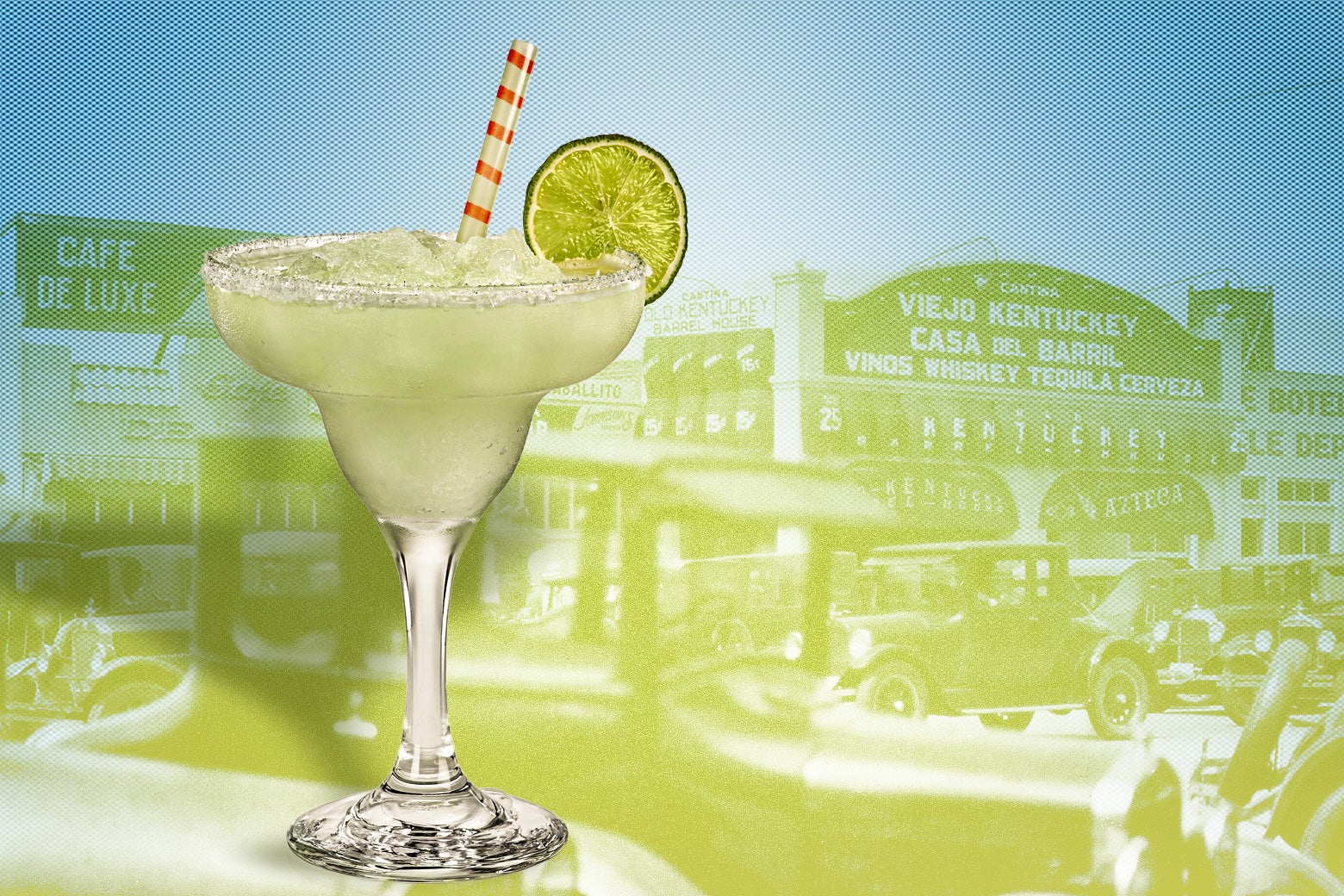
Drink The Margarita Is One of the Great Cocktails. But Its Origins Have Been Blurry—Until Now. New evidence suggests that the drink arose in an earlier and more fascinating world than was previously thought. Photo illustration by Slate. Photos by ullstein bild/ullstein bild via Getty Images and Getty Images Plus. Sign up for the Slatest to get the most insightful analysis, criticism, and advice out there, delivered to your inbox daily. Lime juice, orange liqueur, and tequila. For the devout mixologist, these make up la Santísima Trinidad. Simple, citrusy, and beloved, the margarita is not the most complicated cocktail, but it has risen to nearly unrivaled status at the American bar. Alongside only the martini and Collins glasses, the marg’s inverted bell-shaped vessel has staked its claim among a well-furnished bar’s glassware. Some will even spring for an ad hoc contraption designed to encrust the rim of each glass with a flaky halo of salt. The tequila drink’s popularity is indisputable, but, as many writers have discussed for the past 90 years, we don’t really know where this delicious concoction came from. The mysterious context from which the margarita emerged is becoming clearer, and in my research on Mexican drinks for my new book The Complete Guide to Mexican Beverages, I’ve identified several sources that push the origins of the drink back to an earlier and more fascinating milieu than previously thought. But first, lend me a minute to explore the historiography of the cocktail; it’s not without its controversies. When barman Danny Herrera died in 1992 at the age of 90, the local San Diego Union-Tribune published an obituary titled “Carlos ‘Danny’ Herrera Dies; Invented Margarita in Late 40’s.” The Los Angeles Times followed suit with “Danny Herrera, Inventor of Margarita, Dies at Age 90.” At least as far as Herrera’s obit writers were concerned, the drink seemed to have a clear origin story. Shortly thereafter, however, the San Diego Reader debunked the claim, abetted by a longtime CBS correspondent, John Beck, who has spent decades working in the Baja Peninsula and claimed that the drink was invented in the coastal city of Ensenada as early as 1940 at Hussong’s Cantina. The establishment, founded in 1880, is the oldest cantina in Baja California. Conveniently, the Mexican state began publishing reports on its monthly Baja California History Seminar lecture series, called Memorias, in 1991. The edition for 1992 (the year of Herrera’s death) included a competing origin story that corroborated Beck’s theory. In translation, the lecture reads, “It was in October 1941 that the ‘MARGARITA,’ one of the most famous and globally preferred Mexican drinks, originated by chance at the bar at Hussong’s. It was invented by Don Carlos Orozco, the establishment’s bartender.” The Memorias article also notes that the drink was “originally made with tequila, Damiana liqueur [a plant endemic to the region], and lime juice, Since the ’90s, newer stories and theories have circulated, and more recently the tequila daisy cocktail has come to the forefront. Celebrated cocktail historian David Wondrich has noted that a 1936 Iowa newspaper article discussed a Mexican bar run by an Irishman serving a drink called the tequila daisy. Wondrich drew the connection between the family of cocktails known as daisies and the Spanish word for “daisy,” which is (surprise, surprise) margarita. A daisy cocktail generally combines a spirit with citrus juice and a sweet liqueur. This class of drinks is similar to sours (like the whiskey sour), except that sours don’t contain liqueur and instead feature plain simple syrup alongside the citrus and spirit. The modern margarita, with just lime juice, orange liqueur, and tequila, is, in essence, a tequila daisy. The popular Tommy’s Margarita, containing just lime juice, agave syrup, and tequila, is, in essence, a tequila sour. So Wondrich’s 1936 mention of the tequila daisy is evidence of an earlier margarita than those claimed by Hussong’s Cantina and Danny Herrera. The drink just hadn’t translated its name into Spanish yet. Similarly, Difford’s Guide points to a 1939 recipe for the first tequila sour in Charlie Connolly’s World Famous Cotton Club: 1939 Book of Mixed Drinks. Yet, as it turns out, both the tequila daisy and tequila sour were popularized about a decade earlier, during the years of American Prohibition. In scouring newspaper archives, I’ve found the antecedents of our favorite tequila cocktail in the jazz-filled early days of Roaring Twenties Texas. Tijuana, Mexico, has the reputation of Tijuana, Mexico, for a reason: American Prohibition. During the dry era of U.S. history, border towns in Mexico became havens catering to passport-toting gringo drinkers. Fleeing Prohibition south of the border, Americans would have been able to legally enjoy cocktails in newly opened bars and cafés in cities like Ciudad Juárez, Mexicali, and Tijuana. Gambling, drunkenness, and vice ensued, but so did some novelties that have turned into American mainstays. Among them? The prototypes for the margarita and, should you want a little roughage with your drink, the original Caesar salad. Yes, it was thanks to the 18th Amendment that the Caesar salad was born. Caesar Cardini, an Italian-born restaurateur, opened up shop just across the border in Tijuana to serve tippling Americans. Cardini, believed to have invented the recipe for the Caesar salad on the floor of his Tijuana restaurant in 1924, attracted Americans (including a young Julia Child) to his café through fanfare-worthy events, including spaghetti-eating contests, cabaret performances, and the highly publicized sponsorship of meals for an American boy named Joe Fisher, who had been imprisoned in Mexico on robbery charges. Successful during the 1920s, Cardini has a story representative of the era. Following the end of Prohibition, which decreased the drive for Americans to wine and dine in the borderlands, the Mexican government eventually cracked down on gambling too, destroying what was left of the cross-border economy. Cardini closed up shop in July 1936 and relaunched his hospitality business stateside in San Diego later that year. But Cardini’s 1920s hurrah in Mexico was not an isolated affair. Other social clubs, like the Kentucky Club, the Foreign Club, and the Aloha Club, appeared on the frontier, serving booze and playing music and shows while advertising themselves in American newspapers. Agua Caliente Casino became a notorious oasis for gamblers. To supply these establishments, the region saw new breweries open, like Cervecería Mexicali in 1923, wineries like Vinicola L.A. Cetto in 1926, and even distilleries like Tecate’s Donlevy Whiskey, which closed in 1932. It was in this frenzy of Mexican-made booze for a mainly American audience that, I argue, the early margarita was born. During Prohibition’s regime of sobriety, we encounter earlier mentions of both the tequila sour and the tequila daisy than those recorded by Wondrich and Difford’s Guide. On April 15, 1923, the San Antonio Light ran an article in the Society section of the Sunday paper ruminating on how older women were wont to utter the phrase “Well, when I was a girl.” The article continues: “Well, were things so different when mother was a girl? … The stately minuet, polka and the old-fashioned waltz bear as much resemblance to the jazz dance of today as a cool, refreshing slightly wicked mint julep does to a ‘tequila sour.’ ” The passage, which is clearly written from the point of view of a flapper caught up in the Ziegfeldian zeitgeist of the age, includes quotation marks around the cocktail name, indicating that it might have been specific to the in-the-know slang of the day. Meanwhile, on June 9, 1927, the Dayton Daily News recorded the names of George Howard Earle III’s polo horses. No, horses are not cocktails (though they may be related etymologically), but Earle, who hailed from a prominent American family, had served in the U.S. military during the Mexican Revolution, fighting the militia of the famed revolutionary Francisco “Pancho” Villa in 1916. In 1927 he had two horses, Tequila Daisy and Palome, seemingly in reference to tequila cocktails he must have been exposed to during his time in Mexico. All but confirming the earlier existence of the tequila daisy, the Waco Tribune-Herald would, in 1935, advise tourists to spend their first evening south of the border drinking a “tequila sour tasting harmless as lemonade, then a glass of beer, then more tequila.” It is significant that the first mentions of these drinks appear in English. The idea of the cocktail, in general, was something that Mexico adopted from the U.S. In fact, the first cocktails appeared in Mexico following the invasion and occupation of Mexico City by the American military in 1847 and 1848. American soldiers, encamped in the country’s capital for nearly six months, began drinking rye whiskey, boozy eggnog, and the classic cocktail the Tom and Jerry. Though the era was short-lived, Americans would begin returning behind the bar in Mexico during the 1890s, by which time they were already experimenting with tequila cocktails, and perhaps even landing on an earlier margarita, though the records don’t divulge ingredients. Slate receives a commission when you purchase items using the links on this page. Thank you for your support. The Daily Anglo American, an English-language newspaper published in Mexico City, noted in August 1891: “We have been successful, and today, beside all the old drinks we have had to mix for our English and American patrons, many new ‘bebidas’ from liquors of the country have been discovered and are regularly served. …Tequila embellished under the direction of a good barkeeper affords several palatable drinks.” But for Mexico, the cocktail trend that American barmen were ushering in during the 1890s was not always welcome. In a February 1899 article in the Evening Star newspaper, a Mexican doctor complained: “I wish your American bar rooms were in the bottom of the Gulf of Mexico. They are a curse, for they have made drinking fashionable among our youth. Formerly people took tequila and aguardiente and the cantinas were not attractive to young men. But, nowadays, your fancy drinks are playing mischief with our young men.” The American barman had become a negative stereotype by the 1910s (though not as negative a stereotype as the Spanish barman, who was thought to be a loan-sharking and vice-dealing parasite in 20th-century Mexico). During the years of the Mexican Revolution, and particularly under the administration of Álvaro Obregón in the early 1920s, Americans living in Mexico were deported en masse. Article 33 of the 1917 Mexican Constitution granted the president the authority to expel—without the need for a prior trial—any foreigner whose presence was deemed inconvenient. In his paper “Extranjeros indeseables en México (1911–1940),” historian of the Mexican Revolution Pablo Yankelevich notes that the majority of the deported Americans were bar owners. Despite the revolutionary government’s efforts at purging Mexican bars of American barmen, Prohibition ultimately led to the greatest influx of restaurateurs and bar owners, Caesar Cardini included. The 1920s would have finally familiarized drinking for a critical mass of Americans with the tart combinations of citrus and tequila that were being served in borderland bars. After all, Mexicans had long been consuming tequila with salt and lime. While theories continue to swirl about which bartender first mixed lime juice, orange liqueur, and tequila or which cantina can claim to have invented the margarita, the real origin of the cocktail is akin to the origin of the Caesar salad. As American merrymaking took up temporary residence south of the border, local ingredients were bound to infuse into the great Prohibition-era tradition of mixological innovation. In a way, the margarita is a mirror image of the cultural institutions of Tex-Mex and Southwestern cuisine (like the delicious green-chile cheeseburgers down in Albuquerque). Gooey queso, sizzling fajitas, and the all-American wallop of the chimichanga are all part of the delicious cross-border tradition of Mexican American cuisine, but our favorite savory salad and the preferred drink pairing of chips and salsa are examples of the cross-cultural culinary traditions that hover just across the border—what we might term American Mexican cuisine. Whether you take your margarita with salt on the rim or sugar, with Cointreau or DeKuyper, with agave syrup or sweet liqueur, know that the archetype of this versatile drink represents an era of heightened exchange between the U.S. and Mexico. The history of a happy-hour sour may seem trivial, but it proves that these two countries and cultures can collaborate to produce remarkable (and delectable) results. Above all else, the beauty of mixology is in the mixing. To that, we can all raise a glass and say ¡Salud! Food History Mexico Recipes Drink
The Origin Story of America’s Favorite Cocktail Has Been Clouded in Mystery. I’ve Finally Discovered Who We Have to Thank.
Full Article
Original Source
Read the full article at Slate →KhanList aggregates and links to publicly available news content. We do not host full articles from third-party sources. Always verify important information with original sources.