
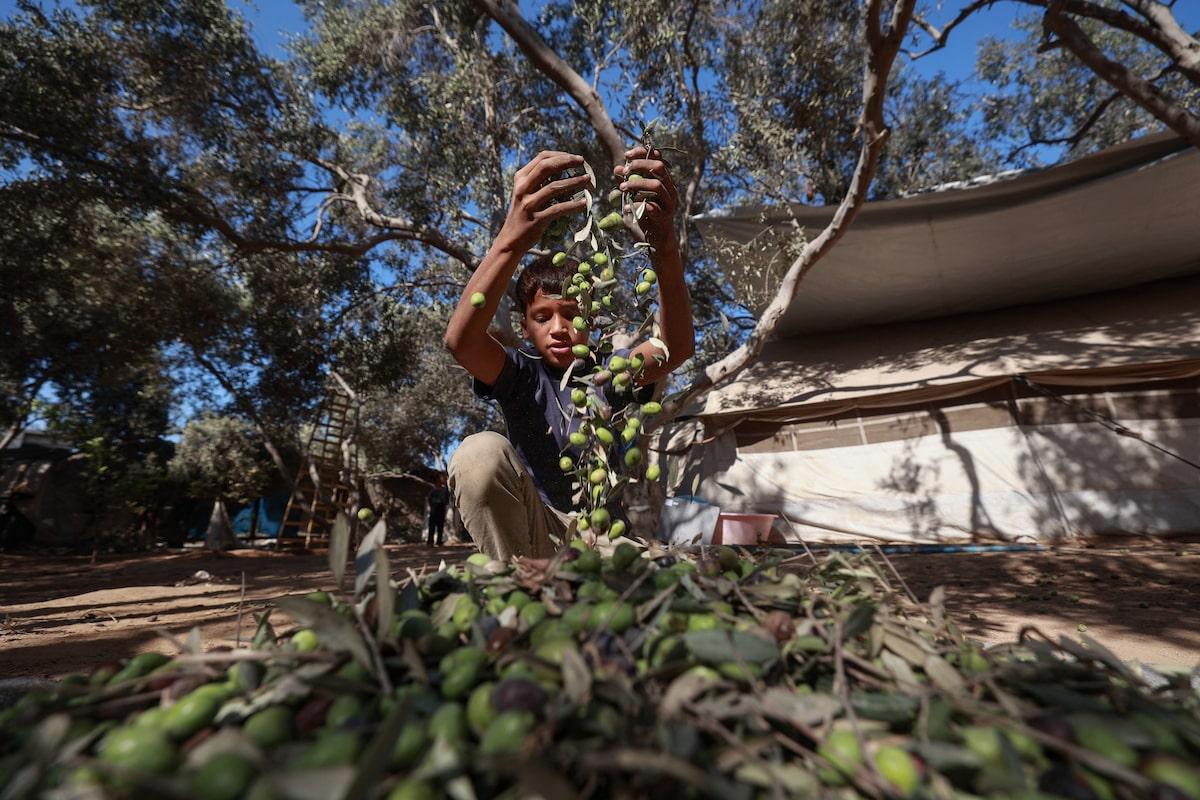
Open this photo in gallery:A Palestinian boy harvests olives from a farm in the area of al-Zawayda in the central Gaza Strip in late September.EYAD BABA/AFP/Getty ImagesIt is the olive harvest season in Gaza, and Mohammad Abu Ouda’s olive press is much quieter than it was at this time of year before the war. The smell of fresh olives fills the place, but there are only a few bags of the crop. The machines run slowly as workers wait for more to arrive. Near the press, an area normally filled with farmers and trucks is almost empty. “We are business owners but … we can barely make our daily income,” Mr. Abu Ouda said. One of his olive presses was destroyed in the fighting between Hamas and Israel. His brother was killed on his way to check on the machine. Before the war began in 2023, the Gaza Strip had 37 olive presses. Today only eight remain operational, and they face shortages of fuel, spare parts and engine oil, making the work much harder. Mr. Abu Ouda estimates that around 80 per cent of Gaza’s olive production has been lost. Noha al-Sharif, a media officer with the Palestinian Agricultural Relief Committees (PARC), says Gaza’s olive sector has suffered huge losses. “Before the war, Gaza produced around 38,055 tons of olives. This year production is expected to be no more than 3,500 tons,” she said. Some 1.3 million olive trees have been damaged or destroyed since October, 2023, according to PARC. And the number of olive farmers has dropped from around 7,000 to about 600 today. Open this photo in gallery:Palestinian farmers try to extinguish fires on their land in the village of Asira al-Qibliya on Oct. 3. Israel's army soldiers fired tear gas at them as they harvested their olives, resulting in the dry fields catching fire.JAAFAR ASHTIYEH/AFP/Getty ImagesOn Oct. 7 this year, Israel marked the third anniversary of the Hamas assault on Israel in which 1,200 people were killed and 251 taken hostage. The deadliest day for Jewish people since the Holocaust triggered a conflict in which Israel has killed more than 74,000 Palestinians in Gaza, according to local health officials, leading a United Nations independent commission of inquiry to conclude that Israel committed genocide in the territory. Israel has rejected the UN report’s conclusions. A fragile ceasefire between Hamas and Israel is holding − Oct. 10 marks its first anniversary – but the Gaza Strip lies in ruins. The agricultural sector is emblematic of that devastation. In Palestinian culture, olives are more than a business. They are part of daily life and represent a deep connection to the land. They are present at family meals and in traditional dishes. No part is wasted − even the pits have an important use, as they are collected and used as a source of fuel. Olives represent generations of farming, heritage, family traditions and resilience. Families would gather around the trees to pick and take the crop to the presses. Open this photo in gallery:A Palestinian woman tosses collected olives in the air at a farm in Deir Al-Balah, central Gaza Strip, in September.Mahmoud Issa/ReutersWhat happened to the olive trees and presses reflects what has happened to farmers such as Talal al-Mansi. For him, the war meant not only the loss of an agricultural season but of the land itself. Land that once provided his livelihood has become difficult or impossible to reach because it is behind the yellow line that cuts through the Gaza Strip and demarcates territory controlled by the Israel Defense Forces from Hamas-controlled areas.“We can no longer reach it or work on it,” he said. And the land that remains within the reach of farmers, and the trees that have survived, are difficult to care for. “There is no water. There is no spraying and there are no pesticides,” Mr. Al Mansi said.
The olive harvest in Gaza decimated by loss of more than a million trees in the war
Full Article
Original Source
Read the full article at Theglobeandmail →KhanList aggregates and links to publicly available news content. We do not host full articles from third-party sources. Always verify important information with original sources.