
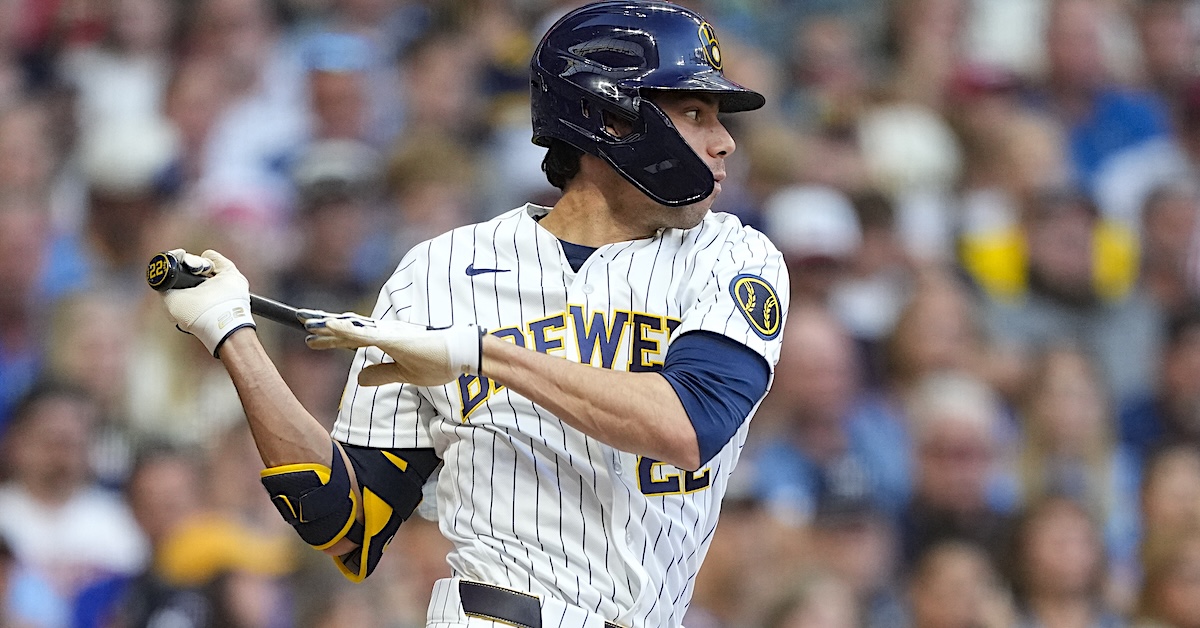
Jeff Hanisch-Imagn Images If you want to understand the history of the Milwaukee Brewers over the past 15 years, you could do worse than the following graph. In January 2018, the Brewers traded four talented prospects to the Marlins for Christian Yelich. Three of those players were athletic up-the-middle guys with power potential but serious questions about their hit tools. None of them panned out. Yelich, who had been a supporting player on some indifferent Marlins teams, took to the Juiced Ball era like a duck to water. In the first two seasons after the trade he won two batting titles, hit a total of 80 home runs, and finished first and second in the MVP voting. This is going to go down as one of the most important trades of the 21st century, and not just because the Brewers won the deal so comprehensively. The addition of Yelich spurred (or at least coincided with) an era in which the Brewers went from a forgettable relic of the post-industrial Midwest to one of the National League’s most bankable playoff recidivists. In terms of heralding a sea change for a historically impoverished franchise, Yelich is like a poor man’s Frank Robinson. Perhaps a very poor man; it bears mentioning that Robinson’s tenure as an impact bat lasted longer than Yelich’s, and that his Orioles won four pennants and two World Series in his first six seasons in Baltimore. Yelich’s Brewers have won two playoff series of any kind in seven attempts, albeit in a much more extensive postseason bracket than you’d find in the 1960s. In the 2020s, Yelich has had injury problems, and as they’ve taken the nitroglycerine out of the ball, his power numbers have taken a hit as well. But Yelich has remained a crucial component of the Brewers’ offense. You Aren't a FanGraphs Member It looks like you aren't yet a FanGraphs Member (or aren't logged in). We aren't mad, just disappointed. We get it. You want to read this article. But before we let you get back to it, we'd like to point out a few of the good reasons why you should become a Member. 1. Ad Free viewing! We won't bug you with this ad, or any other. 2. Unlimited articles! Non-Members only get to read 10 free articles a month. Members never get cut off. 3. Dark mode and Classic mode! 4. Custom player page dashboards! Choose the player cards you want, in the order you want them. 5. One-click data exports! Export our projections and leaderboards for your personal projects. 6. Remove the photos on the home page! (Honestly, this doesn't sound so great to us, but some people wanted it, and we like to give our Members what they want.) 7. Even more Steamer projections! We have handedness, percentile, and context neutral projections available for Members only. 8. Get FanGraphs Walk-Off, a customized year end review! Find out exactly how you used FanGraphs this year, and how that compares to other Members. Don't be a victim of FOMO. 9. A weekly mailbag column, exclusively for Members. 10. Help support FanGraphs and our entire staff! Our Members provide us with critical resources to improve the site and deliver new features! We hope you'll consider a Membership today, for yourself or as a gift! And we realize this has been an awfully long sales pitch, so we've also removed all the other ads in this article. We didn't want to overdo it. Christian Yelich’s wRC Rank Among Brewers We’re into Year Seven of “Yelich isn’t what he used to be” takes, and for probably half of that time those takes have included some sort of vague warning about the end being nigh. And yet: Each season from 2018 to 2025, Yelich was either the Brewers’ most productive hitter by wRC (which I chose instead of wRC+ because it’s a counting stat and therefore expresses quantity as well as quality), close to it, or injured for a huge chunk of the year. Even as Milwaukee’s offensive output has waxed and waned over the years, even as the Brewers capitalized on a soft free-agent market to grab All-Stars like Cain and Grandal, and even as younger stars like Contreras and Turang have come through, Yelich has been the prime mover of the offense. Until now. This is Yelich’s first below-average offensive season of his entire career, including his time with Miami. Yelich missed time earlier this year with a groin strain, but that didn’t stop him from hitting well once he came back. In fact, his bat has gotten weaker as the year has gone on. Let’s cut his season in half — not at the All-Star break, but at the halfway point for Yelich in terms of games played. Christian Yelich’s 2026 Season, Cut in Half Time PA HR AVG OBP SLG wOBA wRC+ WAR First 42 Games 187 5 .275 .348 .431 .339 114 0.6 Last 41 Games 175 3 .183 .276 .314 .265 65 -0.6 Through August 11 Brewers manager Pat Murphy has taken notice. Up until August 3, whenever Yelich was in the starting lineup, he hit either first, third, or fourth. On August 4, Murphy batted Yelich fifth. Three days later he dropped another spot in the order, then one more the next day, to seventh. In his first eight-and-a-half seasons with the Brewers, Yelich made just two starts hitting lower than fourth. He made seven such starts in an eight-game span from August 4 to August 11, including his first starts in the no. 6 and 7 positions since 2015. What’s actually going on is a bit of a good news/bad news situation. The good news is that, if anything, Yelich’s underlying performance has actually gotten better, even as his numbers have gotten worse. Christian Yelich’s 2026 Peripherals, Cut in Half Plate Discipline and Swing Data Time BB% K% O-Swing% Z-Contact% BatSpd FastSw% First 42 Games 9.6% 28.9% 22.6% 79.2% 72.8 28.5% Last 41 Games 9.7% 25.7% 25.2% 85.1% 73.1 31.3% Batted Ball Time BABIP GB/FB Barrel% HardHit% xwOBA EV90 First 42 Games .376 2.21 7.0% 39.5% .297 104.7 Last 41 Games .236 1.97 11.8% 43.6% .303 104.3 Through August 11 He’s making more contact, striking out less, hitting the ball in the air more. The difference between Yelich’s early numbers and later numbers appears to be the result of a massive BABIP heater, followed by an equally massive BABIP cold spell. This is one of those rare situations where a player regresses to the mean all at once. The bad news is that Yelich’s baseline this year has been poor. The Statcast-derived expected stats don’t always line up with a player’s performance, and you’d expect Yelich — with his reputation as a low-trajectory line drive autocannon — to be an outlier here as well. Not really. Since xwOBA came out in 2015, Yelich’s xwOBA is only two points higher than his wOBA. If you want to cut down the sample just to the years in which Yelich was the Brewers’ offensive talisman — 2018 to 2025 — the margin goes the other way, but the difference is still only two points. The biggest single-season deviation between Yelich’s wOBA and xwOBA, in either direction, is just 31 points, and that came in a 58-game 2020 season. If you only take seasons in which Yelich played 100 or more games, the biggest difference is 16 points. This year, Yelich is running a .303 wOBA and a .300 xwOBA. As of Wednesday morning, there are 253 players with at least 250 plate appearances this year; of those, Yelich is 191st in wOBA and 194th in xwOBA. He’s not the only hitter who’s having a rough time this year; Yelich’s neighbors on the leaderboard this season include Trea Turner, Mookie Betts, and Gunnar Henderson. Ordinarily those guys would all be up at the other end. The emergence of Turang and Jackson Chourio as impact hitters, as well as the unexpected mid-career transformations of Jake Bauers and Andrew Vaughn, could scarcely have come at a better time, then. Yelich still has good plate discipline. He’ll take a walk and make plenty of contact. He’s a smart player, and he still runs pretty well for a 34-year-old corner outfielder whose back has been bothering him since he was hitting in front of Travis Shaw and Eric Thames. But Yelich can no longer carry Milwaukee’s offensive load all on his own. It’s time for someone else to pick up that burden.
The Old Man’s Christian Yelich Association
Full Article
Original Source
Read the full article at Blogs →KhanList aggregates and links to publicly available news content. We do not host full articles from third-party sources. Always verify important information with original sources.