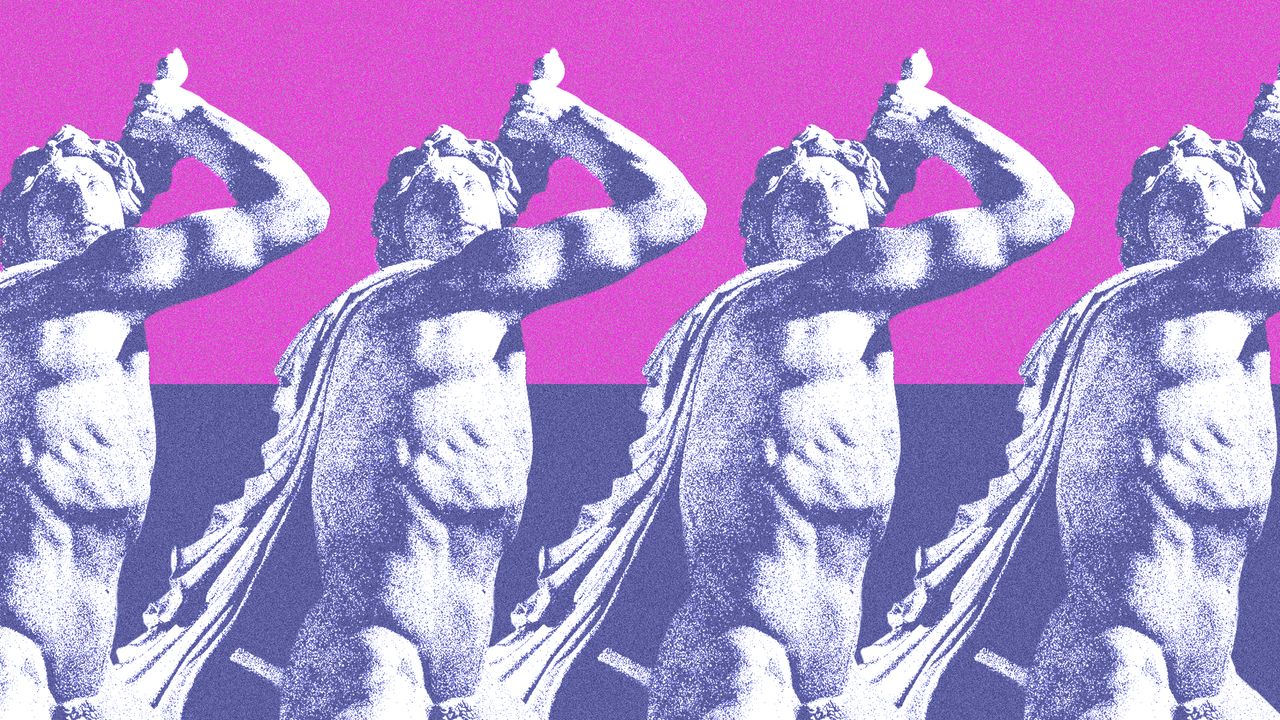
Christopher Nolan’s The Odyssey throws up a lot of weighty and profound questions. Were all ancient Greeks as jacked as Matt Damon? Did every guy really have a beard? What the hell kind of grooming routines were they into? And why is the film so light on sex?For answers, we spoke to classicist Honor Cargill-Martin. Cargill-Martin has published a biography of the ancient Roman empress Messalina and writes on her Substack and elsewhere about the parallels between the ancient and modern worlds.It turns out that ancient Greek men were just as into looking good as we are, and were confronted with nearly as many depictions of unattainable male bodies as the average Instagram feed. Read on to learn about the classical world’s cardio-heavy fitness culture, how male grooming was a deeply social act, and why Damon should probably have had a much lusher head of hair.Take us back to ancient Greece and the times when The Odyssey was written. What was the masculine ideal?The ancient concept of masculinity is super bound up with control: control over other people, but also control over yourself. There is much less of a separation than we have today between your mental capacity, your physical capacity and your moral character. Your ability to train and develop your body was an expression of inner strength. If you’re going to war, [getting] your body in shape is also a necessary feature of being a man.Also, physical beauty is seen as an expression of the connection between the human and divine. We see a lot of these [stone sculptures] called kouroi—very beautiful, young, athletic male figures with the musculature really picked out, quite unnaturally so. It’s seen as this respect for divinity, because you’re bringing the human body as close as it [can go] in perfection.In the film, Matt Damon’s Odysseus is properly yoked, like a standard Hollywood action hero. Would an ancient Greek have been able to get anywhere near that physique?The type of athletics they’re doing is very functional. There’s lots of running, but also discus, javelin, and these decathlon-style things. So there’s probably quite a bit of emphasis on overall strength; a big emphasis on running, but a lot of it is sprints. But they understand there are different body types. There are ideals for younger men, where obviously they’re slimmer, and then older men in their prime [who] are depicted with broader shoulders and much more developed musculature.So even in the ancient world, people were confronted with unattainable bodies.The poor young Greek boys looking at these statues—unrealistic body standards! Certainly by the classical Greek period, if you are a nobleman, you are expected to spend a good deal of your day at the palaestra, which is the public exercise ground. Exercise is worked into your daily life and also your social life. You see that a bit in the Odyssey; there are a lot of games.Showing off how fit you are in public—sounds familiar…I see a lot on Instagram [of] this almost monastic thing: “I get up at 5am before anyone else is up, and I go work out, and I’m doing it for myself.” Whereas in Ancient Greece, there’s this expectation that what we might now call self-care—exercise, but also grooming—is an essentially social act.What did that grooming involve?In the Odyssey, whenever someone goes to someone else’s house and is received as a guest, the first Homer mentions every single time is [that] they are bathed, anointed with oil and dressed. That is done for them by their hosts, and it is this symbol of their acceptance and integration into this temporary home. It strikes us as odd: that these intimate, bodily, everyday things— that we would never not do for ourselves, unless old or ill—are social acts.Greeks were very concerned with cleanliness and scent. A lot of cities put emphasis on having good water supplies. After people exercise, they are essentially rubbed down with these copper instruments—almost exfoliated—and then have these perfumed oils [put on them]. Even in the time Homer is writing about, this perfuming of the body is super important. We also have razors going right far back, so we know they’re grooming their beard, or shaving them in certain instances.Was there any sense that grooming was more for women than men?Way less than today. There’s no sense this is unmanly; quite the opposite—preparing your body in the correct way is a necessary part of masculinity. In the Odyssey itself, I think there are more scenes of men grooming themselves than of women.People tend to think of buff marble statues when they think of ancient Greece. What role did they play in all of this?In the development of Greek sculpture, the ideal body actually changes at a couple of points. The first great classical sculptor creates something called the canon, which is essentially the ideal proportions of the perfect male body. That then alters with fashion in the same way body types change with fashion today. So a little later you get another sculptor who does slightly effeminate male bodies. They’re much longer; they’re more languid; they’re softer. Then there’s another one who kind of brings back the old style, but with different proportions.Let’s talk about beards—they’re everywhere in The Odyssey. Did all men in Ancient Greece have them, or is that a myth?Within the Odyssey itself, there’s this real association of beards with adult masculinity. There’s this amazing line where Odysseus says to Penelope, “Don’t leave my house until [my son] Telemachus has got his first beard. Then you’re free.” The growth of the beard corresponds precisely to a man’s assumption of the adult male role in society. When Odysseus is transformed into a beggar, all his hair is removed. And then when Athena transforms him back into his real form, one of the things Homer emphasizes is the regrowth of his beard. But there’s much more variation in when people are clean shaven and when people have beards in actual [history]—certainly for the earlier Mycenaean period.What about hair length? Damon's is pretty short in the film.That seems to be something that varies quite a lot with fashion. With the Archaic kouroi, they’re generally clean-shaven, because they’re youths. But they have this long flowing hair—clearly incredibly well kept, essentially in ringlets. There’s a line in the Odyssey where Athena talks about Odysseus’s very lush head of chestnut hair. But it’s hard for us to tell—does that mean long or does that mean thick?There are a lot of bare arms and legs with the film’s costumes— even in wintry scenes. Surely people would wrap up a bit warmer?Layering is a massive part of ancient dressing—there are always tunics and cloaks over things— because you don’t want to have a wardrobe that’s totally different for different parts of the year. When [Odysseus] goes to Cerci’s palace, after she’s kindly returned his men to human form, she has her nymphs bathe them, oil them, and then dress them in “fleeced cloaks and fleeced shirts”. I love the idea of a fleeced shirt—that sounds so comfortable!There’s a suspicious lack of sex in the film. Does that reflect the source material, and the ancient Greeks’ attitude to sexuality in general?There aren’t a great number of sex scenes [in the poem]. It really is quite concentrated: when he’s on Calypso’s island, when he’s on Cerci’s island, and then when he comes home to Penelope. [In general] there’s this incredibly clear separation between sexual relationships which are for pleasure with unmarriable partners—men, foreigners, slave girls, high-class courtesans—and relationships with your wife. The issue only comes in when those two categories start interfering with one another. A lot of Odysseus’s reticence with Calypso is not to do with the sexual element of the relationship, [but] because Calypso wants him to become her husband and stay on her island.The Odyssey is a remarkably heterosexual poem for ancient Greece—almost oddly so. I think in part that’s because this is a story about the restoration of a man’s household, and homosexuality is obviously not part of that side of Greek life. Whereas homosexuality was very integrated into the military side of Greek life—quite explicitly and formally so.So we can let Nolan off the hook on this one.I think so. [But] he could have played with it a bit more.This story originally appeared in British GQ.
‘The Odyssey’ Needed Way More Body Oil
Full Article
Original Source
Read the full article at Gq →KhanList aggregates and links to publicly available news content. We do not host full articles from third-party sources. Always verify important information with original sources.