
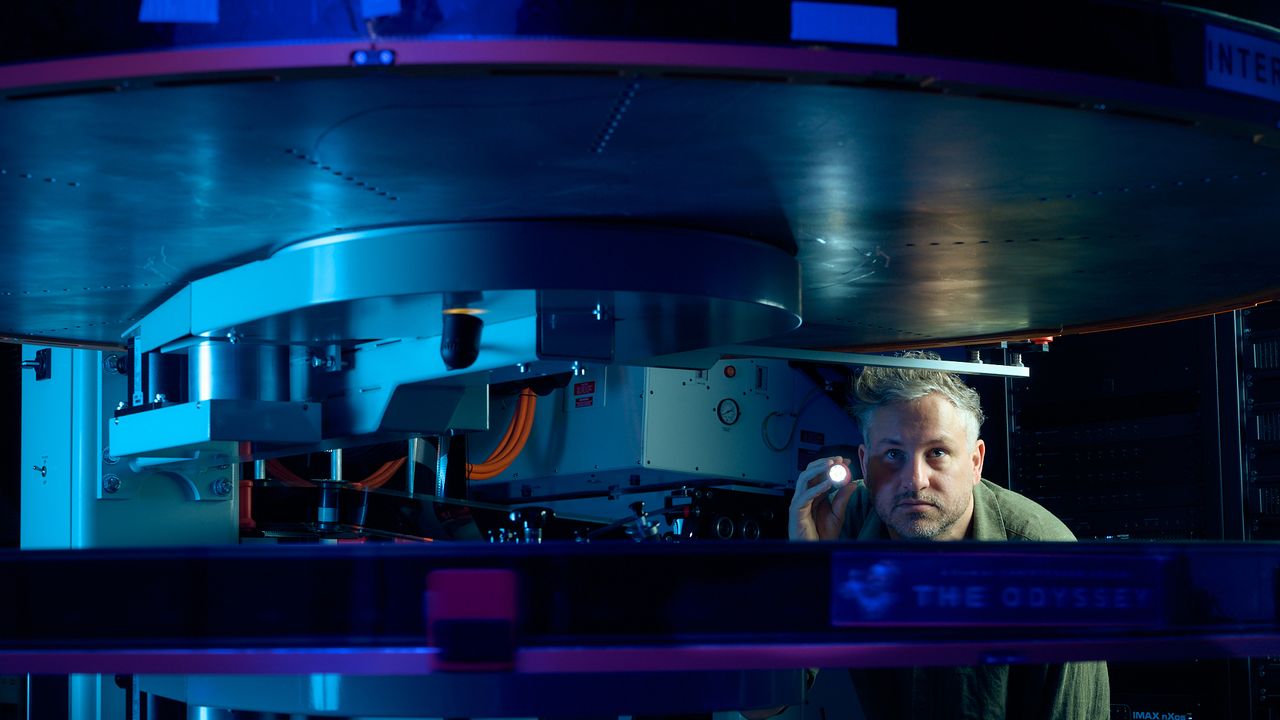
To show Christopher Nolan's Olympian blockbuster in he hottest film format of the moment, theaters rely on old-school technology—including a PalmPilot or two.Dan Drobik, Technical Manager at IMAX Melbourne at the Melbourne Museum, one of the few theaters in the world showing The Odyssey in true 70mm IMAX.Eugene HylandTo read GQ's cover story on the making of Christopher Nolan's The Odyssey, click here.There’s something uniquely satisfying about sitting in a movie theater and hearing the sound of a film projector sputtering to life. It was once a common experience—basically all movies were screened on film before the advent of digital projection in the late-‘00s—but these days, film projection has become a boutique operation, the domain of rep houses.Some filmmakers, though, have been intent on keeping the practice alive, with limited numbers of new 35mm and 70mm prints now regularly being struck for releases as varied as The Brutalist, Marty Supreme, and The Invite. Among film formats, the Rolls-Royce, the cream of the crop, is IMAX 70mm. Christopher Nolan, who pioneered the use of IMAX film cameras for narrative features on The Dark Knight, has been the format’s biggest booster for close to 20 years now, and with The Odyssey, he’s finally achieved his dream of shooting a movie entirely in IMAX. Actually seeing the movie projected on IMAX 70mm is a rare treat, though.There are currently only 25 theaters in the United States (and only around 45 total in the world) equipped to show the movie in true IMAX 70mm. The scarcity is in part because, as many have recently learned, IMAX isn’t in the business of building more of those old projectors. And keeping those machines running is a big job.Eugene Hyland“We've still got the exact same enormous GT film projector from 1998,” says Dan Drobik, Technical Manager at IMAX Melbourne at the Melbourne Museum. Indeed, IMAX fans in Australia have the release of Nolan’s 2017 blockbuster Dunkirk to thank for the projector being operational at all. “In 2015 we actually decommissioned the projector,” Drobik recalls, explaining that the theater had replaced it with IMAX’s 4K dual-laser system, designed as the digital alternative to the full-size IMAX 70mm experience. The film projector was broken down and put in storage. “Because we're part of the museum, I think the intention was to basically put it on display at some point,” he says.Two years later, when Nolan was releasing Dunkirk, he wanted as many theaters as possible to show it on film, so the projector was taken out of storage and rebuilt by Dave Booty, the former general manager who had overseen the projector’s original installation nearly 20 years prior. Drobik describes it as putting Lego pieces back together, “because it's unlike digital—it’s just physical chunks of machinery.”For those uninitiated in the world of IMAX film: The key thing to understand is everything about it is big. The strip of film that runs through the projector is 70 milimeters wide, and unlike standard projection—in which the film is pulled down vertically through the gate in between a bulb and lens—IMAX film runs horizontally. This means the surface area of film being projected is substantially larger than any other film format available, producing very bright, extremely sharp images of essentially unrivalled quality. The film also has a unique aspect ratio of 1.43:1, a square-ish ratio that’s a good deal taller than typical 1.85:1 or 2.39:1 widescreen ratios, which makes for an incredibly immersive experience on a giant IMAX screen, where the image fills up most of your peripheral vision. To pull all this off, the projectors need to be big and powerful, but also gentle and precise, in order to keep the fragile film from being scratched or breaking.Eugene HylandAs with any large, mechanical machine, IMAX projectors run better the more they’re run. “We've been running so much film,” says Michael Ford, head projectionist at BFI IMAX in London. “But if you don't use it for any length of time, that's when it's sort of like you get problems.” It may sound counterintuitive, but like a classic car, keeping the projector running also means maintenance is regular and problems are caught as they go, rather than building up over time as the machine collects dust. Like IMAX Melbourne, the BFI screens film prints quite regularly. Both theaters have the storage space to keep prints of films like Interstellar on-site for regular, sold out revival screenings.At more traditional multiplexes, including some of the locations where projectors have been newly rebuilt and installed for the release of The Odyssey, firing up the equipment again can come with plenty of issues. One of the most common problem areas, even for the BFI and Melbourne, is the projector’s water cooling system, used to keep the extraordinarily bright xenon bulb at an acceptable temperature. Tubing wears out over time, particularly if coolant isn’t being regularly pumped through it, causing leaks and other failures.“I know of instances where we've burst a leak during a show,” Drobik says. The projectionist had to manually work the water system for the entire length of the film, before managing to fix the leak in the 20-minute break between shows. “He's sitting there completely soaked, pouring water for three hours straight,” Drobik says. “But the people in the cinema are none the wiser.” What happens when the cooling system fails? “We had a lamp explode once,” Ford recalls. “That was quite horrendous. The noise it made was just like… Yeah, I don't want to hear that ever again.”The biggest concern when it comes to the maintenance of IMAX projectors is the scarcity of parts. It’s not just that IMAX has stopped manufacturing projectors, but many of their subcontractors have closed shop as well. The platter system, which holds the massive IMAX film reels and feeds them with computer-calibrated precision into the projector, was built by a German company that doesn’t make them anymore. “IMAX bought all the supplies off them that they could,” Drobik explains. “But it means there's a sort of finite supply of some of these things, until they reinvest in that technology. IMAX does a fantastic job of keeping these incredibly old systems alive, but at the same time there is this sort of endpoint.”Replacing electronic components is often the most difficult task, particularly when systems are built to run on antiquated software. Those German-built platters, for example, were originally controlled by off-the-shelf PalmPilot PDAs which haven’t been made in two decades. The solution was to use an iPad running an emulation of the PalmPilot software—though Drobik says he still keeps two ancient PalmPilots charged and ready to go should the iPad fail. IMAX has also recently been replacing its old digital audio controller, which syncs high quality digital sound to the film running through the projector, and until now was still running on Windows XP. Ford says the new system is both more user friendly, and it’s expandable. Despite the industry moving toward new multi-channel audio formats like Dolby Atmos, Christopher Nolan has been steadfast in mixing his films for the six channels available to him on IMAX film. With the new system, he could presumably take advantage of IMAX’s more advanced 12-channel audio.Of course, maintenance isn’t only just new inventions and replacing busted parts. Every morning, Ford, Drobik and their colleagues check their projectors thoroughly, making sure they’re as clean as possible, both to protect the projector and the film running through it from scratches, dust, and other imperfections in the presentation. Film projection doesn’t require the same kind of recalibration common with digital projectors, but IMAX projectionists still regularly run test strips with holes poked through them in order to assess brightness levels and make sure focus is as sharp as possible.Eugene HylandIt’s becoming easier, lately, to keep those procedures active, thanks to Nolan films like Oppenheimer and The Odyssey—currently sold out at IMAX Melbourne all the way to Sept. 6—but also a string of recent IMAX 70mm releases capitalizing on audience interest. Dune Part Two, Sinners, One Battle After Another, and Project Hail Mary have all played to packed crowds itching for IMAX 70mm even when the movie itself was shot digitally (the less said about Joker: Follie à Deux the better). Dune Part Three, which features footage shot on IMAX film cameras, will no doubt continue the trend late this year. And the audiences aren’t just boomers nostalgic for the days of film, either. “Some people have never seen film projected,” Ford says, noting that many young movie fans grew up after film projection had died out in the early-‘10s. “I suppose it's curiosity to see what it's like.” Ford even fields complaints from some of those patrons, particularly about the flicker produced by the shutter. But the complaints are few and far between.“There's something really magical about just the movement of it,” Dobrik says. “That it isn't so perfect, that it isn't so flawless. And I think particularly in this day and age, when everything's so crisp and clear-cut, and we're all sitting in our phones, and technology's reaching this sort of perfect apex, you go, ‘Well, something’s sort of lost by that.” Particularly with Christopher Nolan’s films, which are still produced photochemically, with film prints struck directly off the original negative, film projection also creates a more tangible connection to the work of art. Dobrik points out a scene between Menelaus (Jon Bernthal) and Telemachus (Tom Holland) in The Odyssey in which he noticed a black horizontal line near the bottom of the screen. It turns out, every other projectionist he’s spoken to around the world has noticed the same thing, meaning it was likely a scratch on the negative itself. A scar of the production, visible on the giant screen.“When you see something like this, knowing there's the little scratch on the film, or maybe a bit of dust blows across the screen, and knowing there's someone up there, and you're all sitting there, not on your phones, with 500 people in a cinema, having that shared experience, seeing something real and raw that is just lit by a huge lamp while celluloid flies past the screen, is really magical,” Dobrik says. “You can't really capture that.” Ford agrees. “There is definitely an interest in film,” he says. “And part of me thinks people didn't know what they had. I suppose it's like a steam engine, isn't it? They're not practical, but everybody likes to see them running.”Director Christopher Nolan and cinematographer Hoyte van Hoytema shooting The Odyssey in IMAX 70mm.Universal/Everett CollectionWith interest in IMAX 70mm only growing, and screenings of The Odyssey sold out for weeks, the question is whether that experience will become more common, and more available to people in more locations. The company has already made clear that any future expansion will be limited, but both IMAX Melbourne and BFI IMAX are able and excited to keep screening the format as long as they can manage, hopefully for many decades to come. There may only be 41 screens currently capable of screening The Odyssey in its director’s preferred format, but the future of IMAX 70mm is looking bright nonetheless—and the growing appeal of the format also means more young people are looking to get trained in the art of IMAX projection and pick up the mantle.“I’m very lucky,” Ford says. “We’ve got a really young team and they pick it up so, so quickly. They're probably better at it than I am now—but I better not say that to them.”
‘The Odyssey’ Can't Be Screened in 70mm IMAX Without These Ancient Projectors. Here's What it Takes to Keep Them Running
Full Article
Original Source
Read the full article at Gq →KhanList aggregates and links to publicly available news content. We do not host full articles from third-party sources. Always verify important information with original sources.