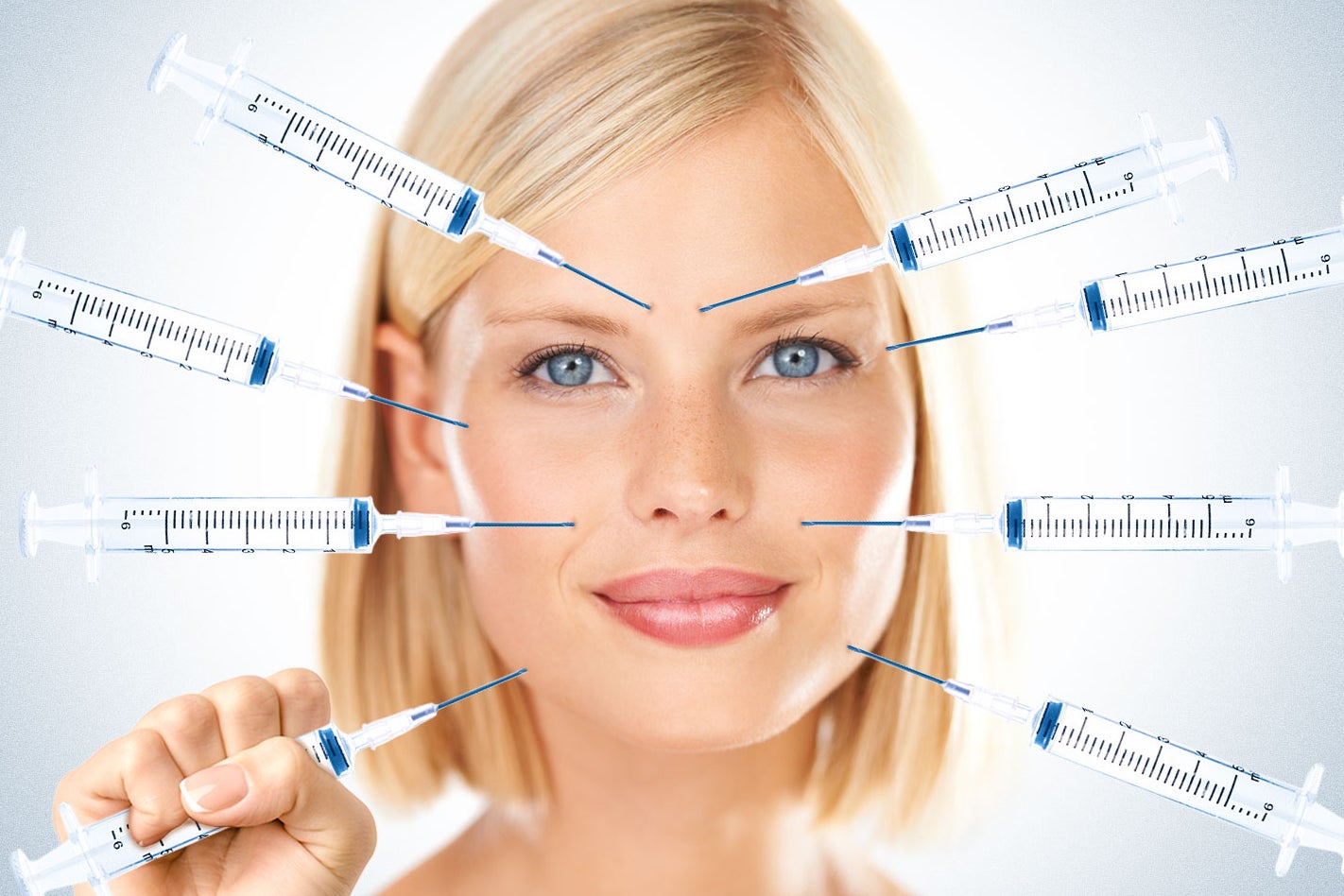
Life DIY Injections Are Dangerous and Illegal. That’s Not Stopping Some People From Doing Them—or Hawking Them. Want illegally shipped cosmetics? Use this code at checkout! Photo illustration by Slate. Photos by Getty Images Plus. Sign up for the Slatest to get the most insightful analysis, criticism, and advice out there, delivered to your inbox daily. Nikki Mayne is focused as she stares off-camera, her forehead and neck dotted with orange ink. In her hand is a syringe containing a Botox-like neurotoxin she’s purchased online, from South Korea. After a lengthy disclaimer about how this is not a tutorial, she prepares and self-injects the cosmetic. “I am so excited today to do some Botox,” Mayne, who was then 58, says at the beginning of the 45-minute video she posted to the video-sharing platform Rumble. (She later clarifies she’s actually using a similar South Korean product called Rentox.) “I’m due.” The self-described DIY rebel skincare influencer from Southern California is treating wrinkles and sagging skin: “bunny lines,” she says, or wrinkles around the nose, as well as the lines on the front of her neck. The structure is typical of Mayne’s online catalog: The full procedure, step-by-step from applying numbing cream to premarking her intended injection spots to the injections themselves, is available for anyone to watch. A custom discount code for AceCosm, the website where she purchased this neurotoxin, is also advertised in the video’s description. Mayne, who declined an interview with Slate, is part of a coterie of creators vlogging their self-injection of botulinum toxins, dermal fillers, and other supposedly restricted cosmetics. In the U.S., these products, because of their risks, are accessible only to licensed medical professionals. Yet despite these regulations, websites, most claiming to be based in South Korea, exist to sell these beauty pharmaceuticals—including ones not approved by the Food and Drug Administration—to anyone. That access has fostered a movement. Known by names like DIY Beauty, DIY Tox, and DIY Aesthetics, enthusiasts of all ages and training levels have begun experimenting with Botox and fillers in their own homes. On platforms like Reddit and Telegram, thousands have sought advice and uploaded their transformations. This momentum has also nurtured influencers who share DIY Beauty tips and journeys with their digital audiences. In a video posted on TikTok in July, Jayme Bykowski, an aesthetician and DIY Beauty creator from Nevada, shares her haul from Meamo, another website selling these restricted cosmetics, with her nearly 265,000 followers. (Bykowski didn’t respond to attempts to reach her for this article.) The massive interest in these treatments and their relative inaffordability—the average cost of Botox in the U.S. is $435, according to the American Society of Plastic Surgeons—have combined to create a market for cheaper products, no matter the consequences. These creators are capitalizing on this popularity, some selling merchandise emblazoned with phrases like “Keep Calm and DIY,” while others, like Mayne, offer exclusive instructive content and resources like injection maps and self-published “educational” books for a fee. Creators have also partnered with the websites selling these restricted cosmetics, advertising discounts to their audiences and often receiving a commission from any sale. Shaelynn York, a Miami-based creator and business consultant, discovered DIY Beauty via TikTok, where she has almost 30,000 followers. Within a month, the 28-year-old had uploaded a clip of herself self-injecting a botulinum toxin to the platform, using a discount shared by another influencer to purchase the cosmetic. “I would say cost was my main motivation behind it,” York explained. The entire vial she purchased was roughly $93, around five times less than what a single treatment in a licensed venue had previously cost her. York, whose content historically has centered around home decorating and makeup tutorials, told Slate that DIY Beauty is “not quite the direction” she plans to go in with her social media, and she doesn’t plan to post another similar clip. Like others in the DIY Beauty space, York isn’t licensed to use botulinum toxins. Instead, she briefly did research online. She had some confidence, though. She said she purchased an FDA-approved product that other creators had also used. In Canada, where she’s originally from, she was also a massage therapist and an emergency medical technician, which afforded her a baseline knowledge of muscles and syringes. “And I know how to inject—not my face—but in that sense,” she said. Cassadi Hernandez, a beauty creator and stay-at-home mom, has self-injected lip filler for over five years. In July 2025, she uploaded her first DIY Beauty video to TikTok, where she has roughly 6,500 followers. That clip has been viewed over 1 million times. She also advertises “DIY lip filler” equipment, including syringes and numbing cream, from her Amazon storefront, where she receives commissions, while also advising commenters where she buys her filler. Yet Hernandez denies actively encouraging DIY Beauty. Her post, she points out, includes a disclaimer that reads, “you should not do this at home, it can be dangerous.” She’ll only share her sources if someone’s insistent. What happens next isn’t her responsibility. “I can’t control adults,” she said. “That’s on them if they get hurt.” Hernandez isn’t certified to inject something like lip filler; she taught herself how to do it online. Licensed injectors can still be underqualified. Doing it yourself, she claimed, has roughly the same risk as going to a professional injector: “Just because they are paid doesn’t mean they’ve been properly trained.” The suggestion that DIY Beauty is misunderstood is echoed by other creators. They claim that while their content isn’t an advertisement, it’s possible to teach yourself how to safely self-adminster these cosmetics, that the harm potential is low, and that the websites, alongside the products they hawk, are legitimate. Some also suggest attempts to stop this practice are part of a conspiracy to keep these cosmetics expensive in the U.S. Health experts disagree, stating that this practice is objectively dangerous. “It’s a very bad trend,” said Dr. Amir Hakimi, a cosmetic surgery fellow at the University of California, Irvine. “It’s extremely unsafe to be injecting yourself with, honestly, anything, but especially for cosmetic purposes, without the supervision of someone who’s trained to do so.” In his research, Hakimi has encountered patients who’ve mistakenly self-injected sunscreen, believing it to be dermal filler. Tutorials posted on TikTok and YouTube are often unreliable, research suggests. A paper co-authored by Hakimi in 2024 cites 18 cases of self-injecting harms, ranging from swelling to hearing loss and decreased blood flow. Most were mild, but severe complications can occur, he said. Dermal fillers can, if administered incorrectly, kill skin tissue and cause blindness, while botulinum toxins can, at a high enough dose, lead to botulism. Last December, New York state warned residents about DIY Beauty after 10 people nationwide were harmed across three months after self-injecting Botox purchased from unlicensed sources. These complications can arise within licensed facilities, but the risk is much lower. “The difference is that skilled injectors also know how to manage these complications,” Hakimi added. Any website selling restricted cosmetics is highly alarming, Saifuddin Ahmed, who investigates counterfeit medicines at John Hopkins University, told me. These vendors are likely operating illegally, he said, meaning there is a high risk the products being sold are either diverted, compounded, or counterfeit. Several companies, including Celmade, AceCosm, Meamo, and Filler Outlet, didn’t respond to questions from Slate. Exactly where these websites are operating is also not clear. Some, including Celmade, list addresses across multiple countries. None of that is illegal, but the clandestine nature means there’s little transparency about these websites and the products sold, Ahmed said. “It is very difficult to track.” The strength and purity of Botox and other injectables are accounted for in regulated doses. If that process is moved underground, unknowables emerge. “Who made it? How were the bacteria grown? Was the culture contaminated? How well did they purify it?” said Sabine Pellett, a bacteriologist at the University of Wisconsin in Madison who studies botulinum neurotoxins. Self-injecting these cheaper cosmetics goes well until it doesn’t, she added. “And that one time when it doesn’t, the consequences are so devastating that it’s just not an acceptable risk.” That risk has caught the attention of authorities. Last November, the FDA issued warnings to 18 websites, including AceCosm and Meamo, for selling mislabeled and unapproved botulinum toxins. The challenge is that there aren’t enough resources to investigate everything imported into the country, said Dr. Robert Califf, who served as FDA commissioner from 2016 to 2017, and 2022 to 2025. These websites also operate overseas. “This is happening outside of the areas that the regulatory system controls,” he told Slate. These efforts appear to have not impeded DIY Beauty. “Emma,” a 20-year-old college student in New York, first self-administered botulinum toxins in November. One of her handful of Filler Outlet orders was intercepted, and contained a non-FDA-approved product. All she received, she said, was a letter asking her to pay $43 in taxes, which she ignored. Eventually, her package arrived. Emma has since distanced herself from DIY Beauty, saying it’s not healthy for her. Still, DIY Beauty is finding new adherents. On Nikki Mayne’s Rumble video, one commenter wrote earlier this year that they’d self-injected a botulinum toxin for the first time. “I am so excited for you!” Mayne wrote in reply. “DIY is so empowering!” Get the best of news and politics Sign up for Slate's evening newsletter. Beauty Internet Culture Social Media TikTok
The Obsession With Botox and Filler Has Reached a Dangerous New Level
Full Article
Original Source
Read the full article at Slate →KhanList aggregates and links to publicly available news content. We do not host full articles from third-party sources. Always verify important information with original sources.