
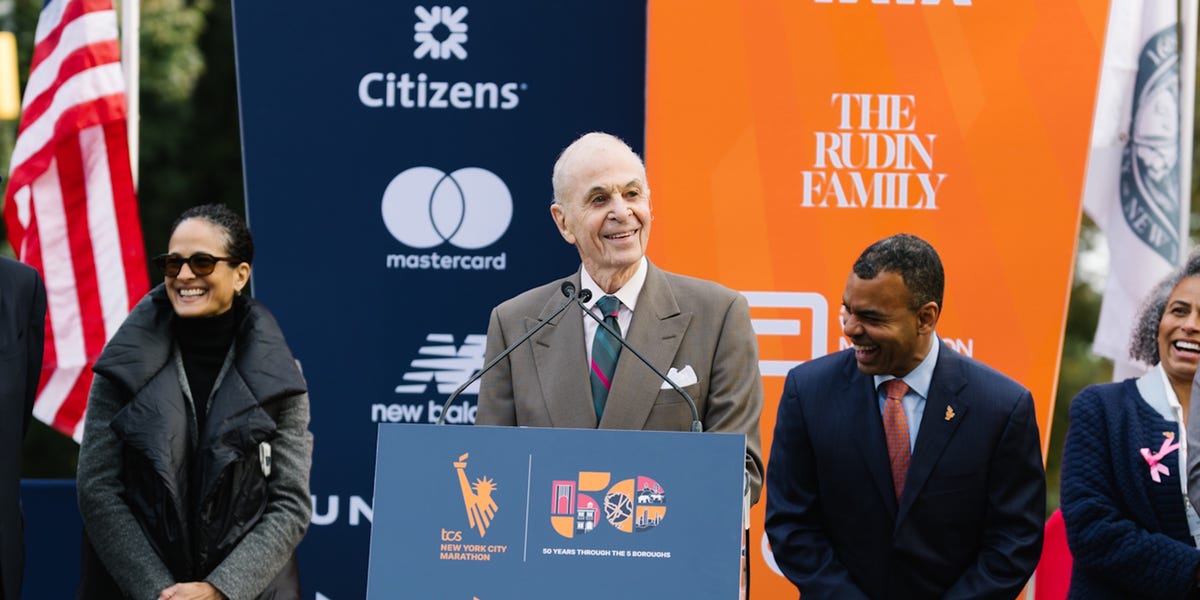
This is a milestone year for the New York City Marathon: Sunday’s race will be the 50th anniversary of the five-borough course, which was first run in 1976.From its inaugural year in 1970, the race was held in Central Park. But five men—Ted Corbitt, Fred Lebow, George Spitz, Percy Sutton, and George Hirsch—spearheaded an effort to change the course to run through each of the city’s five boroughs, starting in Staten Island and ending in Manhattan.Only one of the “trailblazers,” as the New York Road Runners calls them, is still alive. At 92, George Hirsch has seen the NYC Marathon develop from a fringe race in Central Park to the largest marathon in the world. A longtime magazine publisher (including at Runner’s World), Hirsch was the chairman of the NYRR board of directors from 2004 to 2023, and he helped generate the initial media buzz and funds for the 1976 race.In an interview in mid-October, Hirsch shared his memories of the early days of the five-borough race and reflected on how it’s evolved over a half century.A troubled cityThe mid-1970s were a tough time to live in New York City. Crime was high, the economy was struggling, and thousands of residents fled for the suburbs. The city needed a pick-me-up, according to Hirsch. When Hirsch first heard the idea for a multi-borough race from Corbitt and Spitz, his immediate thought was that it would be a massive undertaking. Bridges would need to be closed, police hired, funds raised.“Closing down a major city, the largest city in the United States, for a foot race was ambitious and it was unheard of at the time,” he said, noting that the Boston Marathon has a smaller footprint on the city proper. Still, the pioneers were able to secure the backing of the mayor, Abe Beame, although it was not pitched as a recurring event.Now, they just needed to execute their idea. “Going into the [1976 race], our little running community was super excited about this New York Marathon,” Hirsch said. “But what we had no way of knowing was how the city was going to embrace it.”New York Road Runners//Getty ImagesRunners competing in the 1976 New York City Marathon, starting in Staten Island, and finishing in Central Park on October 24, 1976.So how did it go?When Hirsch lined up on the Verrazano-Narrows Bridge in Staten Island in 1976, he was eager but a little nervous. That quickly changed, as he descended the bridge into Brooklyn.“All of a sudden, there were crowds on both sides of the street yelling and cheering,” he remembered. “Sure, the crowds were nothing like they are today. Don’t misunderstand me. But by those days’ standards, it was extraordinary. And that was the way it was for our entire run.”Courtesy George HirschHirsch (right, bib #2) pushes to the finish in Central Park at the first five-borough marathon in 1976.Hirsch ran 2:49:29 that day, placing 156th out of 1,539 finishers. Bill Rodgers won the men’s race, and Miki Gorman was the top woman. The atmosphere after the race was electric. Hirsch threw a party at his brownstone that night.“It was clearly a victory party,” he said. “There was no question. It was a big celebration. We knew it had worked … It didn’t have to work. There’s a lot of things that can go wrong. And this one, it didn’t happen. It just worked. It was terrific, and we felt really great about it.”The legacy of the marathonAfter the success of the first year, the marathon began to steadily grow, and the five-borough format was adopted permanently. By 1980, there were 12,512 finishers. A decade later, there were 23,774. The race broke 40,000 finishers in 2009, and now it’s routinely one of the largest marathons in the world. Sunday’s race could see a record 60,000 participants.Besides growing demand, marathon day in New York developed into a de facto citywide holiday. More than 2 million people spectate the race, according to NYRR, cheering on loved ones with custom signs, energetic music, and deafening cheers across the city. In many ways, the five-borough race paved the way for other urban marathons that snake through their city’s core.“I’d go so far to say it was the most important development in the history of running,” Hirsch said of the five-borough marathon. “Every city now has a marathon. It’s changed the entire idea of running worldwide. And that didn’t used to be.”New York Road Runners//Getty ImagesSpectators line the road in Central Park during the inaugural five-borough race.In his 92 years of life, Hirsch has witnessed multiple running booms, including the jogging craze of the 1970s, buoyed by Frank Shorter’s Olympic gold in the marathon at the 1972 Games. Fast forward to the present day, and we’re in the midst of another running boom. The COVID-19 pandemic spurred participation, and now, in New York and across the country, race demand has hit a fever pitch.Getting a bib for the NYC Marathon—and even smaller races organized by NYRR—has become extremely difficult. Just 1 percent of the 240,000 runners who applied for the marathon drawing were accepted for the 2026 race.“This is far and away the biggest boom,” Hirsch said. “I mean, there’s no question in my mind.”Sunday’s race will look a lot different than 1976. The race will be about 40 times larger and nearly one-third of the runners will travel in from foreign countries. Fifty years ago, Hirsch had no idea what to expect. Now he can’t stop marveling at what it has become.Find Your Next Running PlaylistTheo Kahler is the senior news editor at Runner’s World. He’s a former all-conference collegiate runner at Winthrop University, and he received his master’s degree in liberal arts studies from Wake Forest University, where he was a member of one of the top distance-running teams in the NCAA. Kahler has reported on the ground at major events such as the Paris Olympics, U.S. Olympic Trials, New York City Marathon, and Boston Marathon. He’s run 14:20 in the 5K, 1:05:37 in the half marathon, and finished 40th at the 2025 New York City Marathon. He enjoys spotting tracks from the sky on airplanes. (Look for colorful ovals around football fields.)
The NYC Marathon’s Last Living “Trailblazer” Looks Back on the Race That Changed Running
Full Article
Original Source
Read the full article at Runnersworld →KhanList aggregates and links to publicly available news content. We do not host full articles from third-party sources. Always verify important information with original sources.