
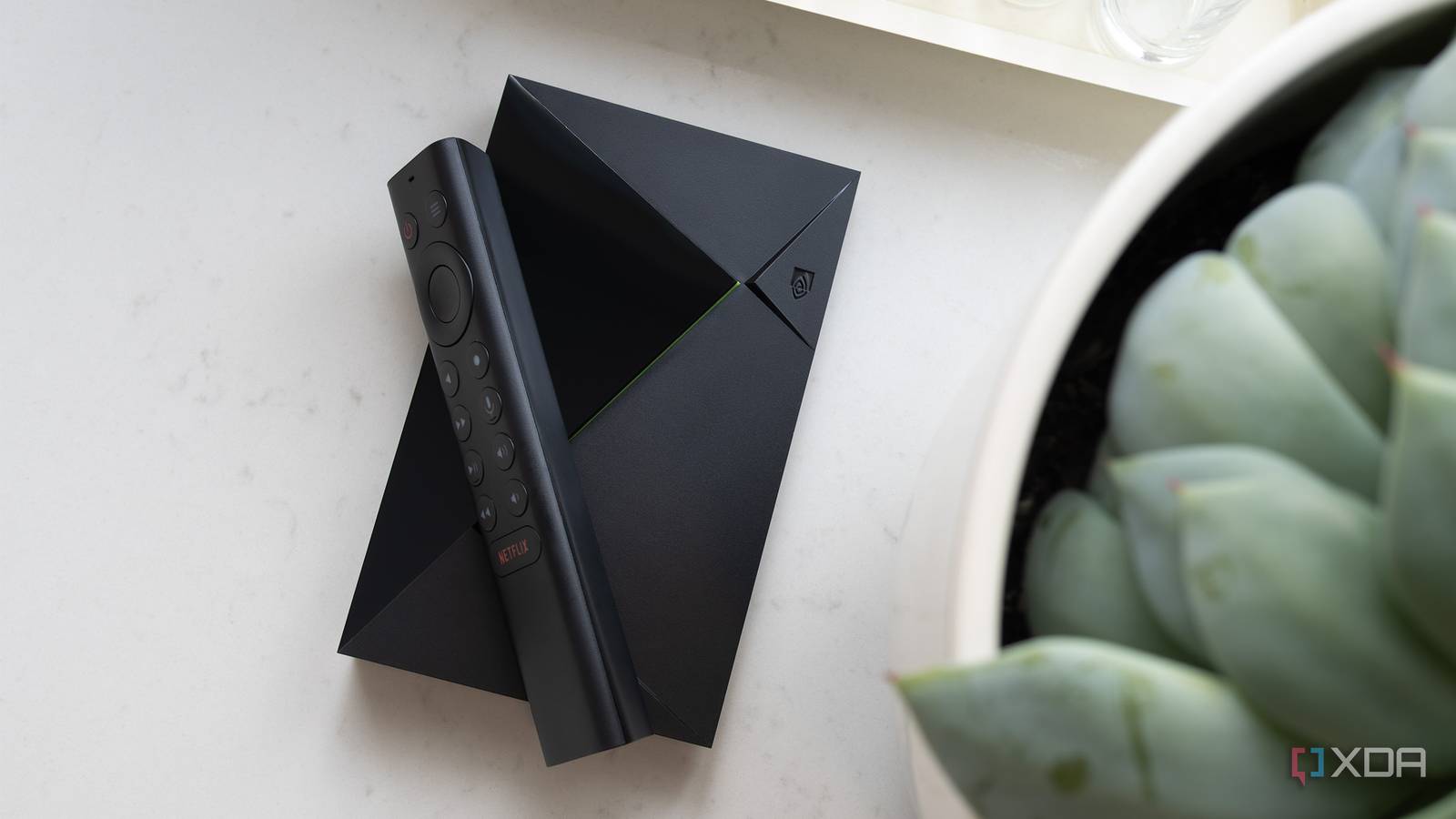
Published Sep 22, 2026, 11:30 AM EDT Anurag is an experienced journalist and author who’s been covering tech for the past 5 years, with a focus on Windows, Android, and Apple. He’s written for sites like Android Police, Neowin, Dexerto, and MakeTechEasier. Anurag’s always pumped about tech and loves getting his hands on the latest gadgets. When he's not procrastinating, you’ll probably find him catching the newest movies in theaters or scrolling through Twitter from his bed. The Nvidia Shield TV Pro debuted in early 2015 and has since received only two major hardware refreshes. The last refresh, which came in 2019, gave the TV streamer an upgraded Tegra X1+ chip, Dolby Vision, and an AI-enhanced 4K upscaler. I still use it in 2026, and while it makes the experience much faster than using the TV on its own, the Shield TV Pro is no longer the fastest. The performance you get is now comparable to a modern TV streamer, and if you use something like Apple TV 4K, you’d actually find the Shield TV Pro slower. I wanted to understand why no newer device has come along and clearly taken its place yet. Hardware is now more expensive than ever TV streamers can’t have the hardware they once had The Shield TV Pro came along at a particular moment when almost everything went right, resulting in hardware that has aged extraordinarily well. That’s why I keep calling it one of the greatest pieces of consumer hardware ever made. To understand why, it helps to look at the processor inside the Shield TV Pro. The 2019 Shield TV and Shield TV Pro use Nvidia's Tegra X1+, which is essentially a refined version of the original Tegra X1 introduced in 2015 rather than an entirely new architecture. Nvidia moved the updated chip to a 16nm process and claimed that the X1+ delivered up to 25% more performance than the Tegra X1 used in the previous Shield TV Pro. What made the Tegra X1 unusual was what Nvidia originally designed it to do. This was not a cheap processor built primarily for a streaming stick. The architecture combined ARM Cortex-A57 and Cortex-A53 CPU cores with a 256-core Maxwell GPU derived from Nvidia's desktop graphics architecture. That graphics hardware made the Tegra X1 fundamentally different from the processors that power most streaming devices. Compare that with the Google TV Streamer. Its MediaTek MT8696 processor is related to the chip Amazon used in the 2021 Fire TV Stick 4K Max. Google launched the TV Streamer in 2024, but instead of using a powerful SoC, it chose something mediocre. Put RAM into the equation, and the Shield TV Pro already starts looking almost too good to be made in 2026. The 2019 Shield TV Pro shipped with 3GB of RAM, and even mainstream streamers in 2026 barely offer that much. A better Shield TV Pro isn't what the streaming market is selling Apparently, a good product isn’t what makes them money Credit: The Shield TV Pro does things that barely matter if you only open Netflix and YouTube. It has two USB ports, Gigabit Ethernet, and support for passing Dolby TrueHD, DTS-HD, and DTS:X audio to a receiver. It can even run a Plex Media Server. If you keep your own movie library, those features are a big part of why a 2019 box is still hard to replace. Roku's annual report gives a fairly blunt explanation for why most streaming hardware goes in another direction. Roku says its operating system is designed to run on low-cost hardware, allowing it to sell devices at competitive prices. It also says it manages device prices to grow its audience and, eventually, its platform revenue. In 2025, platform services accounted for 87% of Roku's revenue, while its devices segment reported a gross loss. Roku's business benefits more from getting another household onto its platform than from selling that household an unusually powerful processor. Apple shows that a faster streamer is possible. The current Apple TV 4K has an A15 Bionic chip, but it lacks ports for external drives. It solves the speed problem without replacing everything the Shield TV Pro does for people who use it as a local media box. Nvidia hasn't replaced the Shield TV Pro either And I don’t think they can I strongly believe that recreating what Nvidia achieved with the Shield TV Pro would be much harder today. Even if Nvidia decided to make another Shield TV Pro, I suspect it would either cost considerably more or require compromises the 2015 and 2019 models didn't. Nvidia is still treating the Shield TV Pro like an active product. Its 9.2.4 update brought security patches through January 2026 and fixed a Disney+ playback issue, among other bugs. That’s remarkable support for hardware whose last refresh was in 2019, and it has helped keep the box usable while its processor has aged. Nvidia’s senior vice president of hardware engineering, Andrew Bell, told Ars Technica in January 2026 that the company had no plans to stop making or updating the Shield soon. His team has experimented with new Shield TV Pro concepts, but he didn’t announce a replacement. There are reasons. The current Shield TV Pro lacks hardware support for newer video formats such as AV1 and VP9 Profile 2, the latter of which would enable HDR playback on YouTube. Bell also pointed to HDR10+ and newer Dolby Vision profiles as priorities for a possible refresh.
The Nvidia Shield TV isn't fast anymore, so I tried to find out why nobody has actually replaced it
Full Article
Original Source
Read the full article at Xda-developers →KhanList aggregates and links to publicly available news content. We do not host full articles from third-party sources. Always verify important information with original sources.