
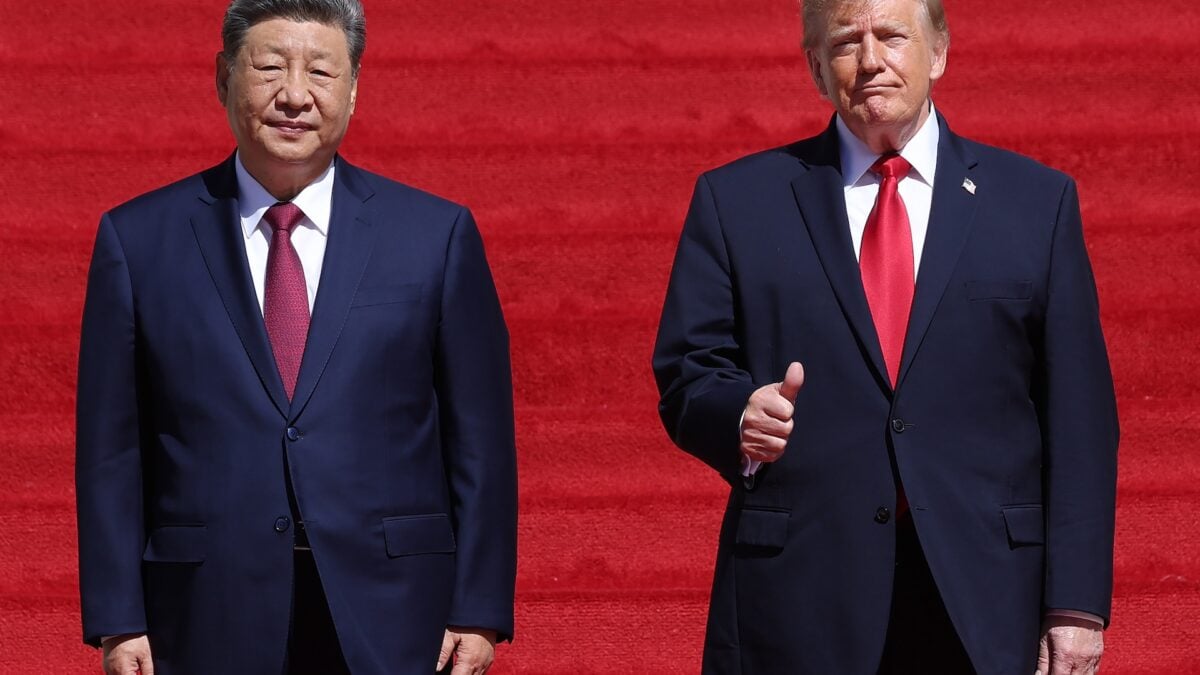
Amid the controversy of ex-Nvidia CEO Jensen Huang’s fall from grace, the Trump administration announced new rules on Monday intended to prevent China from remotely accessing embargoed Nvidia chips. But that loophole isn’t the only trick Beijing has up its sleeve for sidestepping U.S. export restrictions. According to a Tuesday report from Reuters, developers in China are getting increasingly creative in their use of distillation, a common industry practice through which new AI models are trained on the outputs of larger “teacher” models. While not technically illegal in the U.S.—OpenAI and Anthropic use it to train new versions of their proprietary models—distillation has become an intensely fraught subject in recent months amid the high-stakes AI race between the U.S. and China. Based on a review of hundreds of academic papers, patents, corporate notices, and other official documents, the Reuters report found that distillation has become a widespread practice not only within niche AI circles in China, but throughout Chinese industry writ large. Chinese government documents reviewed by Reuters reportedly encourage distillation as a means of advancing AI usage across the country—without explicitly promoting the distillation of models from American companies like OpenAI and Anthropic. Both of those companies have publicly accused leading Chinese AI labs of large-scale, illicit distillation campaigns. OpenAI’s GPT-6 Astra, released with much fanfare in September, was heavily distilled by Chinese AI firms DeepSeek and Moonshot AI in the process of developing their most recent models, according to an October report from The Information. The Trump administration has also repeatedly accused China of what it described in an April memo as “deliberate, industrial-scale campaigns to distill U.S. frontier AI systems.” Beijing has denied any wrongdoing, pointing out the ubiquity of distillation across the global AI industry and promising “resolute countermeasures” if the U.S. should use it as a pretext to try to suppress AI tools from Chinese companies. (Both OpenAI and Anthropic have vowed to crack down on illicit distillation of their AI systems, for example by making it more difficult for third parties to access a model’s full reasoning transcript.) But as the Commerce Department’s noose tightens around the so-called remote access loophole, China could turn to innovative new forms of distillation in order to maintain its competitive edge against the U.S. Just as advances in AI cybersecurity capabilities have created an arms race between defenders and black hat hackers, Chinese and American AI firms could become locked in a never-ending game of distillation cat-and-mouse, each continually trying to outwit the other. Competition breeds creativity. The new rules the Trump administration announced on Monday follow revelations in a bombshell New York Times report last month detailing Jensen Huang’s affair with a woman believed by some U.S. intelligence officials to be a Chinese intelligence asset. That woman, Alice Huang, was an executive at Megaspeed, a Singapore-based data center company currently under federal investigation for potentially diverting embargoed Nvidia chips to China. Megaspeed told CNBC over the weekend that Ms. Huang left the company in August 2025 and is no longer affiliated with the company. Meanwhile, The Information reported last week that Ms. Huang has family ties to Century Litong, a Chinese data center company which invested an undisclosed amount in DeepSeek’s latest funding round and has imported at least $7.5 billion worth of blackmarket Nvidia chips into China since 2023. It will take time for the knotty threads connecting Nvidia, Megaspeed, China, and—perhaps—the Trump administration to be untangled. Jensen Huang, who on Tuesday said in a X post that he “would be honored” to be reinstated as Nvidia’s CEO following a passionate pressure campaign from Nvidia employees and others in the tech industry, is expected to testify before the U.S. Senate Banking Committee next month. Also expected to testify is Commerce Secretary Howard Lutnick, who has reportedly been criticized by other Trump administration officials for not doing enough to prevent the illegal flow of Nvidia chips into China. Trump is scheduled to meet with his Chinese counterpart Xi Jinping in Shenzhen on Thursday, though he has intimated that he won’t be focusing the conversation much on the subject of AI.
The Nvidia Scandal Is Only Half the Story of China’s AI Workarounds
Full Article
Original Source
Read the full article at Gizmodo →KhanList aggregates and links to publicly available news content. We do not host full articles from third-party sources. Always verify important information with original sources.