
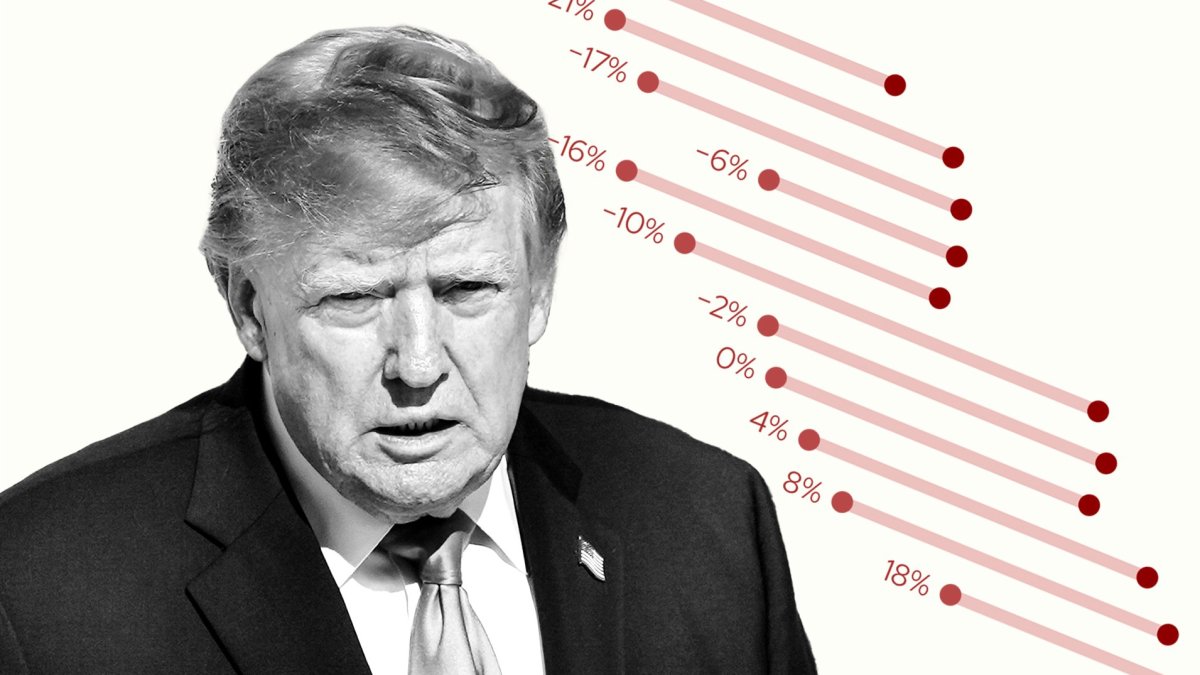
Donald Trump’s popularity has plummeted this year, as the repercussions of his war with Iran drag on, hitting his Republican Party’s chances of holding on to power in next month’s crucial midterm elections. Trump’s approval rating has fallen in every US state, but the most dramatic declines have been in parts of the country that backed him in the 2024 presidential election. As a result, Republican strategists are panicking as they try to manage the fallout and win crucial races for the House and Senate. In every key battleground state, Trump’s abysmal approval ratings seem to be harming Republican candidates, while boosting their Democrat rivals. Shorts Trump is campaigning in Tennessee, Ohio and Montana this week – all states he won comfortably in 2024 but where voters are now blaming him for the spiralling cost of living and high energy costs. In Ohio, 55 per cent of voters opted for Trump in 2024. Now, the latest polling shows 55 per cent of people in the Midwestern state disapprove of the President’s performance. His unpopularity appears to be damaging his party’s candidate in a closely fought Senate race, with the Democrat challenger, Sherrod Brown, now odds on to win and flip a seat previously held by Trump’s Vice President, JD Vance. It is the same story across much of the country with ordinary families struggling to cope with rising prices at the petrol pump and the supermarket, and many putting the blame squarely on the shoulders of the President and his policies. In Texas, Trump has dropped 27 per cent from a net positive approval rating at the start of his term to a net negative of 21 per cent, raising the possibility of a Democrat winning a state-wide election there for the first time since 1994. James Talarico is now up significantly in the polls against Ken Paxton. The extent of Trump’s desperation can be seen in his announcement of a deal with the Russian President, Vladimir Putin, last week to buy Russian diesel. The agreement, which experts say will make no difference to rising US fuel prices, is being seen as a paltry attempt to reduce economic pressures in the US at the expense of Ukraine, and to shift the blame from Trump’s war in Iran. Some Republican lawmakers have expressed their concern, referring to an explicit ban in 2022 by Congress on importing Russian energy, to prevent the US from financing Russia’s invasion of Ukraine. With postal voting now open in almost a third of states, and more opening this week, Republicans are beginning to worry that in addition to swing voters, their core voters will either stay home or vote for a Democrat. One Republican staffer told Politico that the polling outlook has “a lot of people scared to death”. Thirty-five of 100 seats in the Senate are being contested this year, with Democrats needing to make a net gain of four to take control of the upper chamber. All 435 seats in the House of Representatives are up for grabs. Trump’s Republican Party currently holds a majority in both chambers. Most analysts say that the Democrats are likely to gain control of the House. But they are now being increasingly forecast to take control of the Senate too, which the Republicans were previously expected to hold. Trump’s “number one priority now is to give Republican candidates some red meat, some positive stories to tell on the doorstep”, Christopher Pich, an associate professor in marketing at Nottingham University and expert in political branding and communications, told The i Paper. “The diesel deal is very toxic for Republicans who are divided on the issue of Ukraine, but it’s a classic out of Trump’s playbook really pushing America first,” he added. But the cost of living crisis is getting so bad in the US that changing voters’ minds about who they blame is increasingly difficult, Pich said. “When people have made up their mind to turn away from Trump, it’s very hard to win them over again.” Max Yoeli, a senior research fellow on the US and North America programme at the Chatham House think-tank in London, said that Trump’s tactics might be too little, too late. “For most voters, the economic frame going into the elections is already set,” he said. “The majority of voters would not be more likely to vote Republican even if gas prices dropped suddenly or if inflation fell dramatically.” Instead, Republican candidates need to demonstrate that they understand voters’ pain and will fight for them, even if that means taking a stand against Trump and his policies, Yoeli added. “A good example is in Ohio, where Republican Senator Jon Husted has said that the war in Iran needs to come to an end as quickly as possible so we can lower gas prices.” Husted currently trails his Democrat opponent by an average of three percentage points across polls, having been appointed to fill the seat when Vance entered the White House in January 2025. Polls can change, and Yoeli points out that Republicans still have advantages over their rivals, including more money to spend on campaign advertising. There is also the difficulty of Democrats winning in states with a long tradition of voting Republican. But the anger that Trump has successfully whipped up in his supporters throughout his political career could now be turning back on him, said Pich. “With the cost of living issues and the other problems in the US at the moment, that could be a driving force for people to rise up and make their voices heard to send a message to the President.”
The numbers that show where Trump is hurting his party the most
Full Article
Original Source
Read the full article at Inews →KhanList aggregates and links to publicly available news content. We do not host full articles from third-party sources. Always verify important information with original sources.