
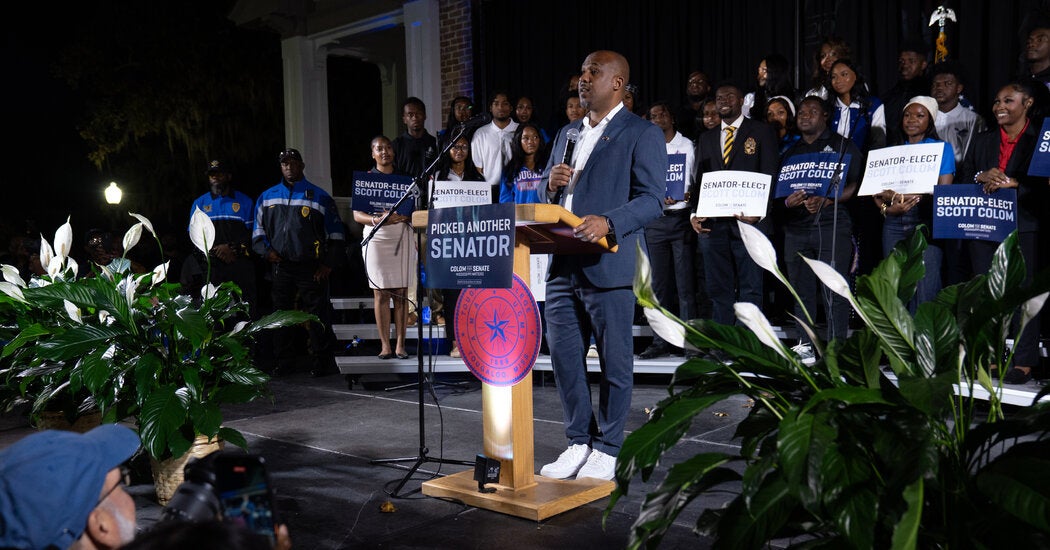
AdvertisementSKIP ADVERTISEMENTTo win a Senate seat in a highly polarized, deeply Republican state, Scott Colom needed a perfect storm. He got it.Scott Colom will be the third Black senator to represent Mississippi and the first to be elected by voters rather than the state Legislature.Credit...Rory Doyle for The New York TimesNov. 13, 2026, 5:30 p.m. ETTo pull off Mississippi’s first Democratic Senate victory in more than four decades — in a state Donald J. Trump won by nearly 23 percentage points just two years ago — Scott Colom couldn’t simply ride a shifting national mood over the finish line.A win would require high turnout among Black voters, who make up nearly 40 percent of the state’s population, and inroads with white voters. It also would not hurt if his opponent, Senator Cindy Hyde-Smith, did worse than other Republicans on the ballot, as she had in the past.In the end, he achieved all of that and more. Mr. Colom is the first Democrat elected to the Senate from Mississippi since John C. Stennis, a staunch segregationist who opposed civil rights for much of his tenure. He will also be the first Black man to hold the position since the Reconstruction era. In a year of upheaval for the Senate, Mr. Colom’s win stood above the rest as Mississippi was the reddest seat flipped by a Democrat.As in other Southern states this year, Black turnout in Mississippi was high. Voters in numerous majority-Black counties turned out at rates nearly as high as the 2024 presidential election — a remarkable achievement in a midterm. In some majority-Black neighborhoods, more voters turned out for this election than did so in 2024, even though that election featured the first Black woman presidential nominee.The Black share of the Mississippi electorate rose to 33 percent in 2026, compared with 30 percent two years ago, according to Times Voter Trends, which estimates how demographic groups voted using a variety of data sources. Black voters in the state are overwhelmingly Democratic, and 91 percent of them supported Mr. Colom. An increase of a few percentage points in the Black share of the electorate translates to large gains for the party.Mr. Colom also won an estimated 25 percent of white voters in Mississippi, no small feat in one of the most racially polarized states in the country. White voters there were more Republican than white voters in any other state in 2020 and 2024, according to Times Voter Trends, with just 16 percent of them backing Joseph R. Biden Jr. or Kamala Harris.The strongest county-level shift toward Mr. Colom occurred in DeSoto County, a suburban area near Memphis where the Black population has grown rapidly in recent years. The county backed Mr. Colom by seven percentage points, a 31-point swing from its 2024 presidential margin.Mr. Colom also did particularly well with younger voters, winning that group by 30 percentage points, according to Times Voter Trends. In a precinct near Jackson State University, the margin was extreme: Of the 376 votes reported thus far, just one was for Ms. Hyde-Smith.ImageHiram Revels was elected to the Senate by the Mississippi Legislature in 1870, becoming the first Black senator. He held the position for a little more than a year.Credit...Brady-Handy Collection, via Library of CongressImageBlanche Bruce, who was also elected to the Senate by the state’s Legislature, held the office from 1875 to 1881 and was the first Black man to preside over the chamber.Credit...Library of CongressWhile Mr. Colom will be the third Black senator from Mississippi, he is the first to be elected by voters in the state. His predecessors, Hiram Revels and Blanche Bruce, were elected by the Mississippi Legislature during Reconstruction.Mr. Revels’s path to the Senate was not easy: It took several ballots across days of voting to decide the winner. At the time, Mississippi’s population was 54 percent Black and the Legislature was about 25 percent Black. The state’s Black legislators united behind Mr. Revels, hoping that his election would be a “weakening blow against color-line prejudice,” as he later said. When Mr. Revels arrived in Washington, Democratic senators disputed the validity of his election, but the chamber voted 48 to 8 to seat him.Mr. Colom’s path was more straightforward, with a delay resulting from a very close election that could not be called until the state had accounted for outstanding mail-in and provisional ballots.For as surprising as Mr. Colom’s victory has been, it is not unheard of for a modern Democrat to be competitive in a statewide contest in Mississippi. Gov. Tate Reeves, a Republican, won by five percentage points in 2019 and only three points in 2023. The state elected a Democratic attorney general as recently as 2015. But this Senate race flew under the radar. No election forecaster rated it as closer than “likely Republican” — a fact that Mr. Colom has criticized — and not a single nonpartisan poll was conducted in the state.The ingredients for an upset, however, were there.In addition to strong turnout among Black voters and a significant shift to the left by white and younger voters, a large factor in Mr. Colom’s victory was Ms. Hyde-Smith’s continuing her history of underperforming other Republicans. Her margin of victory in the 2018 special election for Senate was 11 percentage points less than that of Roger Wicker, the other senator from Mississippi, who won his re-election bid that year. In her successful 2020 bid to retain her seat, she ran seven percentage points behind Mr. Trump’s margin, the largest gap of any incumbent Republican senator.This year, she lost to Mr. Colom by about half a percentage point, even as Republicans carried the statewide House vote by five points. She struggled the most, relative to other Republicans, in the whiter, eastern half of the state, including Oktibbeha County, home to Mississippi State University. Mr. Colom serves as district attorney there.Luke Vrotsos is an elections analyst at The New York Times.Evan Reynolds works in the Election Analytics department of The Times and is a member of the 2026-27 Times Fellowship, a program for journalists early in their careers.Related ContentAdvertisementSKIP ADVERTISEMENT
The Numbers Behind Scott Colom’s Stunning Upset in the Mississippi Senate Race
Full Article
Original Source
Read the full article at Nytimes →KhanList aggregates and links to publicly available news content. We do not host full articles from third-party sources. Always verify important information with original sources.