
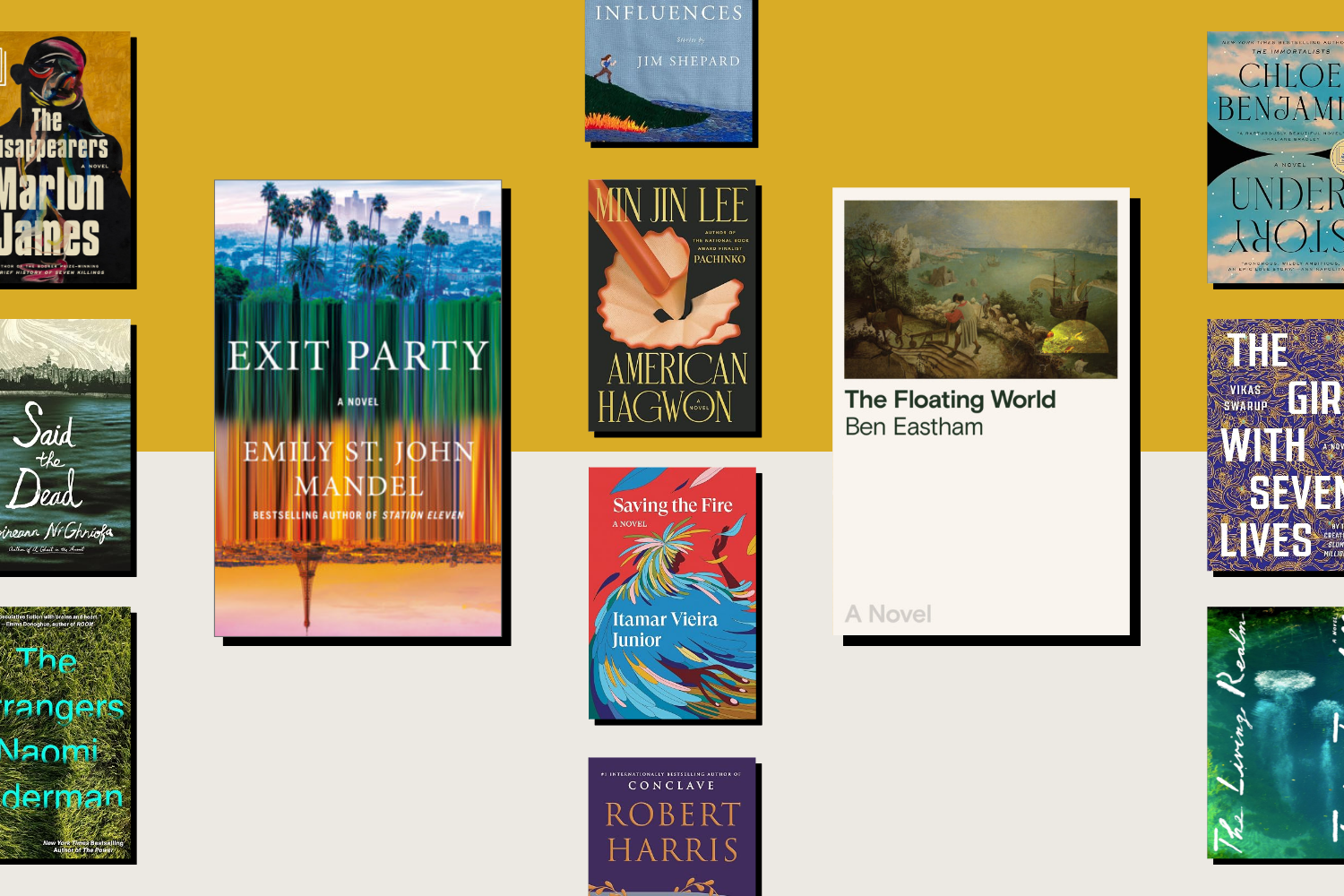
Domed cities—those classic symbols of science (and climate) fiction—make an appearance in both of the novels we’re reading this month, which transport readers to the United States after a second civil war and an eerie utopian community on a Greek island. Exit Party: A Novel Emily St. John Mandel (Knopf, 320 pp., $32, September 2026) The United States is known as a country of relentless—and sometimes naive—optimism. So it’s striking that, in recent years, serious thinkers from across the political spectrum have taken to warning of the possibility of a second civil war, or some other form of U.S. societal collapse. In a stunning new novel, Emily St. John Mandel imagines what might come after that potential rupture. Unfortunately for human civilization, Mandel—a veteran of dystopian fiction—has previously proved herself an unwitting forecaster of very real geopolitical crises. Her 2014 novel Station Eleven was set in the wake of a global pandemic. Readers flocked to it six years later, and an HBO adaptation was quick to follow. Mandel—who, I should note, is Canadian—begins Exit Party in Los Angeles in 2031, when a curfew and foreign military occupation of the city are lifted after a U.S. civil war. “The United States had come undone following a coup d’état. Several states had seceded within a week of the coup, either alone or in alliances with neighbors,” she writes. The Republic of California is now its own country, one of “multiple small nations and city-states with ever-shifting borders and countless combatants, militants battling for control across the former nation.” To mark the first curfew-free night, protagonist Ari Waker and her friends attend a party. Mandel describes the fete in painstaking detail. Only later in the story does it become clear to readers that this technical play-by-play has a function: The party—and the bizarre, inexplicable events that occur there—are the foundation for a sci-fi journey through two parallel trajectories for the former United States. Understanding what occurred at the party is essential to understanding all that follows. Although the Republic of California is comparatively stable (“and therefore unaffordable,” Mandel writes—some things never change), most of the rest of the former United States is in shambles. Abandoned Staples office supply stores have become camps for internally displaced people, whose children attend makeshift schools housed at TGI Fridays; militias set up their headquarters in erstwhile shopping malls. (Washington, D.C., locals may be interested to learn that one of the most powerful armed groups is based in Silver Spring, Maryland.) To make ends meet, Ari finds herself drawn into a criminal web dealing weapons to rival militias—a journey that eventually leads her to flee to Paris. But while European borders seem mostly intact, the continent has its own problems. “In those days France was dangerous because everywhere was dangerous,” Mandel writes. Countries seek to gird against the effects of climate change by building Simpsons-esque domes over wealthy areas, creating new classes of haves and have-nots. It is in France that Ari, through links to that party in Los Angeles—and a dose of quantum physics—discovers an alternate path for the former United States. In the totalitarian United State, surveillance ensures prosperity. Futuristic bullet trains crisscross the country, and the entire population is immunized against cancer. But democracy is a thing of the past. Secret police not dissimilar to the East German Stasi make sure that “people who broke the rules disappeared.” Each of Mandel’s make-believe futures for the United States is equally unsettling. As Ari and fellow party guests toggle between scenarios of havoc and order, clashing with and sometimes abetting authority, it becomes clear that both systems have drawbacks. “There was a world where my homeland had fractured into disarray, and another where my homeland had closed like a fist,” Ari observes. What the two versions of the United States have in common, however, is that residents are tired—of tyranny, tumult, and struggling to get by. In believing that it’s “an exhausting moment to be alive,” they are no different from their real-life compatriots in 2026. As Ari narrates: “We were Americans, which is another way of saying that chaos felt like home.”—Allison Meakem The Floating World: A Novel Ben Eastham (Astra House, 288 pp., $26, September 2026) If there is anyone well positioned to write satisfying fiction about contemporary art, it’s Ben Eastham. The co-founder of the White Review and a regular critic for the Guardian, Eastham has made a name for himself by variously decoding the art world’s relationship to its bedfellows of power and capital, and dissecting—with compassion—works of art in ways that render them accessible, anew, or otherwise worthy of attention. So it is little surprise that Eastham’s debut novel, The Floating World, is at once a humorous send-up of this rarefied but often-mocked industry and a moving meditation on morality, grief, and the miracles that art may yet offer. The premise of Eastham’s novel slots neatly into the ultrarich-on-an-island genre popularized in recent years by films such as Glass Onion and The Menu, though it perhaps owes more to The Magus, John Fowles’ 1965 masterpiece about a young Englishman enthralled by an enigmatic Greek art collector. Like Nicholas Urfe, the disillusioned yet romantic protagonist of that novel, Eastham’s unnamed narrator is a writer who arrives on a remote island in the Aegean to find himself swept up in schemes beyond his grasp, soon unable to decipher reality from artifice. This recently widowed narrator has left London for Greece to work on an immersive exhibition by a renowned artist that will inaugurate the so-called Floating World, an island community ensconced in a giant dome. A settlement was originally constructed on the island in the 1950s as a utopian community for mine workers and their families after the discovery of rare-earth deposits, only to be abandoned during an economic downturn two decades later. Now, a billionaire heir to an arms manufacturing corporation has set his sights on resurrecting the site as a climate haven. The project is described, by various characters, as a “tax haven,” the heir’s “ideal city-state,” a “doomsday bunker for billionaires,” and “a sustainable, holistic, homeostatic community for powerful people who want insurance against the end of the world.” The narrator is aware that his work amounts to propaganda for an ethically dubious project but is eager for a distraction from his grief. And while he is often critical of the art world and its excesses, he is also attuned to art’s capacity to console and delight, especially amid the great crises of our time, from inequality to humanitarian suffering to ecological catastrophe. (Incidentally, the narrator’s emotional state appears to correlate to his charitability—or lack thereof—toward the individuals and artwork he encounters. “I could overhear an artist telling the minister for National Heritage that his work resisted categorization, even though I knew his work to be categorically shit,” he recounts at one particularly low point.) Contemporary art may be the cultural expression of runaway capitalism and globalization, the narrator thinks, but hasn’t art always been entangled with economic realities, whether that took the form of Renaissance masters exalting Italian merchants or the abstract expressionists propping up the U.S. vision of free-market liberalism? The art world, like much of society, may be fallen, but that hardly makes it irredeemable. At one point, the narrator reflects on a postcard of a painting based on an Albrecht Dürer engraving: “This cheap reproduction of a picture that is preserved in a palace built on state power and spiritual corruption, painted five hundred years ago by an unremembered copyist from a copperplate engraving, is itself a miracle. It moves me in a way that I cannot rationalize away by its formal qualities … It exceeds the infrastructures by which we strive to make sense of it.”—Chloe Hadavas September Releases, in Brief Booker Prize-winning Jamaican author Marlon James returns with The Disappearers, a 640-page queer epic centered on 1980s Kingston. In Doireann Ni Ghriofa’s genre-defying Said the Dead, the archives of a storied asylum in Cork, Ireland, are brought to life. Autofiction meets sci-fi in video-game designer and novelist Naomi Alderman’s The Strangers. In the 12 stories collected in The Queen of Bad Influences, Jim Shephard finds humanity across catastrophes from 16th century Madrid to the seas of World War I. Min Jin Lee, of Pachinko fame, chronicles the impact of the 1997 Asian financial crisis on one Korean family in American Hagwon. With the fictional memoir Agrippa, historical fiction stalwart Robert Harris turns his eye toward the Emperor Augustus’ right-hand man. The long shadow of colonialism haunts a Brazilian family in Itamar Vieira Junior’s Saving the Fire, translated from the Portuguese by Johnny Lorenz. In Chloe Benjamin’s Under Story, a portal found at a scientific research base in Antarctica opens to a parallel universe. Vikas Swarup, the Indian diplomat whose debut novel inspired Slumdog Millionaire, offers up another high-stakes thriller, The Girl With Seven Lives. And Canadian playwright and novelist Jordan Tannahill’s The Living Realm doubles as a ghost story and a paean to queer Berlin.—CH
The Novel Imagining Life After a Second Civil War
Full Article
Original Source
Read the full article at Foreignpolicy →KhanList aggregates and links to publicly available news content. We do not host full articles from third-party sources. Always verify important information with original sources.