
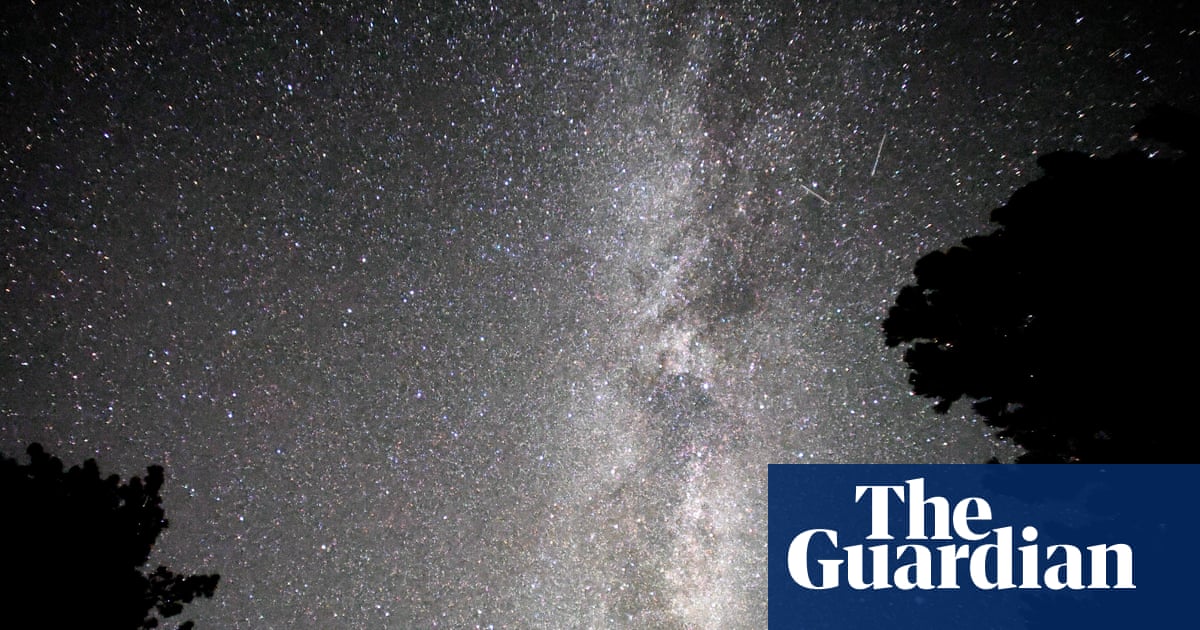
Every night, I can turn off the lights in my room – but I can’t do anything about the outdoor lights in the walkway or parking lot that leak through the curtains. Living in Portland, where the night is still illuminated by street lights, porch lights and parking lot glare, I forgot what it actually feels like to sleep in darkness.I was excited when I realized my travels to a residency in south-east Oregon would show me a sky I hadn’t experienced in decades. In the Oregon outback, part of the International Dark Sky Places network, I would be surrounded by 2.5 million acres of unpolluted night in every direction.I sent out a note to the other residents asking if anyone wanted to look at the stars with me. Everyone said yes. Thirty minutes after sunset, we trekked through the tall grass and out on to the dry lakebed. Those of us with headlamps set them on red so we wouldn’t destroy our night vision. We lay down our blankets and looked at the night sky together. There, just over the hills, was Venus. Vega shone overhead. So did numerous satellites which we could tell weren’t natural by their movement. They were so bright my eye was constantly drawn to them.As it got darker, more stars and constellations seemed to materialize: Ursa Major and minor, Cygnus, Cassiopeia. By the time the Milky Way appeared, a band of light rising out of the night, we fell silent. We saw one shooting star and then another. I lay on my blanket and looked up until I felt small.Every year, the night sky is becoming 10% brighter. Eighty per cent of people live under light polluted skies. And while the UN declared a healthy environment – clean air, clean water – to be a human right, I believe we also all have a right to darkness as well.Lights across downtown Portland, Oregon, in 2014. Photograph: Wolfgang Kaehler/LightRocket/Getty ImagesThis doesn’t mean turning off every streetlamp. But do we really need bright white floodlights at the front of every garage? Replacing lights with ones that are bright enough to do the job – and no brighter – might make it so I wouldn’t have to get in my car and drive for hours to see the night sky as it actually shines above us.To preserve the darkness would mean rules and enforcement around the warmth of the lights, where they point, and how bright they can be. It would mean not putting in three lights when one would do. If we recognized that darkness is something we need, we’d become more careful about chasing it away.Some communities have already done this. Flagstaff, Arizona, was the first city to have outdoor lighting rules, adding them in 1958. In 2001, Flagstaff became the first recognized Dark Sky City. Their rules regulate how much light can be used, what type, and where it can shine.Other cities and towns in the US and abroad have followed. New York state is now considering a Dark Skies Protection Act, which would add restrictions on outdoor lighting – including some that would affect the city that never sleeps. All it takes to preserve the night near you is the desire to protect it with a new zoning law or, perhaps, a rule for how bright car headlights can be.Access to darkness is about more than stargazing. The night is its own habitat. Artificial lights confuse animals who use the moon to navigate, whether they’re baby sea turtles navigating toward a parking lot instead of the ocean or moths who fly in circles around a lightbulb. Lightning bugs and frogs need darkness to complete their courtship rituals. Migrating birds get thrown off course by the bright lights of big cities.But the effects of light pollution linger even after it’s daylight again, becoming visible. Research has shown light pollution is breaking the relationship between plants and pollinators, changing the time of year trees break into flower, and disrupting circadian rhythms for all living creatures. This includes humans. Whether it’s artificial lights indoors or creeping in through the window at night, studies have found that we need darkness in order to rest, recover and stay healthy.People spend time in a brightly lit park in New York City, in 2026. Photograph: Selcuk Acar/Anadolu/Getty ImagesMost light pollution comes from street lights, buildings, parking lots and sports courts left lit all night but increasingly there’s a threat of light pollution coming from the sky itself. Even if the rules of the Dark Sky Sanctuary let me see the Milky Way that night on the lake, it couldn’t stop the growing number of satellites from mixing in with the starry night.Dark-friendly practices such as making sure nightlights are targeted and shielded won’t do anything about the more than 11,000 Starlink satellites currently in orbit, or a company who wants to provide artificial sunlight on demand, using satellites to illuminate areas of the Earth as large as three miles. Things we launch into space aren’t required to have an environmental review even when they affect life back on Earth.The stars hold our history. They have been maps, calendars, omens and landmarks. When it was dark, the constellations helped eons of people find their way home. Now the night sky is an attraction people travel to. In our urbanizing world, the night sky is out of reach for those who don’t have the time or resources to find it.Darkness is becoming another luxury, but it can belong to all of us again. A right to darkness doesn’t mean every city would look like the rural Oregon outback but it might make a few more stars visible after dark, let a few more creatures rest, give all of us a reason to look up again – no matter where we are.
The night sky is getting 10% brighter every year. We’re forgetting what darkness feels like
Full Article
Original Source
Read the full article at Theguardian →KhanList aggregates and links to publicly available news content. We do not host full articles from third-party sources. Always verify important information with original sources.