
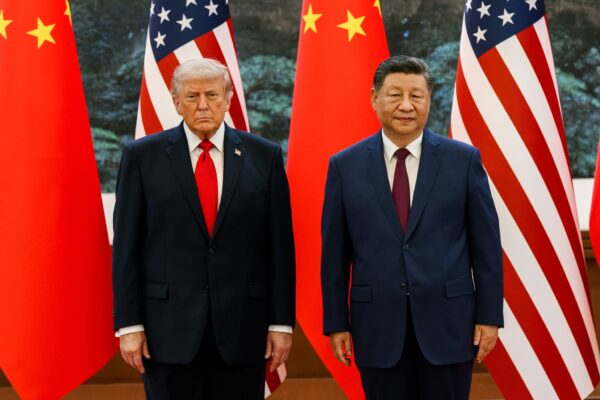
The Asia-Pacific Economic Cooperation (APEC) summit, to be held in Shenzhen, China on November 18–19, will take up the strengthening of supply chains and regional economic integration. But with tensions between the United States and China over supply networks continuing, reaching substantive agreements at a forum attended by both countries is not easy. So what can APEC accomplish amid ongoing rivalry? The question to ask is not whether the meeting can resolve U.S.-China tensions, but whether it can identify practical areas of cooperation that the region, including both the U.S. and China, can pursue together. The Next Phase for FTAAP’s 20-Year Journey One promising avenue is the Free Trade Area of the Asia-Pacific (FTAAP) concept. The idea was first raised by the APEC Business Advisory Council (ABAC) in 2004, and in 2006 leaders adopted it as a long-term vision. This year marks the 20th anniversary of that leaders’ commitment. FTAAP has not, however, come anywhere close to the stage of negotiating a single free trade agreement. It remains a long-term endeavor: building common foundations for regional economic integration while accounting for differences in institutions and capacity among economies. China has this year proposed an independent outcome document on FTAAP, and the Shenzhen meeting could offer an opportunity to move discussions forward. A direction for connecting FTAAP to practical action has already been set. The 2024 APEC Leaders’ Machu Picchu Declaration called for mapping the similarities and differences among regional free trade agreements and advancing capacity-building and information-sharing. It also identified digitalization, inclusivity, and supply chain resilience as issues to be linked to the FTAAP discussion. Discussing supply chain cooperation as groundwork for FTAAP is therefore not a departure from the existing agenda. Turning Risk Diversification into Value Creation Supply chain resilience should not be measured solely by the diversification of procurement sources and production bases. If countries each build up redundant production capacity for the same processes in preparation for supply disruptions — weakening their connections to each other’s markets and technologies in the process — the result risks rising costs and economic fragmentation. Diversification only enhances the resilience of the region as a whole when it is linked to productivity gains within the region and to the development of enterprise and human capital. To achieve this, it is necessary to make it easier to verify where and how goods are processed as they cross borders, and under which rules of origin their origin is determined. Using electronic certificates of origin and digital traceability would make it easier to cross-reference records covering everything from raw material procurement through processing and assembly. This would help address concerns that Asia serves merely as a transshipment hub for circumvention exports, by providing verifiable information. Since rules of origin vary by product and agreement, digitalization serves as a means of confirming actual production and processing activity. Institutional arrangements are also needed to enable the verification of necessary information while protecting trade secrets. For example, if not just assembly operations but also parts procurement, design and maintenance services, and skills development take root in a region, technology and employment accumulate there as well. Confirming which processes have taken root in diversified production locations — and where value is being created — is what distinguishes value-creating diversification from mere production relocation. It is not realistic for APEC to immediately establish uniform disclosure obligations across all member economies. A more practical first step would be pilot programs involving willing economies and companies, to verify the scope of shared data, verification procedures, and the protection of trade secrets, and to share the results. The Significance of Both the U.S. and China Participating The participation of both the United States and China makes reaching agreement more difficult, but it also provides a forum for discussing supply chains and trade procedures across the region, including both countries. Of course, APEC itself cannot resolve strategic rivalry. But there are areas (the use of electronic documentation, trade facilitation) where progress can be made independently of political confrontation. It is precisely when major agreements are difficult to reach that the effort to accumulate practical cooperation and connect it to future rule-making becomes important. APEC agreements are voluntary and carry no legal binding force. However, APEC can be used as a forum for countries to identify shared challenges, compare institutions, and advance capacity-building. Even incremental agreements can contribute to building the foundations that will support future regional integration. The Next Step Japan Should Demonstrate Japan can advocate for a free and predictable trade order while putting forward supply chain transparency, trustworthy data flows, and AI cooperation as concrete agenda items. Simply expressing concern about other countries’ policies will not advance regional institution-building. Japan’s role lies in supporting capacity-building that allows small and medium enterprises and economies at different stages of development to participate, and in broadening understanding and practice of common rules. A comprehensive FTAAP agreement at the Shenzhen summit under conditions of U.S.-China rivalry will be difficult to achieve. The near-term priority should be to improve supply chain transparency and digitize trade documentation, laying the groundwork for future digital mechanisms that can verify production and processing histories in accordance with rules of origin. This would be a touchstone for achieving inclusive growth: easing concerns about circumvention exports while supporting the establishment of value-added production hubs within Asia.
The Next Step for APEC in Shenzhen
Full Article
Original Source
Read the full article at Thediplomat →KhanList aggregates and links to publicly available news content. We do not host full articles from third-party sources. Always verify important information with original sources.