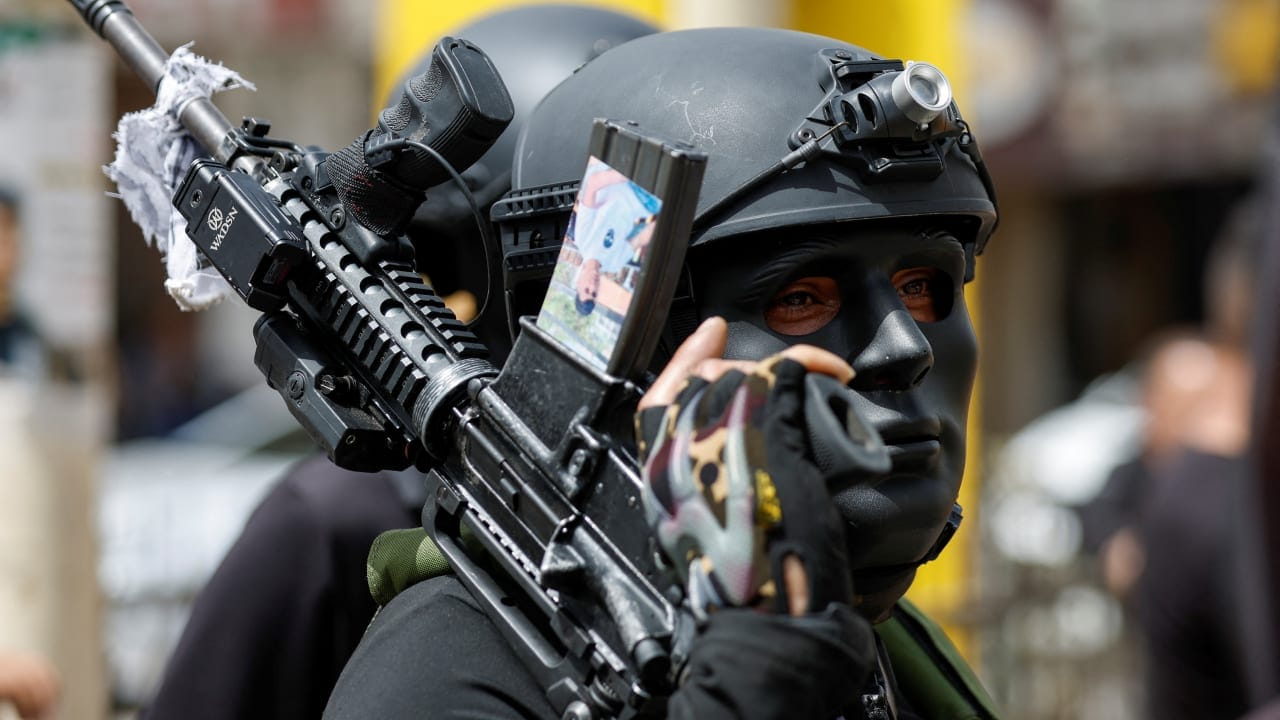
ByDAVID BEN-BASATJULY 24, 2026 18:41The October 7 massacre fundamentally changed Israel’s perception of security. What had long been viewed as an extreme scenario became a brutal and painful reality. Thousands of Hamas terrorists infiltrated communities in southern Israel, murdering residents, taking hostages, and destroying entire communities.Since then, it has become clear that Israel cannot rely on outdated assumptions or security concepts that have not been reexamined. Against this backdrop, a study by retired lieutenant-colonel and attorney Maurice Hirsch deserves particular attention. It warns of the potential threat posed by the Palestinian Authority’s security forces.The study raises serious questions. How did a limited police force, originally intended to maintain public order under the Oslo Accords, become a much larger security apparatus?Findings of the studyAccording to the study, the force now includes more than 70,000 security personnel equipped with tens of thousands of weapons. They receive training in areas including urban warfare, parachuting, diving, and other military activities.The study asks whether such a force continues to serve its original purpose or whether its growth requires Israel to reassess the threat it may pose.Palestinians take control of an Israeli tank after crossing the border fence with Israel from Khan Yunis in the southern Gaza Strip, October 7, 2023. (credit: ABED RAHIM KHATIB/FLASH90)One of the study’s most striking comparisons is with the Hamas attack on October 7. Thousands of terrorists infiltrated Israel that day. The force that penetrated the farthest reached the Ofakim area, about 22 kilometers from the Gaza Strip.By comparison, the distance from Kalkilya to Israel’s coastal plain is only about 14 km. That area includes Kfar Saba, Ra’anana, Hod Hasharon, Herzliya, industrial zones, and critical national infrastructure.The significance is clear. Central Israel has almost no strategic depth, and any unusual incident could escalate with extraordinary speed.This does not mean that the Palestinian Authority has decided to launch an attack against Israel. However, every responsible security establishment examines not only intentions but also capabilities.Intentions can change overnight. Military capabilities built over many years remain in place. This is one of the central lessons Israel has drawn from the events of October 7.Israel’s political and security leadership has also significantly changed its approach to the threat over the past year. Defense Minister Israel Katz regularly conducts security assessments and meetings concerning emerging threats in the West Bank.Lessons of October 7Learning the lessons of October 7 requires a fundamental change in thinking. For years, many believed that economic interests and security coordination would be enough to prevent escalation.Similar arguments were made about Hamas. It was said that the organization was focused on governing the Gaza Strip and was not interested in a broad confrontation. Reality proved otherwise.Therefore, even when security coordination with the Palestinian Authority continues, Israel must constantly evaluate the potential risks.A scenario in which hundreds or thousands of armed men infiltrate central Israel from the West Bank cannot be dismissed simply because it appears extreme. The role of the security establishment is to prepare even for scenarios that may be unlikely but could have devastating consequences.Should such an event occur, the response time would be extremely limited. The potential damage to civilians, transportation routes, and national infrastructure could be severe.At the same time, it is important to distinguish between a security warning and a definitive conclusion. The existence of a large security force does not, by itself, prove an intention to launch an attack.That is precisely why close intelligence oversight, continuous monitoring, and a professional assessment of force structures, weapons, and training are essential. A responsible country does not wait until a threat materializes.Israel must also continue strengthening the defense of communities along the seam line. It must expand early warning capabilities, improve physical barriers, reinforce local emergency response teams, and ensure that the IDF, police, and other security agencies can respond quickly to any scenario.There is no room for complacency in the new security reality.Hirsch’s study is not necessarily a prediction, but it raises questions that a responsible country cannot ignore. Following the national trauma of October 7, Israel has an obligation to reexamine every basic assumption, every military buildup, and every potential threat.It is better to confront a warning in time than to explain afterward why it was ignored.The most important lesson of October 7 is simple. A country cannot base its security on the hope that the other side will always choose restraint.Security is built on intelligence, preparedness, deterrence, and clear-eyed thinking. If Hirsch’s study helps ensure that decision-makers continue examining reality without outdated assumptions or illusions, it will already have played an important role in protecting the citizens of Israel.The writer is CEO of Radios 100FM, an honorary consul and deputy dean of the Consular Diplomatic Corps, president of the Israeli Radio Communications Association, and a former news monitor for Israel Army Radio and television correspondent for NBC.Follow us on Google
The next October 7 could begin in Kalkilya - opinion
Full Article
Original Source
Read the full article at Jpost →KhanList aggregates and links to publicly available news content. We do not host full articles from third-party sources. Always verify important information with original sources.