
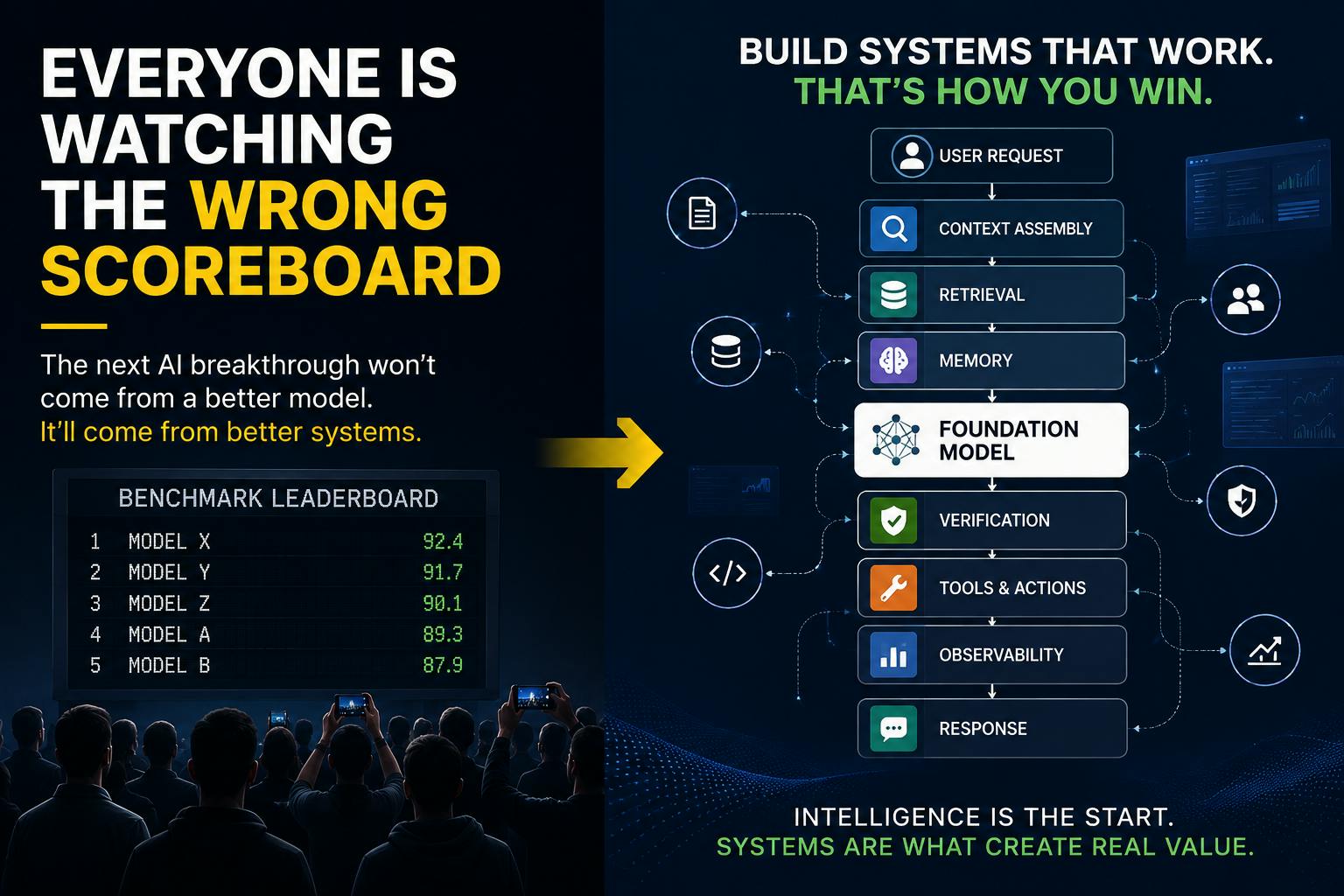
Everyone is watching the wrong scoreboard. Every few months, a new AI model is released. Benchmarks get updated, leaderboards shift, and social media fills up with comparisons. One model scores a little higher than another, and it’s quickly called the next big breakthrough. Then a few weeks go by; for most teams building AI products, not much actually changes. The new model might be a bit faster or better at reasoning, but the biggest challenges are still the same. Agents still need the right context. Retrieval still has to find the right information. Security still matters. Workflows still need to be orchestrated, and systems still need to be monitored and evaluated. None of this takes away from the incredible work being done by the companies building foundation models. Their progress has been remarkable. But there’s a shift happening that deserves more attention. The next big leap in AI won’t come from a model that scores a few points higher on a benchmark. It will come from building better systems around models that are already powerful enough for most real-world applications. That’s where the next chapter of AI innovation will be written. The benchmark trap Think about this for a moment. Imagine two companies using the same AI model. It’s smart enough to write code, answer complex questions, and solve difficult problems. Company A connects it to a chatbot. Users ask questions, get answers, and every conversation starts from scratch. Once the chat ends, everything the model learned during that interaction is gone. Company B uses the same model very differently. It remembers past interactions, retrieves the right information instead of guessing, checks its work before responding, knows when to use the right tools, and hands tasks over to a human when confidence is low. Over time, it even improves by learning from user feedback. The intelligence behind both products is the same, but the experience isn’t. One feels like a chatbot you occasionally try. The other becomes something people rely on every day. That difference doesn’t come from a smarter model. It comes from better system design. I think this is where the AI industry is starting to change. For a long time, we treated model capability as if it automatically translated into product capability. In reality, the model is just one part of the solution. It’s an incredibly powerful component, but it’s still only a component. What creates real value is the system built around it. Traditional AI User │ ▼ Foundation Model │ ▼ Response vs Production AI User │ ▼ Context Assembly │ ▼ Retrieval │ ▼ Memory │ ▼ Foundation Model │ ▼ Verification │ ▼ Tools │ ▼ Observability │ ▼ Response What "system" actually means here It’s easy to say that better systems matter more than better models, but what does that actually mean? When I talk about systems, I’m talking about the engineering that turns a capable language model into something people can genuinely rely on. Take retrieval, for example. Does the model have access to the right information when it needs it, or is it trying to answer based only on what it learned during training? Then there’s memory. Can it remember something from five minutes ago, last week, or even months ago when it’s relevant? Just as importantly, does it know what not to remember? Tool integration is another big piece. A useful AI system shouldn’t just tell you how to do something. It should be able to query a database, send an email, run a workflow, or complete a task when it’s appropriate. Reliable systems also need ways to catch mistakes before users see them. That could mean verifying responses, running additional checks, or asking for human review when confidence is low. They should also improve over time. The best AI systems learn from real-world use, user feedback, and evaluation rather than remaining exactly as they were on the day they were deployed. And finally, there’s failure handling. No AI system is perfect. What matters is what happens when something goes wrong. Does it recover gracefully, ask for help, or quietly return an answer that sounds convincing but is completely wrong? None of these challenges is solved by making the model a little smarter. They’re solved by building better systems around the model. In fact, when you look at successful production AI applications today, most of their value comes from these engineering decisions, not from switching to the latest model with slightly better benchmark scores. AI System ┌──────────────┐ │ User Input │ └──────┬───────┘ │ ▼ Context Engineering │ ▼ Retrieval │ ▼ Memory │ ▼ Foundation Model │ ▼ Verification Layer │ ▼ Tool Orchestration │ ▼ Observability & Logging │ ▼ Final Response The evidence is already sitting in plain sight You don’t have to take my word for it. Just look at where the biggest improvements in AI have actually come from over the past couple of years. Take Retrieval-Augmented Generation (RAG). It didn’t reduce hallucinations because someone built a dramatically smarter model. It worked because existing models were given access to the right information at the right time. The breakthrough wasn’t that the model suddenly knew more. The system got better at finding the right information before asking the model to respond. The same thing happened with AI coding tools. They didn’t become genuinely useful overnight because the models took a huge leap forward. They became more reliable because they were connected to codebases, test runners, terminal outputs, and feedback loops. The model was already capable of writing code. The surrounding system made it capable of writing code that actually worked. The same pattern applies to structured outputs and tool calling. The improvement didn’t come from making the model more intelligent. It came from creating reliable ways for models to interact with applications, APIs, and workflows instead of hoping every response followed the right format. Even techniques like reranking and hybrid search often improve accuracy far more than switching to a slightly better model. That’s because they solve a retrieval problem, not an intelligence problem. If the model receives the wrong context, even the smartest model will struggle to produce the right answer. When you step back, the pattern becomes hard to ignore. Many of the biggest advances we’ve seen recently haven’t come from dramatically smarter models. They’ve come from better engineering around the models we already have. That kind of engineering rarely makes headlines, but it’s what transforms an impressive AI demo into a system that people can trust and use every day. Why the industry keeps mistaking models for the whole story There’s a reason this way of thinking has stuck around for so long. Models are simply much easier to measure and compare. A benchmark score is a single number. It’s easy to put in a chart, compare across models, and turn into a headline. Systems engineering doesn’t work that way. You can’t summarise the quality of a memory architecture, a retrieval pipeline, or an evaluation framework with one number. Every system is different because every problem is different. As a result, most of the attention goes to model performance because it’s visible. It’s easy to see when a model scores a few points higher on a benchmark. What’s much harder to see is the engineering happening behind the scenes. That’s where many companies are quietly building their advantage. They’re improving memory systems so they remain efficient over time. They’re refining retrieval pipelines to reduce hallucinations. They’re adding verification layers that catch mistakes before users ever see them. None of that makes headlines, but it makes a huge difference to the people using the product every day. A few years later, people start asking why one AI product feels so much more reliable than another, even though both are using similar models. More often than not, the answer isn’t the model. It’s the system around it. The reality is that very few organisations can compete with the AI labs investing billions of dollars in training foundation models. But every engineering team has the opportunity to build better systems. In the long run, that’s where many of the biggest competitive advantages will come from. The diminishing returns problem nobody wants to say out loud There’s another reason this shift is happening. As AI models become more capable, each new improvement has a smaller impact on the way people actually use them. The jump from models that struggled with basic coding tasks to models that can write clean, working code was a huge leap. But moving a benchmark score a few points higher today doesn’t change the user experience in the same dramatic way. Those improvements are real, but for many production applications, they’re no longer the biggest factor. The biggest challenges have moved elsewhere. Most AI systems don’t fail because the model isn’t smart enough. They fail because the model doesn’t have the right context, can’t verify its own output, doesn’t remember what it should, or has no reliable way to recover when something goes wrong. None of those problems is solved by training a bigger model. They’re solved by building better systems. You can connect an incredibly capable model to a poorly designed application and still end up with an unreliable user experience. Intelligence is important, but on its own, it isn’t enough. The quality of the system around the model is what ultimately determines whether people can trust it in the real world. What "better systems" actually looks like in practice A few trends stand out. First, there’s context engineering. Teams are spending less time trying to write the perfect prompt and more time making sure the model receives the right information at the right moment. Prompt Engineering │ ▼ Context Engineering │ ▼ Memory │ ▼ Tool Calling │ ▼ Evaluation │ ▼ Observability │ ▼ Governance Then there’s memory. Instead of treating every interaction as a fresh conversation, modern AI systems are learning when to remember past interactions, when to forget them, and how to use that information to deliver better results over time. Tool integration has become just as important. Rather than simply answering questions, AI systems are expected to query databases, search documentation, send emails, update records, and interact with business applications. The model provides the reasoning, but the surrounding system makes that reasoning useful. We’re also seeing a much bigger focus on evaluation and observability. Teams don’t just ask whether a response looks good anymore. They want to know why it was generated, which documents were retrieved, which tools were used, how much it cost, and whether the answer can be trusted. Security and governance have become essential as well. AI systems need clear permission boundaries, audit trails, and safeguards that prevent misuse while keeping sensitive information protected. None of these ideas depends on a dramatically smarter model. They’re examples of better engineering around models that are already remarkably capable. And together, they’re changing how production AI systems are designed, built, and operated. Memory architectures that focus on the right context, not just more context When a model forgets something, the obvious reaction is to give it a larger context window. But bigger context isn’t always better. It increases cost, adds latency, and important details can still get lost in the middle of thousands of tokens. A better approach is to build a memory architecture that knows what information matters. That usually means separating working memory, session memory, and long-term memory, then bringing only the most relevant information into the model’s context when it’s needed. That’s not a model problem. It’s a systems engineering problem. Verification loops that treat the first answer as a starting point One of the most effective patterns in production AI is surprisingly simple. Don’t assume the model’s first answer is the final answer. Instead, verify it. Compare it with source data, run additional checks, or ask the system to review its own work before sending the response to the user. It’s no different from how experienced engineers review their code or how writers edit a draft before publishing it. This simple layer of verification can make the difference between an AI demo that looks impressive and a product people actually trust. Orchestration that uses the right model for the right task Not every request needs the largest or most expensive model available. A well-designed AI system knows when a lightweight model is enough and when a more capable model is worth the extra cost. Simple classification, summarisation, or extraction tasks can often be handled by smaller models, while complex reasoning can be routed to a frontier model. This isn’t just about reducing costs. It also makes systems faster, more predictable, and easier to scale. Feedback loops that keep improving over time Unlike a trained model, a production AI system doesn’t have to stay the same after it’s deployed. Every interaction can become an opportunity to learn. User feedback, corrections, failed responses, and evaluation results can all be used to improve retrieval, routing, prompts, and workflows over time. That’s one of the biggest advantages of treating AI as a system instead of just a model. A system that improves a little every week through real-world usage will eventually outperform one that started slightly ahead but never evolved. Steelmanning the other side: doesn't scale still matter? It’s important to acknowledge the strongest counterargument because it’s a fair one. There are still problems where the model itself is the limiting factor, and no amount of good system design can completely overcome that. Take long, complex reasoning as an example. If a model can’t follow a complicated chain of logic from start to finish, even the best-designed system can’t create reasoning that isn’t there. It can detect mistakes, ask for human review, or signal uncertainty, but it can’t replace capabilities the model doesn’t have. The same is true for genuine discoveries in science or mathematics. Retrieval can provide existing knowledge, but it can’t give a model an insight that nobody has discovered yet. Applications like drug discovery, theorem proving, and open-ended scientific research still depend heavily on advances in model capability. So this isn’t an argument that model scaling no longer matters. It absolutely does. The point is that these use cases represent only a small part of how AI is being used today. Most organisations aren’t asking AI to solve unsolved scientific problems. They’re using it for coding assistance, customer support, document search, enterprise knowledge management, workflow automation, and content generation. In these situations, the biggest challenges usually aren’t about whether the model is smart enough. They’re about whether the system provides the right context, remembers what matters, uses the right tools, verifies its output, and handles failures gracefully. Models and systems aren’t competing with each other. They solve different problems. The mistake is assuming every AI application needs a more capable model when, in many cases, what it really needs is better engineering around the model that’s already there. The uncomfortable implication for how the industry allocates attention If that’s true, it changes where we should be focusing our attention. Right now, a lot of the industry’s energy goes into building bigger models and chasing higher benchmark scores. That’s understandable because new model releases are exciting, easy to compare, and make headlines. But some of the biggest opportunities now lie elsewhere. This isn’t an argument against building better models. Frontier AI research is still incredibly important, and there are real challenges left to solve, especially in areas like long-horizon reasoning and solving completely new problems. The point is that improving models isn’t the only way, or even the main way, to make AI more useful for most real-world applications. As high-quality models become easier to access through APIs and open-source releases, simply having the latest model is becoming less of a competitive advantage. The teams that stand out will be the ones that know how to build reliable systems around those models. They’ll have strong retrieval and grounding, useful memory, thoughtful verification, continuous feedback loops, and the engineering discipline to make AI behave consistently in production. In the end, the companies that shape the next generation of AI products probably won’t be the ones with the smartest model. They’ll be the ones that know how to turn a capable model into a system people can trust every single day. What this means if you're building AI products right now If you’re building AI products today, here are a few lessons I’ve found to be worth keeping in mind. Don’t make upgrading to the latest model your first solution. If your biggest challenges are poor retrieval, weak memory, or unreliable outputs, switching to a newer model probably won’t solve them. It may just produce the same mistakes with more confidence. Start by improving how your system finds and uses information. Don’t trust the first response blindly. For workflows that really matter, treat the model’s first answer as a draft. Add a verification step, check it against source data, or have the system review its own work before the response reaches the user. In most cases, that extra step costs far less than dealing with the consequences of a wrong answer. Design for failure, not just success. No AI system gets everything right. What matters is how it behaves when something goes wrong. A system that can recognise uncertainty and hand a task over to a human will earn far more trust than one that confidently produces the wrong answer. Build feedback into the system from the beginning. Every interaction is an opportunity to learn. User corrections, evaluation results, and production data can all help improve retrieval, prompts, routing, and workflows over time. A system that continuously improves will eventually outperform one that’s left unchanged after launch. Measure what your users actually care about. Benchmark scores are useful, but they don’t tell you whether people trust your product or whether it consistently solves real problems. Pay attention to reliability, accuracy in production, user satisfaction, response quality, and how often people complete their tasks. Those are the metrics that ultimately determine whether an AI system delivers real value. If not benchmarks, then what? If model benchmarks aren’t the best way to measure progress anymore, the obvious question is: what should we measure instead? There probably isn’t a single number that captures the quality of an AI system, and that’s okay. Building reliable AI is more complicated than measuring model performance. Still, there are a few metrics that tell us much more about how a system is performing in the real world. Traditional AI Metrics Benchmark Score Latency Cost ↓ Production AI Metrics ✓ Task Success Rate ✓ Human Correction Rate ✓ Grounding Rate ✓ User Satisfaction ✓ Time Saved ✓ Reliability ✓ Business Impact The first is task success rate. Did the system actually help the user complete their task? That’s far more meaningful than how it performs on a carefully selected benchmark because it reflects real production traffic, with all the unpredictability that comes with it. Another useful metric is the human correction rate. How often does someone need to step in and fix the system’s output? If that number keeps falling over time, it’s a good sign that the system is genuinely improving, regardless of whether the underlying model has changed. There’s also grounding quality. Can the system explain where its answers came from? Are its responses backed by trusted sources, or are they based only on what the model remembers from training? The easier it is to verify an answer, the easier it is to trust it. Finally, there’s the metric businesses care about most: real outcomes. Is the system resolving customer issues faster? Is it reducing manual work? Is it helping employees complete tasks more efficiently? Those are the kinds of improvements that create real value, and they’re ultimately why we build AI systems in the first place. None of these metrics is as simple as a single benchmark score, but that’s because production AI isn’t simple. Every application has different goals, different users, and different success criteria. A customer support assistant shouldn’t be measured the same way as a coding agent or a research assistant. That makes evaluating AI systems more challenging, but it also makes the results far more meaningful. Instead of chasing one number on a leaderboard, we should focus on the metrics that reflect how well our systems perform where it matters most: in the hands of real users. The breakthrough is already available; it's just not where people are looking Here’s the point I’m trying to make. For most real-world AI applications, the biggest challenge isn’t making models smarter anymore. It’s building the engineering around them. Reliable memory, good retrieval, verification, feedback loops, and thoughtful system design are what turn a capable model into something people can actually trust and use every day. That may not be as exciting as a headline announcing a new model or another benchmark record. It probably won’t come with a flashy demo or millions of views on social media. But it’s where the real progress is happening. The teams building the best AI products aren’t sitting around waiting for the next model release. They’re improving the systems they already have and making them more reliable, secure, and useful with every iteration. I don’t think the next AI breakthrough will be announced with a leaderboard or a benchmark score. It will be the product that quietly works every single time. The one people trust without thinking twice about the technology behind it. And by the time everyone else realises that’s where the real innovation happened, the teams that invested in better systems will already be far ahead.
The Next AI Breakthrough Won’t Come From a Better Model. It’ll Come From Better Systems.
Full Article
Original Source
Read the full article at Hackernoon →KhanList aggregates and links to publicly available news content. We do not host full articles from third-party sources. Always verify important information with original sources.