
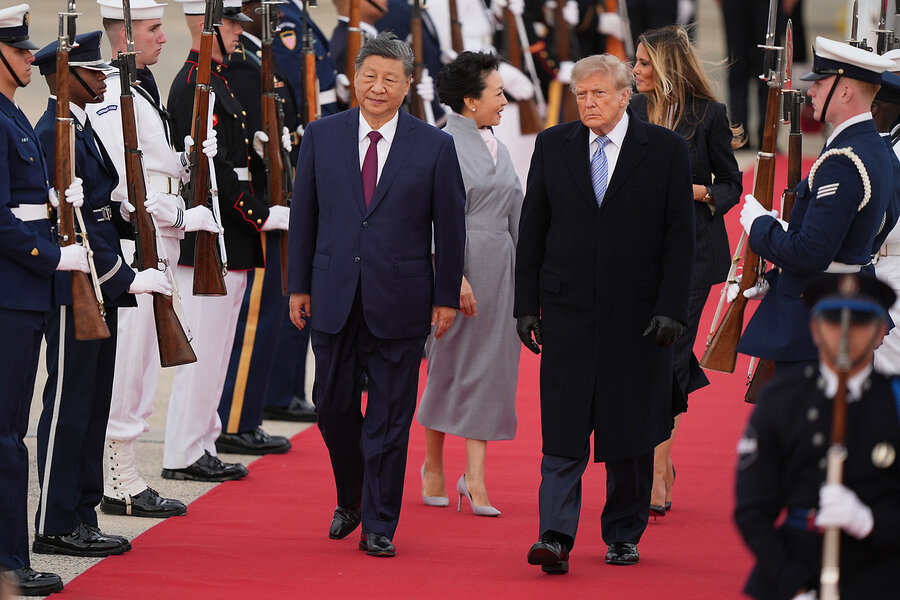
Two main events have dominated the world stage this week, both starring President Donald Trump: his assertively “America first” speech to the United Nations in New York, and his Washington welcome for the one leader he appears to view as a great-power peer, China’s Xi Jinping.Yet a series of offstage meetings during the annual opening of the U.N. General Assembly highlighted another trend that could alter America’s place – and its influence – in the world.The key players were leaders of U.S. allies: from Europe and Asia, and next door in Canada. And their New York diplomacy was part of an increasingly assertive response to a nagging worry: that Mr. Trump’s transactional reframing of their decades-old partnership, and his readiness to pressure them, meant he might suddenly limit or abandon it if he deemed U.S. interests weren’t being met. The president has already shown his readiness to pressure them.The allies’ immediate aim is to keep him on board. Their close economic, trade, and security ties with the United States mean they’re not eager for a split. But longer term, they’re seeking to hedge against their reliance on the U.S. by expanding ties with other countries.A vivid illustration of the approach followed Mr. Trump’s speech. Prime Ministers Mette Frederiksen of Denmark and Jens-Frederik Nielsen of Greenland joined him for the signing of an agreement that confirmed wide U.S. military and security powers on the Arctic island. It was Mr. Trump’s insistence last year that America needed to buy, or seize, Greenland that prompted a more hard-nosed response from U.S. allies.Earlier in 2025, most had followed his sudden announcement of steep tariffs with a mix of personal flattery and negotiating concessions to get new trade deals. Julia Demaree Nikhinson/APU.S. President Donald Trump speaks to the United Nations General Assembly, in New York, Sept. 22, 2026. During his remarks, Mr. Trump praised America’s projection of power globally. But Mr. Trump’s repeated calls for American control of Greenland – under Danish rule for more than two centuries – sparked pushback not just from Denmark, but also from other European members of the transatlantic NATO alliance.Denmark told Mr. Trump it also favored establishing a greater military presence on Greenland in light of increased Chinese and Russian naval activity, but that an existing U.S.-Danish treaty already gave him the ability to do that.This week’s deal was essentially an extension of that 1951 pact, with an added provision of U.S. veto power on non-NATO access to the island’s resources.The Danish and Greenlandic prime ministers echoed Mr. Trump’s celebration of the deal. That’s partly because it reaffirmed Denmark’s sovereignty and also recognized the interests of the local population.But it’s also because it framed Greenland’s defense as a NATO-wide issue. That addressed allies’ longer-range concerns over the durability of America’s commitment to European security, especially critical for them as they face up to Russia’s aggression against Ukraine. Mads Claus Rasmussen/Ritzau Scanpix/APPrime Minister Mette Frederiksen of Denmark, left, and Prime Minister Jens-Frederik Nielsen of Greenland answer questions from the media during a news conference at the Danish U.N. mission in New York, Sept.22, 2026. Key Asian allies arrived in New York this week with a similar concern: that ahead of Mr. Trump’s second summit in the past several months with Mr. Xi, their interests might take a back seat in the U.S. president’s drive to improve ties with Beijing.Japanese Prime Minister Takaichi Sanae, who held what she termed “timely” pre-summit talks with Mr. Trump, was reportedly concerned he might soften U.S. support for the island democracy of Taiwan.South Korean President Lee Jae-myung’s meeting with the president followed U.S. criticism of Seoul’s decision not to support the Iran war. It also came on the heels of Mr. Trump’s decision to scale back recent joint military exercises.The two Asian allies publicly voiced confidence in their ties with the Trump administration. Yet questions about America’s defense commitment have sparked a debate in both South Korea and Japan over whether they might develop their own nuclear deterrent.Japan has also been broadening its military ties with other countries – including Australia, Indonesia, and India – in an apparent effort to hedge against its reliance on Washington.All of this is in line with an appeal at the start of this year by Canadian Prime Minister Mark Carney for like-minded “middle powers” to cooperate in response to the “rupture” of the international order created and largely led by the U.S. since World War II.Mr. Carney was also in New York this week. With Canada and the U.S. now embroiled in a tariff war, he did not meet with Mr. Trump.But he did co-sponsor the launch of a “Partners for Multilateralism” body including the European Union, Australia, Brazil and India.In talks with EU leaders before heading to New York, Mr. Carney also welcomed a suggestion that Canada might join the 27-nation trading bloc as an “associate member.” That would build on his efforts over recent months to widen Canada’s international economic relationships and make a dent in Canada’s heavy trade dependence on the U.S., where it sends a large majority of its exports. The prime minister also characterized a Canada-EU partnership as going beyond mere trade. It could, he said, become a “beacon for democracies” and help forge the “next just, stable, and prosperous world order.” Deepen your worldviewwith Monitor Highlights.Politics with respectGet political stories with respectful analysis.There‘s a world of new ideas in everyBooks newsletter.There‘s more to life, enrich yours withCulture & Learning weekly.Follow humanity‘s discoveries withScience & Nature stories in your inbox.Gain a spiritual perspectivefrom the stories in your inbox.Want to understand the deeper impact of critical events? Learn the Monitor‘s insight.Already a subscriber? Log in to hide ads. In remarks to the BBC, Canadian Finance Minister François-Philippe Champagne elaborated on Mr. Carney’s reference to the need for a “next” world order, urging Britain to join a new Canada-EU alliance as well.“The world has changed. America has changed. So we need to change,” he said. ALREADY A SUBSCRIBER? LoginReal news can be honest, hopeful, credible, constructive.The Christian Science Monitor was founded in 1908 to lift the standard of journalism and uplift humanity. We aim to “speak the truth in love.” Our goal is not to tell you what to think, but to give you the essential knowledge and understanding to come to your own intelligent conclusions. Join us in this mission by subscribing.
The new West: US allies find ways of coping with Trump administration
Full Article
Original Source
Read the full article at Csmonitor →KhanList aggregates and links to publicly available news content. We do not host full articles from third-party sources. Always verify important information with original sources.