
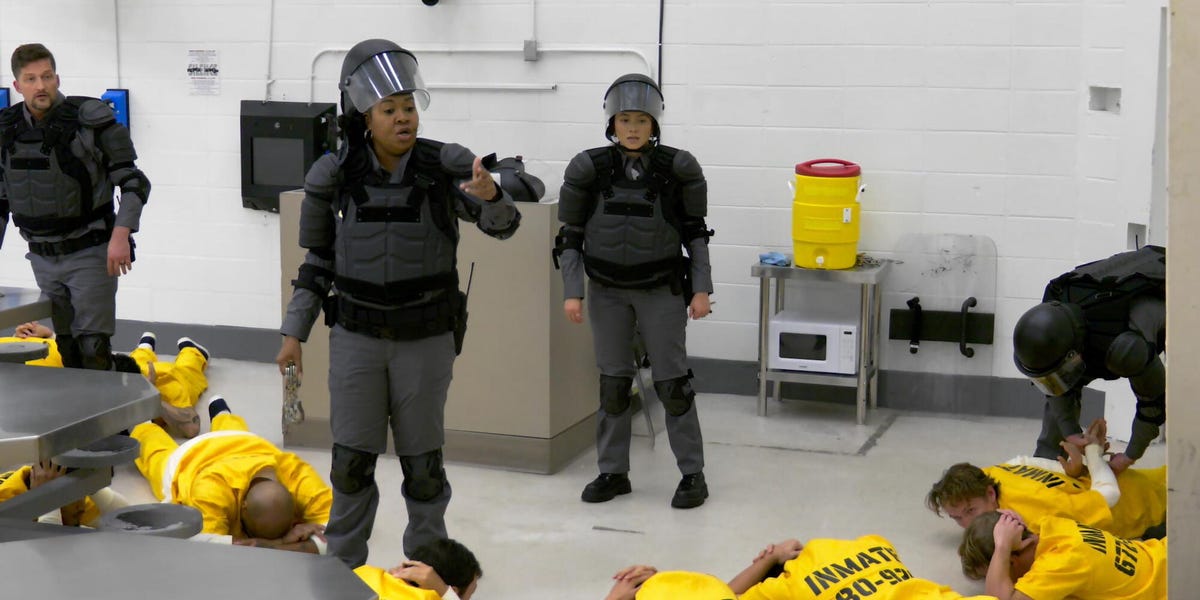
Netflix has expanded the perimeters of reality TV: bringing us formats like Love Is Blind, where contestants agree to marry someone without seeing their appearance, as well as Squid Game: The Challenge, which re-stages some of the games from the iconic international hit drama Squid Game.Now, the streaming platform is back at it, with a new show called The New Stanford Prison Experiment: an unscripted, six-episode series which reimagines a notorious 1971 experiment.It's worth noting that when the show was announced, it drew controversy. “When the show was first announced, there was a lot of outrage that anyone would even attempt the Stanford Prison Experiment again,” executive producer Jane Lipsitz told Netflix’s Tudum.But what is the show about? And why was the original study so controversial?What is The New Stanford Prison Experiment about?The New Stanford Prison Experiment is a TV show in which 30 volunteers are randomly assigned either prison or guard uniforms.It is staged in a real prison, with filming taking place 24 hours a day and production interference kept to a strict minimum.An unscripted TV series, the show examines the psychological role of power.What was the Stanford Prison Experiment?The Stanford Prison Experiment is a notorious 1971 psychological study conducted by Philip Zimbardo.In it, 24 male university students were selected after replying to a newspaper ad looking for paid participants for a “psychological study of prison life.” The participants were randomly split into guards and prisoners, with Zimbardo in the role of superintendent.The study took place in a simulation of a prison environment at Stanford University, in the basement of the psychology building.It was initially supposed to last two weeks, but was cut short after multiple prisoners had to leave early due to emotional distress and Zimbardo was confronted by a fellow psychologist who was shocked by what she had seen in the experiment: specifically, increasingly brutal abuse of the prisoners by the guards.How does the New Stanford Prison Experiment differ from the original study?There are a number of differences between the original study and the Netflix version. Namely, the Netflix show is based in an actual prison, and there are 30 (not 24) participants.Additionally, the original experiment has been critiqued for only having male participants, as well as a lack of safeguarding. This has been corrected in the Netflix version, with a mixed-gender cast.The show also aimed to implement more robust safeguarding, with psychological support and greater consent protocols.“The participants all made informed decisions when signing up, and they all underwent psychological screenings prior to entering the experiment, ” Lipsitz explained to Tudum.“Everyone had a safe word they could use to opt out at any time, and psychologists were available 24/7 for support.”The New Stanford Prison Experiment is available to stream on Netflix.
‘The New Stanford Prison Experiment’: What Was the Real Study That Inspired the Controversial Reality Show?
Full Article
Original Source
Read the full article at Cosmopolitan →KhanList aggregates and links to publicly available news content. We do not host full articles from third-party sources. Always verify important information with original sources.