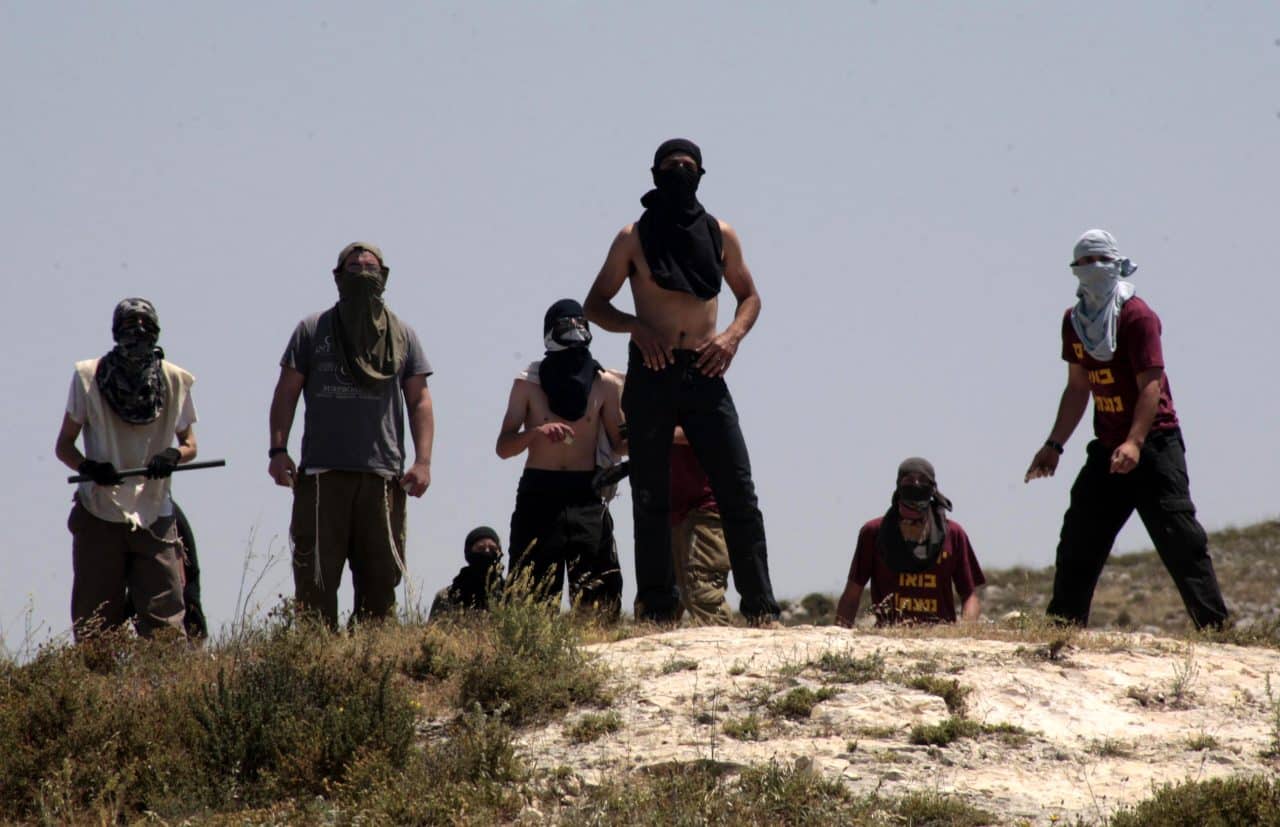
Four Palestinians and two Israelis are dead after Palestinians confronted a group of invading Israeli settlers who had stormed the Palestinian village of Til, southeast of Nablus, earlier last week. The incident has become the pretext for Israel’s latest and most sweeping escalation in the West Bank, heralding a new phase in Israel’s assault on Palestinian existence in the territory. But underlying these developments is a deep ideological and social divide in Israeli politics and society that is driving a particular approach to dealing with the local Palestinian population, characterized by unleashing violent settler pogroms on Palestinian villages and towns. In the wake of the events at Til, settler groups launched a renewed spree of attacks on Palestinian towns and villages across the West Bank, from the countryside of Nablus to the southern Hebron hills, torching cars and farmlands, damaging property, taking over houses, and opening fire on civilians. Meanwhile, the Israeli army raided the city of Nablus and several neighboring towns and villages in the northern West Bank, arresting hundreds of Palestinians and conducting field interrogations. In Jenin, Ramallah, and Hebron, the military also blocked roads and demolished properties. The Israeli government immediately treated the incident at Til as a “terrorist attack,” issuing orders for the army to raid villages and announcing an impending large-scale offensive in the West Bank, although it was postponed to take place until after Israeli Prime Minister Benjamin Netanyahu returns from his visit to U.S. President Trump in Washington. But this escalation isn’t just a response to Til. It exposes a deeper conflict inside Israel over how the state defines its own security. One camp, led by Netanyahu’s hardline allies, Finance Minister Bezalel Smotrich and National Securityu Minister Itamar Ben-Gvir, casts settlers as the frontline defenders of the state. The other, rooted in Israel’s more traditional security establishment, sees settler violence itself as the danger. The clash between these two currents, just three months ahead of the upcoming Israeli elections, will likely dictate a new security doctrine for how to deal with the Palestinians for years to come. Netanyahu at a crossroads In the background of the Israeli electoral race is the multi-layer internal political crisis of Netanyahu and his Likud party, including Netanyahu’s personal corruption cases, the ongoing crisis of the military draft for the ultra-Orthodox Haredi community, and the issue of accountability for October 7. Amid these crises, the polls indicate that Netanyahu will struggle to maintain a majority that would allow him to stay in power. In addition, Netanyahu faces accountability for the diplomatic, economic, and social cost of the ongoing regional wars that Israel has launched since October 2023 — including in Syria, Lebanon, Yemen, and Iran — and the failures to achieve the main objectives of eradicating Hamas and Hezbollah and achieving regime change in Iran. All these factors have contributed to Netanyahu’s loss of popularity. This is one of the more immediate factors that inform the current escalation in the West Bank, which serves a specific political purpose for Netanyahu. According to Adel Shadid, a political analyst and expert on Israeli affairs, “the escalation in the West Bank doesn’t necessarily rally votes behind Netanyahu on the right, but it imposes the urgency of an ongoing security situation and sidelines the other issues where Netanyahu and his allies are much weaker.” “Although there is large opposition to Netanyahu, a fresh military escalation puts the entire Israeli political field in a state of emergency,” Shadid told Mondoweiss. “Here, Netanyahu can present himself as the strong, experienced leader who needs to be allowed to lead, and postpone the discussion on all his other shortcomings and Israel’s internal crises. The West Bank is the perfect field where he can do that.” But beyond the electoral conjuncture, the social and political force pushing for a West Bank escalation, represented by settler figures like Smotrich and Ben-Gvir, has emerged as a potent interest bloc. Now it is seeking to effect a major political transformation in the West Bank’s status quo ahead of the elections. A new Israeli security doctrine At the center of the escalation are Israeli settlers, who spearhead the confrontation with Palestinians and form the key interest group backing Netanyahu’s ticket. Smotrich, an architect of the current wave of pogroms, has cast settlers at the forefront of Israel’s security. Alongside Ben-Gvir, he sees settlers as a tool to repress Palestinians and keep the conflict with Palestinian towns and villages ongoing. This way, an Israeli military crackdown on Palestinians becomes perpetually necessary, hence pushing the danger of Palestinian “terrorism” away from Israel proper. This stands in stark contrast to the more traditional current in the Israeli security establishment, dominated by the Israeli center-left that led Israeli politics in the state’s early years, despite more recently losing much of its power. This traditional establishment sees settler violence — although not settlement expansion itself — as a danger to Israel’s security due to the volatility that such attacks brings about. The establishment logic was expressed by Israeli Major General Avi Bluth, head of the Israeli army’s central command, who said last May that it was “almost a miracle” that Palestinians haven’t started a Third Intifada in response to settler violence. Likewise, Israeli liberal daily Haaretz reported last week that unnamed security officials in the army are worried that Palestinian restraint in the face of settler violence and arson might not continue indefinitely. The sentiment was echoed on Monday by Israeli opposition politician Yair Golan, known for supporting the starvation of Gaza in the wake of October 7, who said in a public speech that settlers’ violence in the West Bank endangers the security of the state, pledging to rein it in if he is elected. Polls give Golan no more than 10 out of the 120 seats in the Knesset in the coming Israeli elections. The contradiction in these security visions places settlers at the center of the debate — and at the forefront of the process of shaping a new Israeli security doctrine which casts constant friction with Palestinian communities as a given, rather than an aberration in an otherwise “calm” status quo. The contradiction in these security visions places settlers at the center of the debate — and at the forefront of the process of shaping a new Israeli security doctrine which casts constant friction with Palestinian communities as a given, rather than an aberration in an otherwise “calm” status quo. The emergence of this security approach is intimately intertwined with settlers’ ideological and religious identity, making up half of the historic duality of secularism and religion in Israeli society. According to Khaled Odetallah, the founder of Palestine’s Popular University, seculars represent the predominantly Ashkenazi upper-middle class in Israeli society, and are heirs of the Zionist left that founded the state. This group, Odetallah says, “identifies with the model of a state based on institutions and the rule of law.” Within this model, Odetallah says, the state decides policy, not religious settlers. On the other side of the political aisle are “the religious, mainly non-Ashkenazi Jews for whom Israel is, above all, a Jewish religious entity, in which faith and religion take priority over the law and the state,” he explained. Odetallah points out that the religious current, part of which is made up of the ultra-orthodox Haredis, has historically been focused on religious life and was not involved in Zionism’s state-building and colonization project. But then a new current emerged: religious Zionism. “Religious Zionism is an attempt to merge the Zionist expansionist drive with religious identity, based on a mystic brand of Jewish religiosity that offers a way of becoming religious for free — without having to be subordinated to a religious authority,” Odetallah said, noting that this brand of Israeli politics has given disenfranchised, non-Ashkenazi Jews a political project and an opportunity to lead in Israeli politics. “Religious Zionism is today the main engine of the Zionist project, and it has been taking over Israeli institutions and reshaping them.” “At the center of this movement are settlers who integrate violent groups into their ranks,” he added, referring to the cohort of young disaffected Jews that have been part of violent groups like the Hilltop Youth, which have terrorized Palestinians in the countryside. Religious Zionism is the name of the political party headed by Smotrich, but the political current he represents also includes Ben-Gvir’s Jewish Power party. For both groups, two main objectives have animated their political project: settlement expansion and the expulsion of Palestinians in the West Bank from areas slated for colonization. Ahead of elections, these twin goals are coming to a head for their right-wing coalition, formed in partnership with Netanyahu’s Likud. But the current Israeli settler offensive on the West Bank is much larger than the context of elections and the political calculations they impose on Israeli actors. The far deeper forces moving Israeli militarism today are a direct result of the divide in Israel’s security doctrines, characterized both by ideological and social polarizations. These divides are deeply connected to the struggle over Israel’s identity and its capacity to maintain its expansionist momentum in a region where, after a century of colonization, it still hasn’t been able to naturalize its presence. Qassam MuaddiQassam Muaddi is the Palestine Staff Writer for Mondoweiss. Follow him on Twitter/X at @QassaMMuaddi.
The new settler-led security doctrine driving Israel’s onslaught on the West Bank
Full Article
Original Source
Read the full article at Mondoweiss →KhanList aggregates and links to publicly available news content. We do not host full articles from third-party sources. Always verify important information with original sources.