
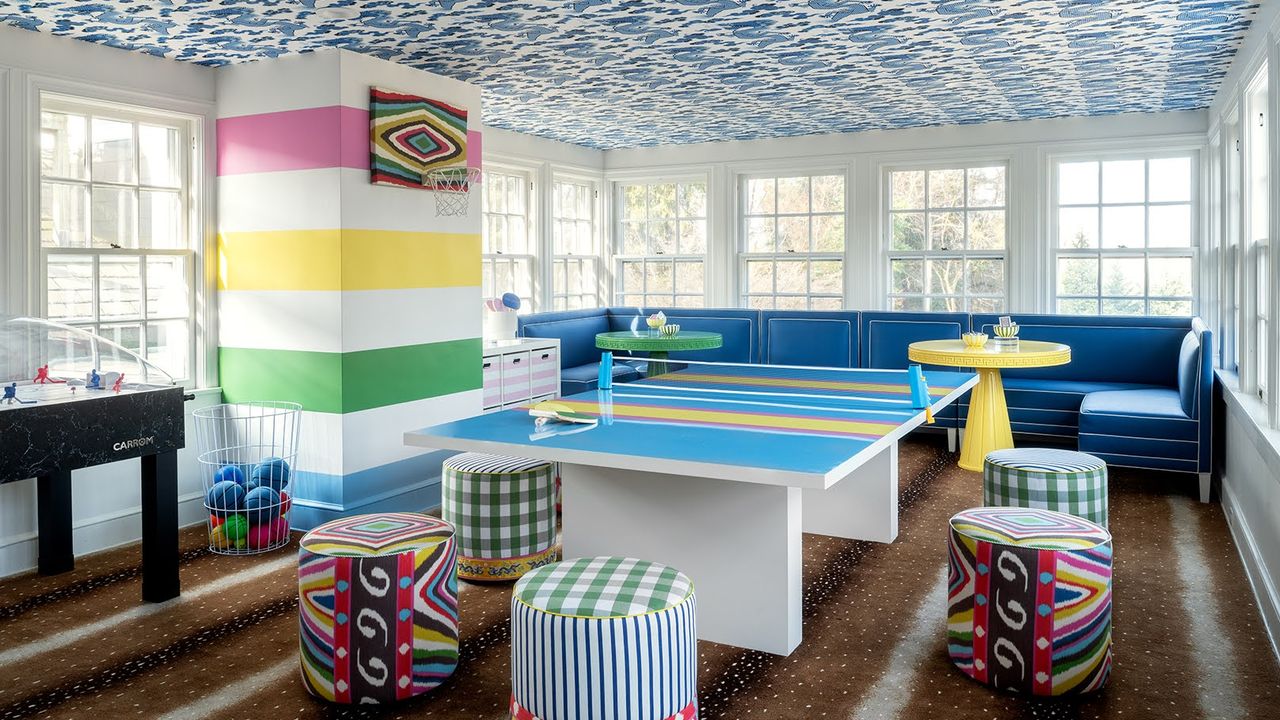
Designing for kids in 2026 means navigating a digital-first landscape where social media snapshots have replaced bedroom posters and stainproof fabrics are increasingly viewed with suspicion. At the same time some things never change: Tweens and teens still need a place to hang out together (even if they’re all on their phones). Designers tell AD how they’re rethinking family spaces today.The Return of the LandlineTin Can phones hold a retro appeal for a generation that has only known iPhones. Photography courtesy of Tin Can“Mom and Dad, I want a cell phone.” These are the dreaded words parents steel themselves to hear from their offspring at an increasingly younger age. AD100 designer Neal Beckstedt said it was a client who first suggested he solve this contemporary dilemma with a retro solution: the landline. “God forbid, but if there’s an emergency [where cell service is out], they can still pick up the phone and call.” (See AD PRO’s story on actor Rachel Brosnahan’s embrace of vintage rotary dial phones).Increasingly, families are installing faux-landlines that offer the connection kids crave without the pitfalls of a smartphone. Two-year-old company Tin Can leads the pack, producing home phones (priced at $100) designed specifically for children. The screen-free devices take design cues from traditional corded phones but are connected via Wi-Fi.“When kids are asking for a cell phone, what they are really asking for is to feel more connected and to have more agency over their relationships,” says Chet Kittleson, co-founder of the Seattle-based start-up. The chunky, retro design, available in colors like yellow, orange, mint green, and royal blue, transforms the device into a design statement and allows parents to manage approved contacts through a companion app.The Rise of Teen Lounges and Rec RoomsOutfitted with a ping-pong table, foosball, indoor basketball hoop, and flexible seating, this teen-friendly lounge was designed for a Lancaster, PA, family’s four children. Design by Megan Gorelick Interiors. Photo: Rebecca McAlpinTechnology in kids’ bedrooms has become the new taboo. How to avoid it? The so-called teen lounge: a space designed to pull kids away from their devices and back into real-life interactions. These casual enclaves are crafted with teen and tween sensibilities in mind. “It’s not bean bags and lava lamps, but it’s still that vibe,” says interior designer Zoe Feldman. She prioritizes high-comfort elements like slouchy sofas and expansive sectionals, accented with mini-fridges and microwaves. (If you’re wondering, the microwaves are mostly for popcorn.)Elizabeth Graziolo, principal at AD100 firm Yellow House Architects, has designed such spaces for private homes as well as a luxury Manhattan condominium, where a basement teen lounge is offered as a common space for building residents. She refers to the setup as a “slumber party room” and recommends designing these spaces with flexibility in mind—for instance, including multiple ottomans that can do double duty as storage or the foot end of an impromptu bed.Elizabeth Graziolo of Yellow House Architects designed this teen lounge for a luxury condominium on the Upper East Side. Photo: Joshua McHughFour Hands Foosball table Game tables—think table tennis, foosball, or air hockey—often ground the space. They give kids an activity, “rather than social media being their activity,” explains designer Megan Gorelick, whose firm is based in Montchanin, Delaware. “The people in the room are their entertainment.” In fact, we may be seeing a developing foosball renaissance. Adam Dunn, vice president of design for Four Hands, says the furniture maker has recently seen their line of wooden game tables explode in popularity. Analog recreation is “no longer an afterthought,” he says.Rethinking Stainproof Fabric TreatmentsZoë Feldman designed this Washington, DC, girls’ room with cotton curtains and carpet. Photography courtesy of Zoe FeldmanInstead of a rug beneath a family’s dining table, Kacee Withersbee of Inside Studio suggests an all-natural oil cloth which can be wiped clean. She used a patterned oil cloth from Black Point Mercantile for this home in Portland, Oregon. Photo: Elizabeth AtterburyChemical treatments and synthetic materials have proven effective at keeping walls, fabric, and furniture safe from kids’ messes. But according to Jonsara Ruth, co-founder and design director of the Healthy Materials Lab at New York’s Parsons School of Design, stainproofing treatments for fabrics commonly rely on PFAS—often called forever chemicals—to provide water, oil, and, stain resistance. With the public increasingly concerned about the long-term health effects of such chemicals, designers and parents are prioritizing natural fibers for children’s soft goods and upholstery. Ruth says that families are increasingly mindful “that their kids’ rooms feature healthy flooring, suitable walls, healthy furniture.”Feldman, a mother of two, counts herself in the better-safe-than sorry camp. “I’d rather get a stain than have my kids face toxicity all day,” she says. “If it gets stained, well, we’ll clean it.” In lieu of chemically treated fabrics, Beckstedt suggests using forgiving fabrics—textiles that hold up to repeated use and washing. Patterns are ideal, he adds, for hiding minor messes while adding personality to the room. Kacee Witherbsee of Insides Studio suggests lightweight wool or cotton rugs, which can be rolled up and dropped off at the dry cleaner. She is also a fan of patterned oil cloths, which offer a durable, all-natural alternative that can be wiped clean with a wet rag. (They’re ideal for table and floor coverings.) “We try to stick with natural materials as much as possible,” says Withersbee.Hire a ProFind an architect or designer in your area with the AD PRO Directory, our network of AD-approved professionals. Start your searchArrowForget Gendered Rooms and Sad, Beige NurseriesLeah Ring of Another Human designed this royal blue bedroom for a Los Angeles family with a young daughter. Photo: Lance GerberA child’s room used to be one of the home’s most gendered spaces. But the “pink is for girls, blue is for boys” dichotomy is on the wane, as parents and designers take a more personal, less prescriptive approach to decorating for kids. “I try not to lean into gender tropes, as each kid is different,” says AD PRO Directory designer Leah Ring of Another Human. Designers say they are much more interested in hearing what the kids themselves like, whether it’s a theme, like forests or outer space, or a color, like the oceanic blue Ring used to envelop a girl’s room in Los Angeles.“We’re really diving deeper into the child’s personality,” agrees Beckstedt. “We’re taking all their likes and their dislikes and running with that.”For young families designing a nursery, finding that point of inspiration can be a challenge. But the all-neutral rooms swathed in pale oak (think the “sad, beige childhood” meme) are increasingly not the answer either. Beckstedt, designing a nursery for his own six-month-old daughter, seized on Peter Rabbit illustrations for inspiration. So yes, there’s a little pink in the room—but there is also yellow-patterned wallpaper and a green rug and curtain. Don’t just do one color, he says. “Do all the colors.”Want more inspiration for designing for kids? Three AD PRO Directory designers share playful, purposeful, parent-approved tips and out-of-the-box strategies for creative bedrooms for children
The New Rules of Designing for Kids
Full Article
Original Source
Read the full article at Architecturaldigest →KhanList aggregates and links to publicly available news content. We do not host full articles from third-party sources. Always verify important information with original sources.