
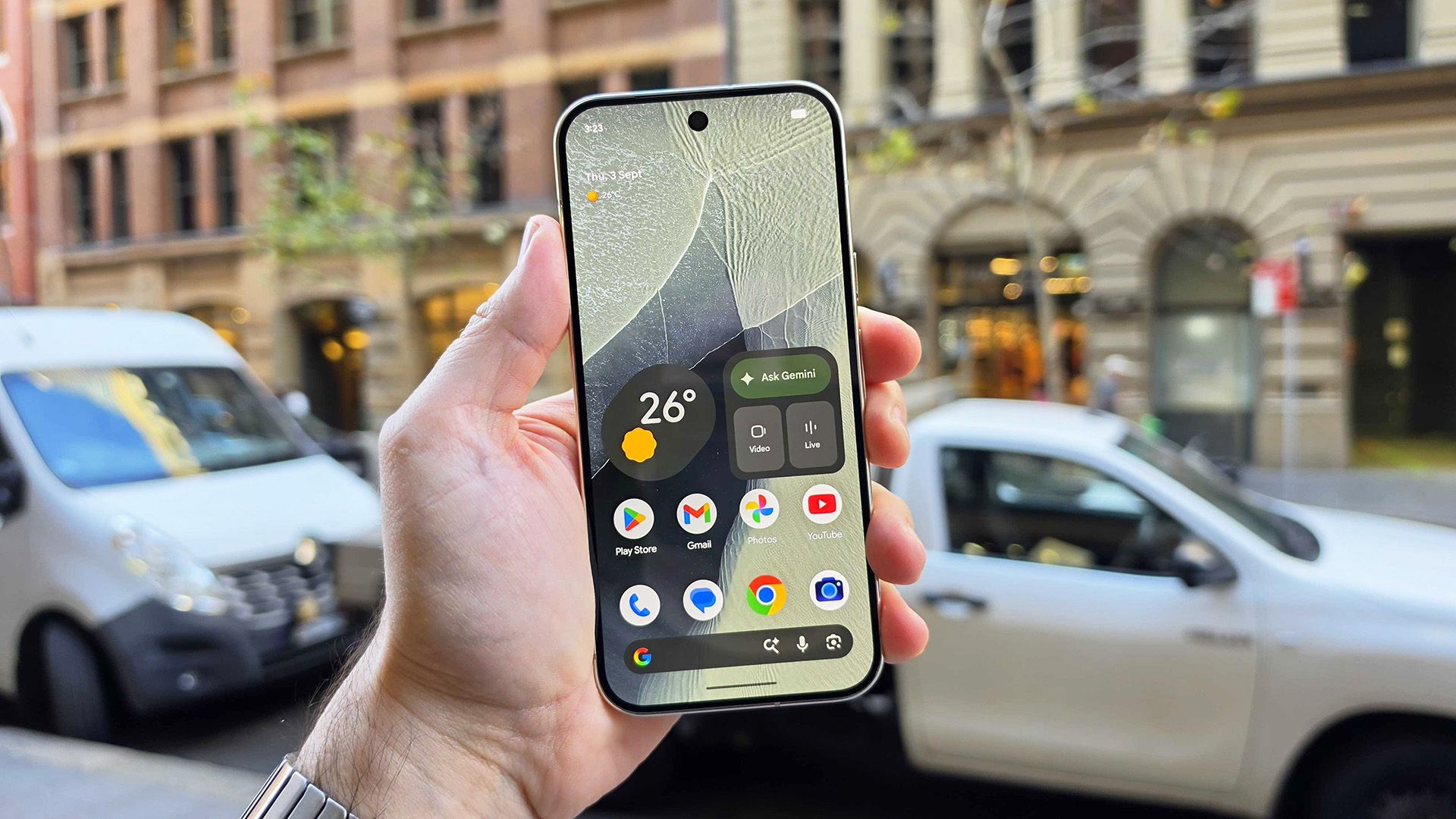
(Image credit: Tom's Guide) I’ve been using Pixel devices for years, and I’ve always appreciated the way Google approaches smartphones. Pixels always deliver a mix of clean software, clever camera tricks and the confidence that they don’t need to outdo Apple and Samsung when it comes to raw performance.But after spending the last two weeks with the Pixel 11 Pro, that charm is starting to wear thin for me. Not because the phone is bad — it’s actually good in plenty of areas — but because Google seems content to coast. And with 2026, packed with powerhouse devices all trying new things, coasting is a dangerous strategy.This year’s big improvementsFirst, let me point out that the Pixel 11 Pro nails the basics. The camera is still one of the most reliable point‑and‑shoot experiences around, and the display is genuinely impressive this year. As detailed in our combined Pixel 11 Pro and Pro XL review, its screen hits 2,860 nits peak brightness, while its larger sibling reaches 2,877 nits, making them the brightest phone screens we’ve ever tested. That’s brighter than Samsung’s Galaxy Z Fold 8 Ultra at 2,687 nits, and more than double the iPhone 17 Pro Max’s 1,281 nits. Out in the Australian sun, that difference is immediately apparent.Camera performance is strong, too. Its 5x telephoto lens produces crisp long‑range shots, and as detailed in our review, Google’s AI‑boosted 120x zoom actually outperforms Samsung’s 100x attempt in clarity. The new Magic Capture mode, which records a video and simultaneously extracts high-quality stills from it, works quite well, and Rambler, which uses Gemini AI to transcribe your rambling speech into well-structured text, is quite impressive. Live Translate for media is also genuinely useful, allowing you to dub content into another language in real-time — it’ll even keep the voice and accent of the original speaker, which is actually kind of mind-blowing.Impressive AI features, but do they justify a new phone?Despite being sold as the ultimate AI phone, the Pixel 11 Pro isn’t exactly a compute monster. In fact, our benchmarks show its Tensor G6 chipset landing well behind its rivals in Geekbench AI tests — a surprising result for a device built around on‑device AI features. And that’s what makes this year’s Pixel 11-exclusive AI features feel a bit arbitrary. Rambler, Magic Capture, Live Translate for media — they’re clever tools, but none of them appear to require any dramatic hardware leap. The Pixel 11 Pro and Pro XL simply aren’t delivering the kind of AI throughput that would justify locking these features to new devices. (Image credit: Tom's Guide)Google has a long history of keeping software tricks exclusive to the latest Pixel, even when older hardware could clearly cope — think Photo Unblur (exclusive to Pixel 7 at launch) or Audio Magic Eraser (exclusive to Pixel 8 at launch) — and that pattern seems to continue with this year’s lineup. So while the AI perks are fun to play with, they’re far less exciting to me than a refreshed design or a meaningfully upgraded camera system would’ve been. If Google wants the Pixel to feel essential again, it needs to deliver real hardware upgrades — not just software that likely could’ve shipped to last year’s phones.The feeling of sameness is hard to shakeAfter two weeks with the Pixel 11 Pro, the sameness is impossible to ignore. The last few Pixels have looked and felt nearly identical. Same silhouette, same camera bar, and same “good enough” approach to performance. I can pick up a Pixel 9 Pro, 10 Pro or 11 Pro and my muscle memory barely registers the difference. That’s not consistency; that’s stagnancy. (Image credit: Tom's Guide)And stagnancy becomes even more obvious when you look at the hard numbers. The Pixel 11 Pro’s battery life is 13 hours 25 minutes, which is actually worse than last year’s Pixel 10 Pro at 13 hours 43 minutes. Meanwhile, the iPhone 17 Pro hits 15 hours 21 minutes, and the Galaxy S26 Ultra lasts 16 hours 10 minutes. Those are meaningful gaps for devices that aren’t too far off from each other in terms of price.No meaningful performance gainsIt’s a similar story when it comes to performance: the Pixel 11 Pro’s Geekbench 6 scores — 2,649 single‑core / 7,164 multi‑core — are an improvement over the Pixel 10 Pro, but nowhere near Samsung’s Galaxy S26 Ultra (3,785 / 11,563) or the iPhone 17 Pro Max (3,871 / 9,968). And the aforementioned AI benchmark is downright brutal: the Pixel 11 Pro scores 9,148, while Samsung hits 83,047 and Apple reaches 48,549. When a flagship is being outpaced by that margin, especially one that’s being sold as a class-leading AI-centric device, it’s hard to pretend everything’s fine. (Image credit: Tom's Guide)Even the exclusive Gemini features — as polished as they are — don’t change how the phone feels in the hand, or how it performs under load, or how long it lasts on a busy day. They’re clever additions, but they’re still additions. They don’t fix the underlying issue: Google hasn’t meaningfully pushed its hardware forward in years.Good enough is no longer enoughAnd then there’s HiLight, the only visually distinct hardware update Google has made this year. It’s basically a tiny LED that blinks when Gemini is listening or when an assigned contact calls. It’s cute, but it’s hardly the kind of innovation that keeps a brand relevant. Nothing has been offering similar features for years and to be honest, it never really impressed anyone. (Image credit: Tom's Guide)A meaningful redesign would go a long way. And I’m not talking about slightly smaller bezels or a slightly tweaked camera bump — I mean a proper refresh. Something that signals Google is hungry again. Maybe that means an Ultra-style device that actually competes with the big players, or a foldable that doesn’t feel like it’s two years behind the competition. It also wouldn’t hurt if the next Pixel had a Tensor chip that could go toe-to-toe with higher-range Snapdragon chips, or a battery that charges fast and lasts long.Maybe it’s time to go back to the drawing boardOf course, the Pixel 11 Pro’s biggest problem isn’t its performance, battery or price — though all three could be better. It’s that it feels like Google is playing it safe, and that’s risky in a market where everyone else is swinging for the fences.Google clearly wants the Pixel line to sit alongside Samsung and Apple as one of the industry’s top‑tier smartphone brands, but the reality is that it’s falling behind fast‑moving competitors like Motorola, Xiaomi and Oppo. These brands are pushing aggressive hardware innovation, competitive pricing and rapid release cycles, while Google’s hardware strategy has remained relatively unchanged. (Image credit: Tom's Guide)If Google genuinely wants to make a meaningful impact in the smartphone space, it needs more than incremental updates. I want Google’s Pixel line to take risks again and surprise me.I want a Pixel phone that doesn’t feel like it was designed by a committee trying not to rock the boat. Because if Google keeps serving up “good, but boring,” the Pixel line won’t just fall behind — it’ll fade into the background entirely. Follow Tom's Guide on Google News and add us as a preferred source to get our up-to-date news, analysis, and reviews in your feeds. More From Tom's GuideI've been using Pixel phones for the past 5 years, but the lack of Pixel 11 upgrades is indefensibleI checked out the Pixel 11, Pixel 11 Pro, and Pixel 11 Pro XL — here’s the one I recommendGoogle Pixel 11 Pro Fold review: Falling behind the foldable curve Stephen Lambrechts is the Managing Editor of Tom's Guide AU and has written professionally across the categories of tech, film, television and gaming for the last 15 years. Before Tom's Guide, he spent several years as a Senior Journalist at TechRadar, had a brief stint as Editor in Chief at Official Xbox Magazine Australia, and has written for such publications as APC, TechLife Australia, T3, FilmInk, AskMen, Daily Telegraph and IGN. He's an expert when it comes to smartphones, TVs, gaming and streaming. In his spare time, he enjoys watching obscure horror movies on physical media, keeping an eye on the latest retro sneaker releases and listening to vinyl. Occasionally, he also indulges in other non-hipster stuff, like hiking.
The new Pixel 11 Pro is good, but boring — it's time for Google to start shaking things up or risk becoming irrelevant
Full Article
Original Source
Read the full article at Tomsguide →KhanList aggregates and links to publicly available news content. We do not host full articles from third-party sources. Always verify important information with original sources.