
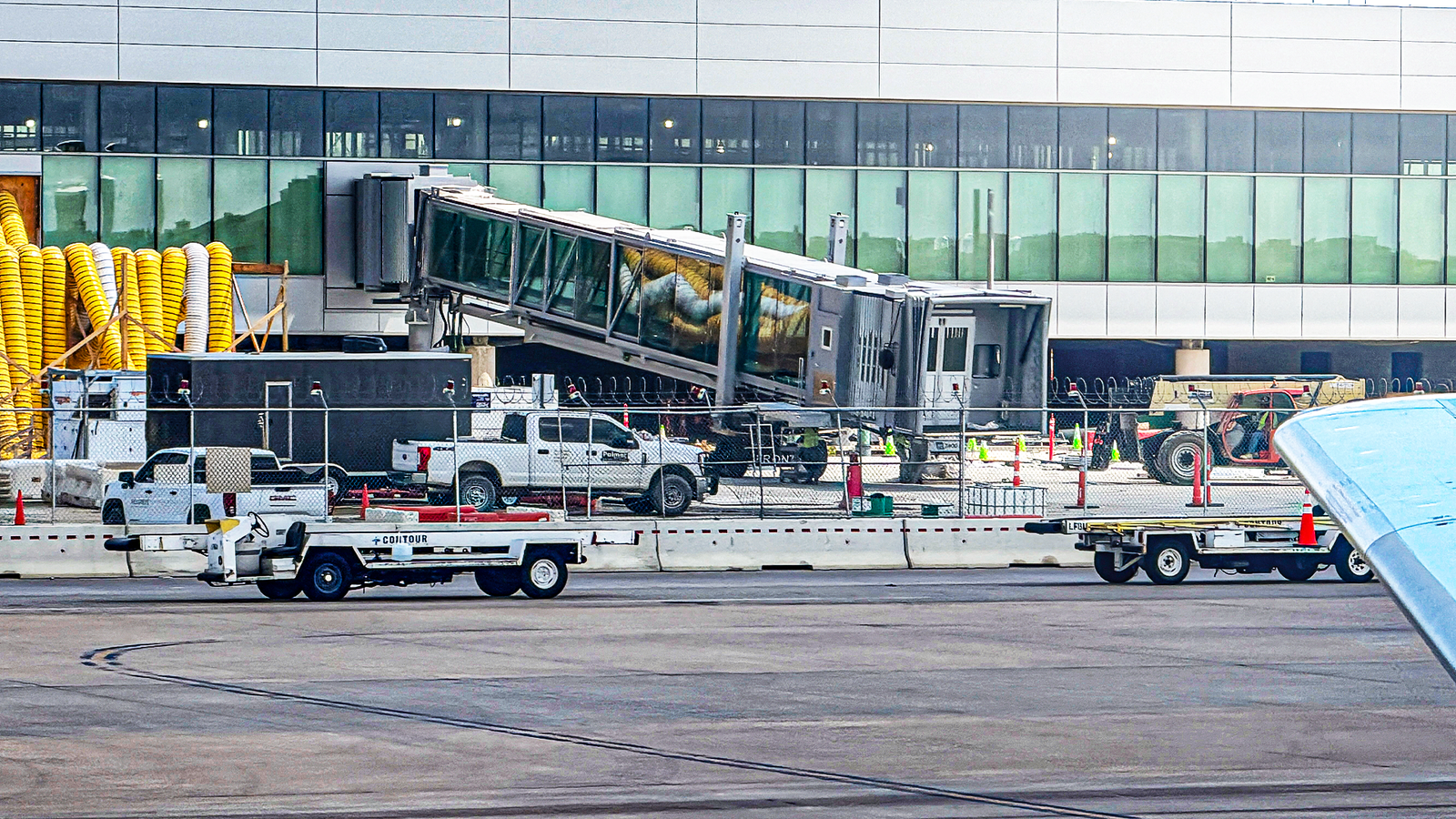
Published Oct 2, 2026, 1:00 PM EDT Luke Diaz is a freelance military writer with experience with active duty experience in the US Navy as well as defense and industrial engineering. He is a former Naval Flight Officer who performed tactical air control on the carrier-based E-2 Hawkeye. Two years after groundbreaking, Dallas/Fort Worth International Airport (DFW) is expecting to open the new Terminal F facility next year. One of the standout features that will set it apart from the older hubs across America is the full-glass jetways that give passengers a clear view of the airfield during boarding. The new terminal and its gates are being built using advanced modular construction techniques. This $1.6 billion project is DFW's first entirely new terminal built in two decades. Phase one features a 400,000-square-foot, double-loaded concourse with 15 gates, a dedicated Skylink transit station, and modernized baggage systems. All of which will be dedicated to American Airlines and valued at $4 billion in total. Construction on Terminal F began in mid-2024. The framing components are prefabricated outside the airport perimeter and systematically moved across the airfield for fast installation, which significantly reduces flight delays during construction. The terminal itself features dynamic smart-glass systems that adjust tint levels to substantially reduce glare, solar heat, and ultraviolet light while staying fully transparent. Bringing Aesthetics Up To Code At DFW Credit: Dallas/Fort Worth International Airport The environment at DFW will be radically modernized with the opening of Terminal F.At the center of the 400,000-square-foot expansion is a design element long considered an impossibility in major American hubs due to regulations. That is the building of its new glass-walled jet bridges. For decades, an industry-wide interpretation of the National Fire Protection Association’s 415 standard acted as the code barrier. The code's restrictive language discouraged US airports from using glass walls and limited transparent materials to the minimum required for operations. This caution stemmed from a specific safety concern over passengers in an evacuation: the fear that see-through walls would cause passengers to stall, gawk, or panic during an active ramp emergency, creating bottlenecks on the narrow egress path. Before DFW, only a handful of pioneering airports managed to break the standard corrugated-steel mold by installing glass-walled jet bridges. Modern laminated and tempered glazing proved it could withstand fire exposure for the code's mandatory five-minute emergency egress window without fracturing. Recognizing that the material could now perform safely under stress, the NFPA officially dropped its restrictive ban on glass boarding bridges in late 2015. The change allowed early adopters like Wichita and later major hubs like Kansas City to legally implement the aesthetic without facing devastating liabilities in court. The bottleneck theory was ultimately overridden by the reality of superior fire-rated glass, turning a decades-long safety argument into an outdated design myth. The Template For Terminal F Credit: Dallas/Fort Worth International Airport The handful of American airports that successfully pioneered glass jetways prior to DFW’s project broke through regulatory barriers in a series of groundbreaking waves over the past decade. Paine Field Passenger Terminal (PAE) in the Seattle metro area utilized custom glass walkways to match its boutique, luxury-lounge aesthetic from day one. In DFW's home state, Killeen-Fort Hood Regional Airport (GRK) and Rick Husband Amarillo International Airport (AMA) served as early testing grounds in Texas. Notably, these fields adopted the style in 2008 and 2014, respectively. These airports were able to install glass jetways before the NFPA 415 change through a legal and engineering mechanism known as the 'Equivalency Clause' or 'Alternative Materials and Methods.' After the code update, Wichita Dwight D. Eisenhower National Airport (ABC) became the first in the nation to install a uniform, all-glass lineup across its 11 gates during a 2015 overhaul. Huntsville International Airport (HSV) also quietly brought the design to the American Southeast by upgrading to a sleek, modern glass system back in 2015. Kansas City International Airport (MCI) boasts the largest pre-DFW rollout, introducing 39 glass bridges as part of its massive single-terminal transformation in 2023. Finally, Key West International Airport (EYW) and Miami International Airport (MIA) led the charge on Florida's modernization by introducing specialized, storm-resilient glass bridges across their coastal terminals. Now that the NFPA 415 roadblock is gone, airports are enthusiastically embracing the glass jet bridge design in renovations and new buildings to update the terminal experience to a modern 21st-century design. Pushing To Bring Light To the Jetway Credit: Dallas/Fort Worth International Airport According to Airport Improvement, Killeen-Fort Hood collaborated with manufacturer ThyssenKrupp Airport Systems and architecture firm Jacobs Engineering Group in 2008 to install what they called the country's first 'crystal bridges.' Instead of rewriting the current safety regulation, their approach required a grueling variance process to get final sign-off and build. The design team argued that these new glass panels legally functioned as an integrated wall assembly rather than a typical window under NFPA 415. To satisfy nervous fire marshals, these early structures were often paired with heavy-duty, dedicated air-conditioning and positive-pressure ventilation systems. Killeen brought two glass-walled gates online in 2008, followed by Amarillo’s six-gate terminal overhaul in 2011, reaching full completion in 2014. The financial premium to achieve that technical distinction turned out to be less than expected for a 'first-of-its-kind' endeavor. Airport Improvement reported that these specialized glass bridges cost between $1.2 and $1.8 million, roughly 10% more than an equivalent solid metal structure. By the time Paine Field’s high-end, privately developed passenger terminal was designed, the NFPA was already considering relaxing its strict stance based on those promising results. Wichita Bets Big On A Loophole Credit: Wichita Airport When Wichita Dwight D. Eisenhower National Airport erected 12 transparent walkways in 2015, it circumvented the previous fire code by categorizing the structures as ground equipment rather than an integrated component of the terminal building. This clever bureaucratic maneuver demonstrated the true scalability of glass jet bridges. The workaround allowed the city to approve the project for $8.8 million, a mere 1.5% cost premium over traditional steel. Today, airport management describes the bridges as a major passenger favorite that frequently attracts visiting design teams from major cities, even though a decade of heavy use has resulted in a few broken glass panels requiring costly maintenance. Wichita’s successful gamble catalyzed a regional shift, paving the way for Huntsville International Airport to place its own $11.8 million order for 12 glass bridges in 2015. The upgrade made it the first airport in the American Southeast to trade its dark, 'metal tubes' for natural light. Smaller installations quickly followed at regional hubs like San Luis Obispo (SBP), Syracuse (SYR), and Paine Field. The trend reached its peak when Miami International Airport announced an expansive $9 billion infrastructure modernization plan to convert all 126 of its boarding bridges to glass by 2028. The full project includes hundreds of other system improvements, according to the Miami Herald. This massive Miami undertaking is being handled by TK Airport Solutions, a manufacturer based right in the Fort Worth metro area. This hyper-local manufacturing connection adds a distinct twist as DFW builds out its own signature terminal. Testing Catches Up With The Code Credit: Dallas/Fort Worth International Airport The true turning point in the glass-jetway transition arrived with the 2016 edition of the NFPA 415 standard, when the regulatory committee officially abandoned its long-standing resistance. The committee's revised rationale noted that modern glass-walled boarding bridges had successfully passed rigorous safety testing. Updated test data showed that transparent barriers did not affect the efficiency or success of passenger evacuations. Real-world field-testing had finally proven that the psychological bottleneck anxiety, which had dictated safety guidelines for decades, was no longer a deal-breaker. While this regulatory move created opportunities globally, the trigger for change came from California, where Santa Barbara Airport (SBA) made a strong argument for glass on its own terms. When SBA planned its new facility, local officials faced an unusual aesthetic dilemma. The city's stringent design review board rejected standard corrugated choices, with the chief architect referring to them as 'long, ugly metal tubes.' The airport was determined to give arriving flyers a direct first glimpse of the stunning Santa Ynez Mountains. In 2010, the Santa Barbara City Council approved a $2.5 million contract with JBT AeroTech to purchase three specialized Jetway Glass Apron Drive Bridges. When the boutique terminal debuted in 2011, it successfully demonstrated that a regional commercial airport could operate glass walkways reliably. By bypassing the visual monotony of traditional gates, Santa Barbara's small-scale success provided the aviation industry with the ultimate proof of concept. The next logical step was figuring out how to scale this aesthetic up to meet the demands of a massive hub like DFW. What Terminal F Will Look Like Credit: Dallas/Fort Worth International Airport DFW is undergoing its biggest expansion since Terminal D opened in 2005. The terminal building itself will feature distinct, curved glass imported from Germany. What started as a plan for 15 new gates has now grown into a massive project that will eventually provide 31 gates. American Airlines will use the entire complex exclusively, with the first phase set to open to passengers in 2027. There is still one major detail that airport officials have not yet confirmed. It is unclear whether the premium German glass will also be used to build the passenger jet bridges, or whether it will be used only on the terminal's main walls and windows. While aviation reports group DFW with other major airports like Los Angeles and Seattle that are adopting glass walkways, they don't specifically say whether Terminal F will get them. However, all signs point to glass. The manufacturer that built Miami's glass jet bridges is located in the Fort Worth area, and the Terminal F design team is already using glass heavily throughout the main building. Until DFW officially names its equipment supplier, travelers will have to wait to see if the new gates will feature clear, modern walkways like those in Wichita and Miami, or stick with traditional steel tunnels.
The New Feature Coming To Dallas/Fort Worth’s Latest Terminal That Not Many US Airports Have
Full Article
Original Source
Read the full article at Simpleflying →KhanList aggregates and links to publicly available news content. We do not host full articles from third-party sources. Always verify important information with original sources.