
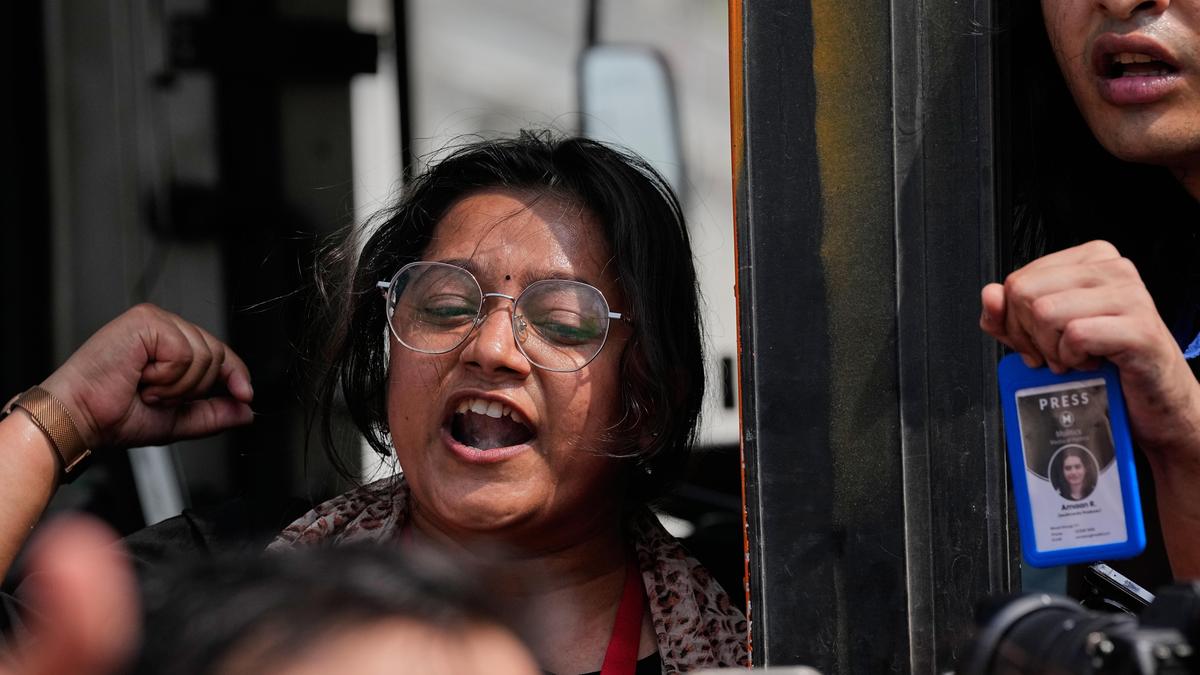
Journalists with an independent online news platform are taken away following their detention during a Cockroach Janta Party protest in New Delhi on October 10, 2026. | Photo Credit: AP The recent protests called by the Cockroach Janta Party (CJP), and helmed by Opposition parties, demanding the resignation of Chief Election Commissioner Gyanesh Kumar have exposed a chink in journalists’ armour. The crackdown on journalists, especially freelancers and independent journalists, during the October 10 protests, has rekindled the debate on who has the right to be recognised as a journalist and about who decides who is a journalist.One has seen how during the CJP protests, both in July over the NEET paper leak and in October over the demand for the CEC’s removal, freelancers and independent journalists, and content creators descended in hordes at the protest venue already bulging at the seams with reporters from registered media houses. However, during the second round of protests on October 10, phalanxes of riot police removed them from the protest site and sent them to detention centres. Only journalists with the Press Information Bureau (PIB) or Directorate of Information and Publicity (DIP) accreditation were allowed to cover the protests.A Bench comprising Chief Justice of India (CJI) Surya Kant and Justice Joymalya Bagchi, while hearing a Public Interest Litigation (PIL) which seeks the protection of the right to freedom of expression by freelance journalists and content creators, wondered whether the right to freedom of expression empowered every citizen of this country to be a journalist. “If everyone starts becoming a journalist, it will create problems for every other person,” the CJI said. During the hearing, senior advocate Indira Jaisingh said that there must be a national protocol for police not to obstruct the professional work of any journalist who has an identity card from the employer. Solicitor General Tushar Mehta said that in the present era, any person with a mobile phone could claim to be an independent or freelance journalist when he/she would, in fact, be making reels only to garner popularity on social media to earn money by either presenting one-sided stories or sensationalising events.Recognising journalistsThese developments have put the focus back on the question of who recognises journalists. As per the Occupational Safety, Health and Working Conditions Code, 2020, a working journalist is a person whose principal avocation is journalism and who is employed in a newspaper, electronic media or digital media. This definition excludes people employed in a managerial or administrative capacity. Further, Central and State governments provide accreditation to working journalists, freelance journalists, camerapersons and technicians. Accreditation recognises working journalists and others and gives them access to designated official sources of information. For journalists in Delhi-NCR, accreditation is provided by the PIB for covering the Central government while the DIP accreditation gives them the right to cover the Delhi State government. Media accreditation guidelines of the PIB and DIP define the eligibility criteria for all those seeking accreditation. However, one of the major issues with government accreditation is that it has a quota depending upon circulation (for newspapers, periodicals and magazines), subscribers (for news agencies), licence under uplinking and downlinking guidelines (for private satellite TV channels), and unique visitors (for digital news publishers). Therefore, all journalists in recognised media organisations don’t get accreditation. This leads us to the question on how all working journalists can be recognised.One solution could be a national media council or commission. Just like there is the Bar Council of India for lawyers and an Institute of Chartered Accountants of India for chartered accountants, the media council can recognise all working journalists, freelance journalists, camerapersons and technicians. Just like you need a law degree to practise law, a medical degree to become a doctor, the media council may mandate a degree or diploma in journalism and mass communication while applying for a licence. A few years ago, the Press Club of India drafted a Media Transparency (and Accountability) Bill, which mandated the formation of a national media council, among other things. Recently, some other journalists’ bodies have also submitted a memorandum to the government with the same demand. As more and more people with a camera claim to be freelance journalists, it may be high time for the government to give some serious thought to the idea of such a council.Rakesh Goswami is Professor of Journalism at Indian Institute of Mass Communication, New Delhi Published - October 26, 2026 01:15 am IST
The need for a national media council
Full Article
Original Source
Read the full article at Thehindu →KhanList aggregates and links to publicly available news content. We do not host full articles from third-party sources. Always verify important information with original sources.