
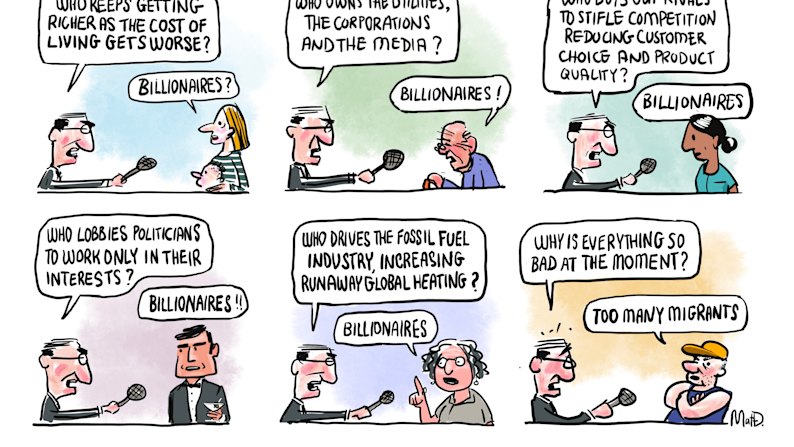
Matt DavidsonWe were always going to be here. Setting up a scheme where middlemen are interposed between those in need and a big bucket of money was always going to be inefficient and prone to manipulation (“Crackdown to target NDIS plan managers”, November 19). Dare I suggest that all plan management be brought in-house to public servants on a salary and to those solely dedicated to looking after Australians in need of assistance? That is the only way to eliminate fraud, and with no profit motive hovering in the wings, at the lowest possible cost. Greg Baker, Fitzroy FallsMark Butler, the Minister for Health and Ageing and Minister for Disability and the NDISAlex EllinghausenAlthough I am very concerned about the fraud within the NDIS system, I wonder how regional and remote Australians are to access this panel of chosen managers. Is there to be yet another tier of bureaucracy as these chosen few are forced to delegate to local managers? Katriona Herborn, BlackheathThree stoogesSo the three bullies are meeting to show the world who really runs the place (“Albanese urges China summit to deliver as Putin sets defiant tone”, November 19). Donald Trump hardly deserves his place given the drubbing he received in the midterms, Putin’s war against Ukraine is taking a hell of a lot longer than he anticipated and those damned Ukrainians are daring to bomb Russia, while Xi Jinping is hardly popular in Hong Kong and is carrying out cultural genocide in Tibet and Xinjiang. And these three claim a seat in the UN Security Council. Is it any wonder that the world is going to hell in a handcart? Genevieve Milton, Dulwich HillI suspect Trump thinks hanging out with the dictators of this world will make him look strong. Unfortunately, it just makes him look even more pathetic, if that’s possible. However, it does make him more dangerous, especially considering his humiliating defeat at the midterms. He could wreak havoc over the next two years, unless the Republicans agree to rein him in, which may require impeachment and conviction. Graham Lum, North RocksClarity on consentJenna Price (“Tinkering with consent laws won’t stop rapists like Brand. Here’s what might”, November 19) reminds me of an interaction in a University Criminal Law class. While discussing changes to the NSW Crimes Act with my Criminal Law class many years ago, I told them that a person who is highly affected by alcohol may be legally considered as incapable of consenting to sexual activity. Almost immediately, one of the “cool guys” in the class called out “Hell, I generally only have sex when we’re both drunk”. This comment drew raucous laughter from the boys in the class. The laughter soon subsided when I informed them that by continuing such behaviour, they may one day find themselves as the accused, rather than the lawyer, in court. I am pleased that affirmative consent laws have resulted in positive changes in the courtroom, but wonder what it will take to change attitudes such as those exhibited by Russell Brand and my former student (and now, no doubt, practicing lawyer). Irene Nemes, Rose BayFamily court failuresDespite the story making for harrowing reading (“Family Court system leaves abuse victim at wit’s end”, November 19), it is gratifying to finally have some Family Court judges exposed for perpetuating the abuse and coercive control of many women and children. As with the judgements arising from myths surrounding rape, women are still being held accountable for the violent and controlling behaviour of their former partners. Many women and children are suffering intolerable burdens. This must stop. Sue Adams, Dulwich HillSelective or just unfairThe recently announced changes for limited year 8 (or later years) placements in selective high schools have placed the soul of our public education at risk (“Overhaul to tackle selective shopping”, November 19). Open to all, despite divisions of religion, economic or social barriers, our selective schools often offer further academic opportunities yet the changes to deny private school students similar opportunities places cracks in the heart of our public school system. It also fails to account practically for those who could not take the tests in year 6 originally (for example, children living overseas for a short period, as was my own son while we were on teacher exchange to Minnesota) or the newly arrived. Hard and fast rules often make for a system that can easily crack and break. Janice Creenaune, AustinmerWho gets to pick and choose for selective schools?GettyOffering the very limited number of “fill up” year 8 to 12 positions at NSW selective high schools preferentially to students of public schools is a good starting point. However, I would like to see the evaluation and recruitment of gifted and talented children boosted, to the point where university vice chancellors went on the road to where the scattered students of “under resourced” backgrounds were. That would ensure not a single one was denied the best employment of their skills, rather than relying on at times poorly informed parental choices based on downplayed community expectations. Excellence is out there to be found, among the children of diverse communities. Garry Dalrymple, EarlwoodBoardrooms to blameAt last, an economics and finance writer prepared to put mediocre management into the frame for Australia’s poor productivity (“Poor management is a drag on our productivity”, November 19). Shane Wright outlines the long-standing evidence of poor change implementation, low investment, short-term thinking and a propensity to blame others (especially “the government”). As Wright points out, the stakes are high for everyone, not least the large workforces, many of whom face an uncertain future as AI takes the world by storm. There is a lot for boards and shareholders to be concerned about. Governance, regulation, cybersecurity, AI and the global environment are a tricky combination. But when it comes to the sustained productivity improvement of the organisations the boards are charged with leading, I certainly hope that the key question of “what have you done for us lately” is put to the large senior and middle management ranks, who are universally well-paid by community standards. Cathryn Callaghan, CroydonShane Wright bemoans management’s failure to implement technology to enhance productivity but ignores that productivity, by definition, is producing more per human employee. So what happens with all that wonderful “productivity”? To the displaced worker? More profit to the owner or lower prices to the consumer? More waste or a sustainable economy? Sorry, economists, productivity is not an end in itself. Michael Berg, RandwickCarbon action, not hot airYour correspondents nailed it with the climate analogies (Letters, November 19). Australia’s climate pollution bathtub is overflowing. In fact, a Carbon Brief analysis has just concluded that Australia is the third-biggest exporter of carbon pollution since 1850, behind Russia and Saudi Arabia. It’s absurd that the Albanese government is presiding over global climate negotiations at COP31 and has signed up to transition away from fossil fuels, but is showing no leadership on addressing our immense coal and gas contributions to the global climate crisis. Larni Dibben, Glen Iris (Vic)Pressure built sandpaper sagaThe ongoing cricket saga confirms the pressure we, the public, put on the team to win (“CA tries to take divisive saga behind closed doors”, November 19). No matter what. Of course, it’s also the team members, but it’s primarily the pressure from cricket fans. I expect another enquiry will be undertaken asap. For many, cricket is more important than politics. Ashley Berry, ToolijooaAs far as I’m aware, and correct me if I’m wrong, at the time the sandpaper issue became public knowledge, not one member of the cricket team had the moral backbone to publicly state it was wrong to cheat and name and denounce those team members who did. Cricket Australia is also at fault for their continued attempts to bury the story, compounded by later handing out promotions to some of those involved. Christopher Woods, West HobartIf “everyone” in the Australian cricket team was “involved” and “knew” what was going on, despite denials by Pat Cummins, will any other country wish to play matches against a bunch of cheats? Now sufficient mud has been thrown, and many have had their say, can players, commentators, past players, opinion writers, everyone now just shut up, “close the chapter” and give us an outstanding summer of cricket? Marjie Williamson, BlaxlandThe world currently balances on a knife-edge. Military conflicts, climate-driven crises, forced displacement in Gaza and the West Bank, nuclear posturing, infectious disease outbreaks and, because of our overuse of antibiotics, our global health is now threatened – to name just a few grave predicaments we currently face. Yet, our media is predominantly burying its head in the sandpaper. Talk about refusing to face reality by glossing over what is truly consequential – albeit uncomfortable – and retreating into denialism. It’s just all too much. Bernard Moylan, BronteCall in Justice Michael Lee. This is the omnishambles to beat all omnishambles. If I were a player not a gentleman, I’d call it a clusterf---. Philip Bell, BronteI’ve suddenly realised that there is another advantage to playing soccer. There is no way the sport can be damaged by this sandpaper nonsense.Klaas Woldring, Nambucca HeadsWorthy version of truthSandpapergate continues (“Whole side knew of sandpaper: Bancroft”, November 19). One of the worst aspects of the whole sorry business has been the constant replaying, by some of the television channels, of the footage of Cameron Bancroft reaching into his groin area and attempting to hide the piece of sandpaper. It’s on the television news every night, over and over again. Bancroft has suffered enough since the incident, being suspended, losing his place in the Test team, and probably/possibly having mental health issues. And eight years later, he’s being humiliated by the constant rolling of that tasteless footage. Is it any wonder that he should come out now and give his version of the truth? Bancroft is a decent young man. He accepted his punishment. He stayed loyal to his teammates, served his suspension with dignity, and deserves to be respected and not humiliated by that dreadful footage. Good on him for coming out and telling his truth. Of all those involved in Sandpapergate, Bancroft is probably the one most entitled to now give his version of the incident and the truth. Ken Butler, Mount ColahCameron Bancroft has provided the most detailed account of the sandpaper affair to date.GettyCameron Bancroft is right. Transparency and accountability are important, something that Cricket Australia has no concept of. It is time for those leaders to resign. There is no democracy in Cricket Australia and there was none in the 2018 team. I hope that the question “What is the national sport of Australia?” is no longer on the citizenship application. Anne Eagar, EppingThe award for the Australian of the Year should go to Cameron Bancroft. Helen Russell, LeichhardtDumped horse? So whatWhat’s all the fuss about the disposal of So You Are’s body (“Dumped horse prompts inquiry”, November 19)? By all accounts, the horse was being given appropriate veterinary care in the circumstances, and when the decision was made that euthanasia was appropriate, it was done humanely. So far, no problem. No matter how the body is disposed of, it involves no suffering of the animal. If the owner and vet decide that landfill is the appropriate method and there are no health issues in the process, where is the problem? A friend’s horse had to be put down some years ago. Humanely by a vet. The body was dragged to an old mine shaft on the property and dropped in. Should that have been criticised in the media? The only issues that merit serious discussion are around the horse’s treatment and demise, and health questions around disposal of the body. Someone wanting horse racing not to exist, or someone wanting a proper funeral and a headstone, are none of our business. Bill Irvine, GoulburnGoodes, Adam GoodesWhat about another Australian James Bond (Letters, November 19)? My nomination is Adam Goodes. He is a proud Adnyamathanha and Narungga man, dual Brownlow medallist, Australian of the year and formidable advocate against racism, and has charisma, intelligence, presence and an unmistakably Australian edge. And frankly, I’d happily volunteer to be his Bond girl. Vivien Clark-Ferraino, DuckmaloiAdam Goodes. Hand the man a martini and let’s get on with itGetty ImagesCharismatic, charming, debonair and deadly. Only one Bond had it all: Chesty. George Manojlovic, MangertonHonesty in reserveA simple solution to the problem of underquoting on housing by real estate agents is available (Letters, November 19). First, the reserve price must be published two weeks before the auction. Second, the highest bid that equals or exceeds that price must be accepted. I fail to see how this cannot be instituted easily and quickly. Michael McFadyen, KareelaTo submit a letter to the Sydney Morning Herald, email letters@smh.com.au. Click here for tips on how to submit letters.The Opinion newsletter is a weekly wrap of views that will challenge, champion and inform. Sign up here.
The NDIS system has always looked vulnerable: bring in inside
Full Article
Original Source
Read the full article at Smh →KhanList aggregates and links to publicly available news content. We do not host full articles from third-party sources. Always verify important information with original sources.