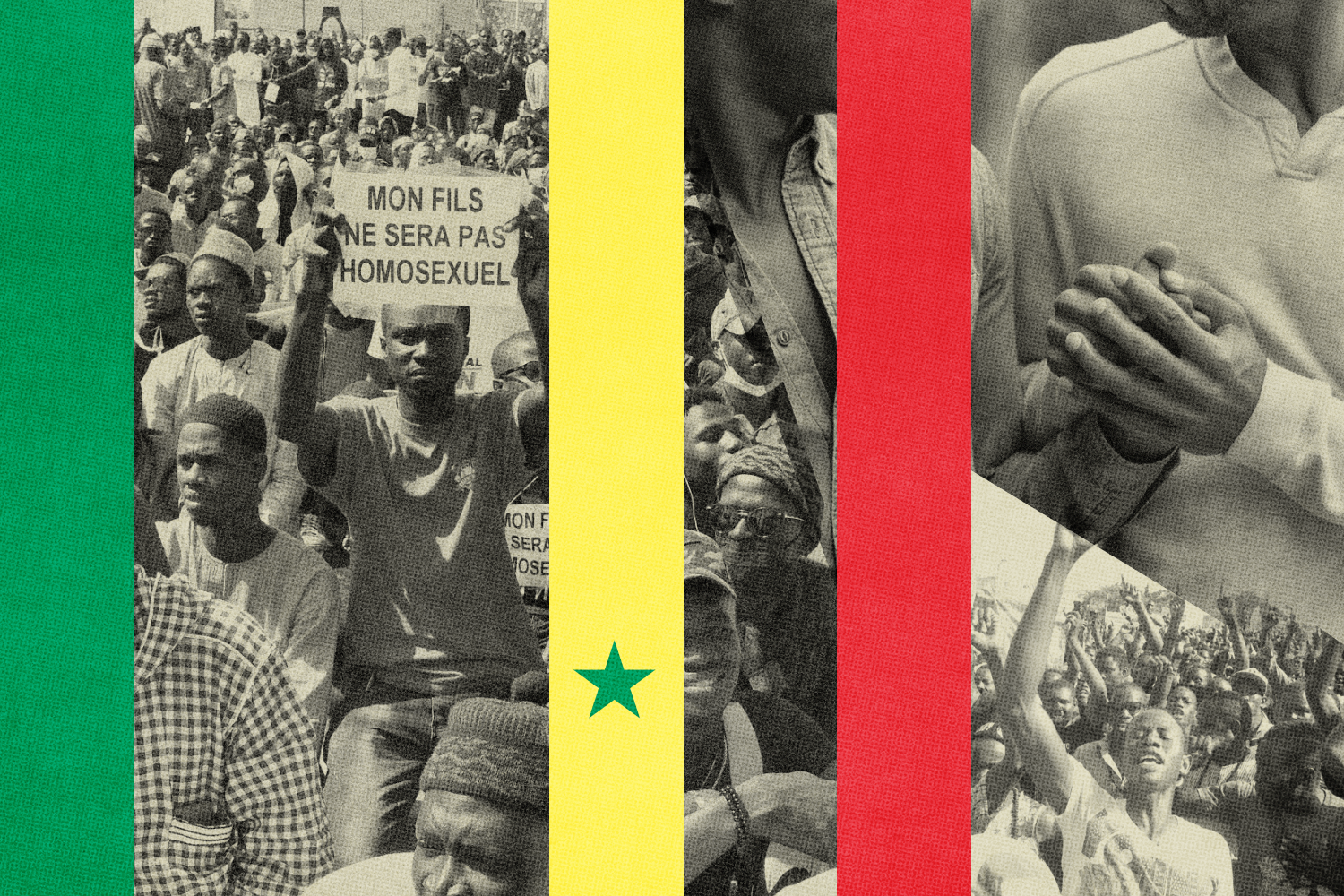
In early March, Senegalese lawmaker Diaraye Ba declared before the legislature, “Homosexuals will no longer breathe in this country; homosexuals will no longer have freedom of expression in this country.” Chillingly, she was met with applause. Pure Men: A Novel, Mohamed Mbougar Sarr, Other Press, 192 pp., .99, June 2026 Pure Men: A Novel, Mohamed Mbougar Sarr, Other Press, 192 pp., $10.99, June 2026 Senegal’s president was about to approve a bill raising the maximum prison term for same-sex relations from five to 10 years and criminalizing advocacy for LGBTQ+ rights. The ban’s language casts queerness as a threat to the health and survival of Senegalese people in a country where queerness is largely viewed as a Western import that corrupts the values of the Muslim majority, and gay men are seen as nefarious spreaders of HIV. Senegalese writer Mohamed Mbougar Sarr’s novel, Pure Men, shines a keen light on this ongoing nightmare. First published in 2018, the book, now translated from the French by Lara Vergnaud, tells the story of Ndene Gueye, a Dakarian professor of literature whose encounters with homophobic violence force him to reckon with what one character describes as Senegal’s lethal moral “totalitarianism.” An explosive cross between a social thriller and a novel of ideas, Sarr’s book probes the roots of Senegalese homophobia, exploring how religious ideals combine with the myth of African heterosexual purity to sustain a culture of murderous hate. It also identifies a fundamental challenge facing those who resist Senegal’s systemic homophobia: how to articulate a queer politics of liberation while refraining from a simplistic characterization of Islam as a religion at odds with Western modernity. People seated in tiered wooden rows inside an assembly room, smiling, laughing, and gesturing cheerfully while interacting with one another. Members of Senegal’s legislature celebrate after the adoption of a stricter law prohibiting homosexuality in March.Seyllou/AFP via Getty Images Pure Men is preoccupied less with homophobic microaggression and ridicule than with the radical, irrational, and bloodthirsty forms of anti-queer prejudice that have evolved in Senegal since 2008, when a local magazine published pictures of a gay marriage and sparked national outrage. The novel opens on Ndene viewing a viral video of a supposed goor-jigeen (the Wolof slur for queer, which translates literally to “man-woman”)—being exhumed by a mob from his grave in a Muslim cemetery. In Islam, those who engage in same-sex acts are believed to have sinned, and, according to Senegalese Muslims, thus cannot be buried among other Muslims. Ndene’s initial reaction to the video is callous, and he impulsively dismisses the man as “just a góor-jigéen.” But Ndene then experiences a moment of crisis. Had he spoken from personal conviction, or through a “shared mouth, a mass grave of sorts in which were buried—albeit resuscitated often—the general opinions of a country”? Befuddled, Ndene teeters toward a grim realization: “I was the mouth of ancient forces that had the powers of life and death over me.” These complicated emotions trigger a quest for knowledge. Ndene determines to find out more about the man in the video: “Who had accused him? Had there been proof of his sexual deviancy? Where was his family? What had become of his body?” The book stages Ndene’s reckoning with his homophobic milieu as a series of epiphanies, the first of which is his recognition of the moral and ontological depth of the stigma of homosexuality in his country. Any Senegalese family with a queer member, Ndene ruminates, must sever all ties with that individual and demonstrate violence toward them to redeem themselves among society. He wonders if the men exhuming the body in the video were the brothers of the deceased, and whether the energy they put into the task “was also going toward their struggle against the ultimate shame: the fear of no longer belonging to humanity.” A crowd of people outdoors, with a man in the foreground holding up a small burning piece of colorful fabric. The surrounding crowd is shouting and holding up phones to capture the scene under palm trees. Protesters burn a pride flag in Dakar, Senegal, on Feb. 20, 2022.Seyllou/AFP via Getty Images As though to test the truth of his bleak conclusion, Ndene asks his father, an orthodox imam at the local mosque, what he would have done had it been his homosexual son buried in that cemetery. His father tells him, in a voice “choked up but firm,” that he would have dug him out himself with his bare hands. The acceptance of homosexuality, he tells Ndene, would constitute “the beginning of our death, a betrayal of our ancestors and our spiritual fathers.” Any minority group who threatens societal cohesion, he says, “needs to disappear.” Meanwhile, Ndene attempts to teach his students the work of Paul Verlaine, a 19th-century French poet who had relationships with men, to growing unrest. They refuse to hear anything he has to say or recognize the beauty of Verlaine’s poetry because they see him as “impure” and “part of Europe’s big propaganda plan to introduce homosexuality into this country.” This idea—that Africa has historically always been heterosexual and that queerness is a Western import—is common in Senegal, and in many other African societies where queerness remains taboo. That charge, however, is rejected outright by Angela, an employee at Human Rights Watch who agrees to help Ndene on his quest. The myth of Africa’s heterosexuality, she holds, persists partly because research debunking it remains largely inaccessible, confined to academic circles out of fear of backlash. Still, Senegal’s homophobia isn’t just a problem of limited public knowledge. “Someone who hates homosexuals couldn’t care less that homosexuality has existed here for a thousand years,” Angela tells Ndene. “Homophobia doesn’t need a historical pretext.” Indeed, the modern labels used to brand and demean Senegal’s queer community didn’t always function this way. Once a term for a sexual and social identity rooted in Senegalese lore, “goor-jigeen” historically referred both to gay men and male individuals who adopt feminine attributes for entertainment purposes. Today, the term is almost exclusively pejorative and synonymous with male homosexuality—a semantic change linked to the strict policing of the boundaries between femininity and masculinity. Ndene begins to understand all this when he meets Samba Awa Niang, a known goor-jigeen whom he first sees in his neighborhood hosting a sabar, a traditional Senegalese drum-and-dance event. Assuming Samba Awa is gay, Ndene is surprised to discover that he is actually a self-identified transvestite with two children and was once married to a woman. A goor-jigeen in the social but not sexual sense, Samba Awa’s character is a rebuttal to the idea that queerness is an un-African, Western aberration, grounding gender non-conformity within Indigenous culture while exposing the limits of Senegal’s narrow definitions of queerness. Samba Awa also challenges the deadly tendency among Senegalese people to conflate public and private selves, gender expression and sexual orientation. “I am a góor-jigéen,” he tells Ndene, “because language is being used incorrectly and imprecisely.” While he receives adulation during his performances—unusual for someone assumed to be gay—it is because the audience believes he is acting, which delivers a form of protection. “I’ve never appeared as a góor-jigéen, only as the character of a góor-jigéen,” he says. Still, Samba Awa knows that he can be killed at any moment “for something [he’s] not but that people believe [he is] because of a word or a rumor.” Lots of his friends, he tells Ndene, have met their end in this way. The lethal power of rumor in Senegal becomes even more real to Ndene when he meets the exhumed man’s mother and learns about the circumstances surrounding his death. The man, he finds out, became a “góor-jigéen” because he fell sick and quickly lost a lot of weight, which gossip attributed to a “homosexual disease.” “From that point on, he was dead,” the mother tells Ndene. When her community refused to let her bury her son, she had him buried in the dead of the night. The stigma Ndene seeks to understand slowly closes in on him as the novel progresses. When his own sexuality becomes suspect, he is suspended from his teaching post. Sarr takes the opportunity to explore the cost of queer allyship and activism in Senegal, and the extent to which one can recognize, name, and embrace queer desire in a society structured by extreme repression. Gay men, he proposes in one incandescent passage, are “pure men because at any moment human folly can kill them, can subject them to violence all while sheltering behind one of the many perverted masks it dons to express itself: culture, religion, power, wealth, fame.” If Ndene really was gay, could he ever arrive at—and survive—that knowledge? Could his interest in the exhumed man have stemmed from some complicated form of identification? The novel leaves Ndene’s sexuality unresolved. But when his colleague is beaten into a coma after getting caught kissing a man on campus, Ndene decides not to distance himself from the rumors questioning his own orientation, embracing homosexuality in defiant, self-destructive solidarity instead. “I’m going out there to become both their nightmare and what they dream of seeing, the better to kill it: a góor-jigéen,” he narrates. “[L]et them judge me unworthy of living, … let them lynch me and abandon me in the open, entrails exposed like rotting carrion!” Alt text: A close-up portrait of a man wearing a dark suit jacket, blue tie, and a black-and-white striped scarf wrapped around his neck. He is looking slightly upward with a calm expression. Mohamed Mbougar Sarr photographed in Paris on Nov. 12, 2021.Thomas Samson/AFP via Getty Images Written before the passing of Senegal’s new law but in prescient dialogue with it, Sarr’s novel asks readers—and, by extension, the country itself—to reflect, reconsider moral values, and confront uncomfortable questions. The book can, at times, seem to pit Islamic conservatism against a favored Western sexual liberalism. Still, it is a measure of Sarr’s sharp discernment as a writer that he also questions the tendency within rights discourse to take Western trajectories of liberation as normative and universally attainable. In one scene, for example, Ndene’s colleague presents his opinion that homosexuals are in danger of death in Senegal because of a loud minority who, influenced by the “white world,” don’t think twice before foisting their queerness upon others. Putting pressure on the government to decriminalize homosexuality, his colleague argues, has “the opposite effect: a rise in homophobia.” When an agitated Ndene then asks him whether he might be reproaching the West for making progress in equal rights, his colleague says, “The march toward equality can’t happen at the same pace everywhere.” Retrospective attention to the French edition of Pure Men after Sarr won the 2021 Prix Goncourt for his novel The Most Secret Memory of Men saw him branded within Senegal as a homosexual and an advocate of Western sexual values in a grim mirroring of his own protagonist’s journey. Sarr, who lives in France and has never publicly discussed his own sexuality, has visited Senegal since this controversy but may today find himself unwelcome—and liable to prosecution—there. Pure Men is anything but a straightforward work of queer advocacy, but its achievement nonetheless lies in exposing the constraints within which advocacy operates in Senegal. Dissent and activism have always found ways to survive, even under extreme pressure—and it bears mentioning that Senegal was among the first countries in Francophone Africa to provide public health programs for homosexual men, despite the criminalization of homosexual activity in 1965. But if Sarr’s novel is any indication, what will be lost under this new homophobic law, in addition to queer lives, is what little room exists for engaging with and protecting queerness in Senegal. Pure Men makes glaring the urgent need for redress.
The Myth of African Heterosexual Purity
Full Article
Original Source
Read the full article at Foreignpolicy →KhanList aggregates and links to publicly available news content. We do not host full articles from third-party sources. Always verify important information with original sources.