
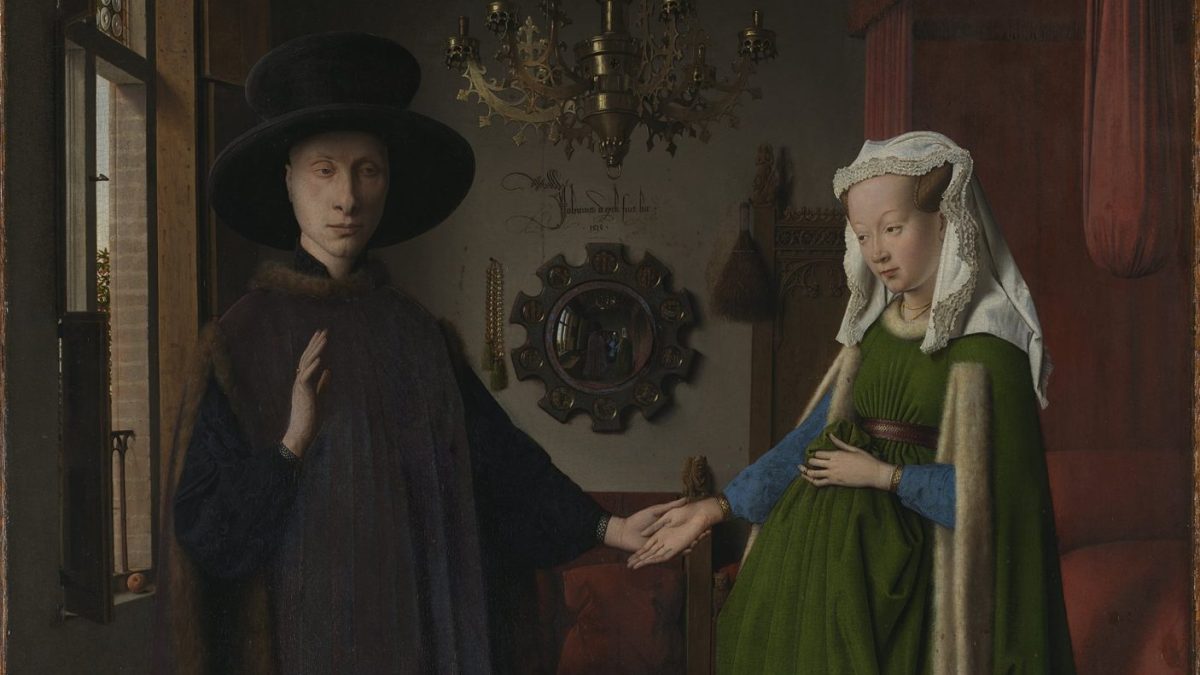
Jan Van Eyck’s The Arnolfini Portrait – one of the most beloved works in London’s National Gallery – looks like a straightforward likeness of an expectant couple. He is in a wide-brimmed top hat; she in an emerald dress. They are holding hands, and her other hand is on her belly. The room in which they are standing has a bed with sumptuous red drapes, and daylight shines in through a window. An elaborate candelabra hangs above their heads, a dog stands at their feet, and a mirror reflects two more figures entering the room, one of whom is perhaps the artist himself, since an inscription in Latin reads: “Jan Van Eyck was here 1434”. But is the young woman really pregnant? Is she even a living person? Is the man her husband? And did the room in which the pair are so carefully portrayed ever exist? As for the artist, is he one of the people in the mirror – or might he in fact be the man in the hat? Nothing is as it seems in this most enigmatic of paintings, and these questions and many more have puzzled generations of art historians since the 15th century. But new insights could be around the corner. Because from 21 November, Van Eyck’s masterpiece will be at the heart of an exhibition designed to shine new light on some of its many mysteries. Portrait of Margaret van Eyck by Jan van Eyck (Photo: Municipal Museums Bruges/The National Gallery) All 10 of the artist’s existing portraits – nine paintings and one drawing – will be shown side by side for the first time ever at Van Eyck: The Portraits. It is taking place at the National Gallery, which owns two more of the works in addition to The Arnolfini Portrait – the rest are being borrowed from museums in Austria, Germany, Romania and Belgium.According to its curators, seeing the couple in The Arnolfini Portrait alongside the other likenesses captured by Van Eyck will reveal as never before what an unusual work it is – both in terms of the artist’s output and the history of painting. “The Arnolfini Portrait is unique – nothing like it had ever been painted before,” says art historian Nicholas Flory, the exhibition’s co-curator. “The idea of showing a couple full-length and in an interior was completely original. Showing it alongside Van Eyck’s more conventional portraits will reveal how strange the work is – and it makes the very clear point that he was doing something very different with this painting. I think that’s why it has been at the centre of so much controversy over so many years.” Nothing in the painting quite adds up. The couple are holding hands, but the man’s other hand is raised in what might be admonishment or warning. And although he is painted with what looks like real-life accuracy, the woman seems more generic, with no quirky characteristics. Which has led some to wonder: was she real? Just about the only unchallenged facts about The Arnolfini Portrait, says Flory, are the identity of the artist and the date when it was created. By 1434, Van Eyck would have been in his thirties or forties (the exact year of his birth is unknown), and he seems to have already been a well-established master painter with impressive clients, the most important of whom was Philip the Good, Duke of Burgundy. Portrait of a Man with a Blue Chaperon by Jan van Eyck (Photo: The National Gallery) A lot of information about the artist’s life is sketchy, but he was probably raised in an area that today is modern Belgium, he had two brothers and maybe a sister, and they were perhaps a family of artists. One of the brothers – Hubert – worked with him on the monumental Lamb of God altarpiece (so-called because of the animal at its centre, whose presence represents Christ) in St Bavo’s Cathedral in Ghent. This work has been under restoration for the past 14 years – a task that will finally be finished next April. Aside from the altarpiece, many of Van Eyck’s surviving works are his portraits, and showing them together will expose a central irony about him: on the one hand he was obsessed with authenticity; and on the other, he liked to employ sleight of hand, with deliberate deceptions. For example, among the other paintings in the new exhibition will be a portrait of his wife, Margaret, and he is included what looks like a scar in her eyebrow. Another work shows his sitter (who may have been himself) with bloodshot eyes, wrinkles and beard stubble. “He focuses on imperfections and small details to show these are exact representations, precise likenesses,” explains Flory. Yet he seems determined to trick his viewer. The Margaret Van Eyck painting is in its original frame, and it and its back (which will also be on view) are painted with a marbled effect. But it is a marble that doesn’t actually exist. It is a clue, says Flory, about how Van Eyck used his imagination as much as his paintbrush – and that is crucial to unpacking The Arnolfini Portrait. Visitors to the exhibition will notice straight away that Van Eyck’s other portraits show individuals alone and against dark backgrounds. Only The Arnolfini Portrait puts his sitters in a busy room – another hint, says Flory, about what is really going on. Because the essence of Van Eyck seems to have been a desire to question whether what you see in life is what you get – how painting can both reveal things and hide them or mislead the viewer. Portrait of an Elderly Man (A Scholar?) by Jan van Eyck (Photo: National Gallery) All this comes to a head in The Arnolfini Portrait. “There has been a constant desire to work out a narrative,” says Flory. “Is the painting the moment the couple met? Is it the occasion of their betrothal? Are they about to set off to church to be married?” There is also the issue of whether the woman is pregnant, or if she is just wearing clothes that were fashionable at the time. Even the painting’s title, in this exhibition, will hint at the many unknowns. It is labelled Portrait of Giovanni (?) Arnolfini and his wife. For many years it has been widely accepted that the man is a member of the Arnolfini family – rich merchants originally from Italy, but with a branch of the family in Bruges – but there have been disagreements over which one. Giovanni was the most prominent member of the clan, but he didn’t get married until 13 years after the picture was painted. Another contender is his cousin, Giannino – but his wife had died by 1434. Could that be why Van Eyck painted her in a bland way? Another theory, expanded on in the exhibition catalogue, poses the idea that the man in the hat may be Van Eyck himself – a self-portrait. This would explain his existence in another of the paintings – no sitter is as easily available to an artist as themselves – and it would also explain the inclusion of a carved figure of St Margaret, his wife’s name. The man looks the age Van Eyck would have been, and Margaret was pregnant around the time the painting was made. Visitors to the exhibition will be able to put the theory to the test by comparing the woman in The Arnolfini Portrait with the portrait of Margaret from five years later. In opening the door on the many conundrums, the National Gallery knows it will reignite the debate over the identity of the individual(s) it portrays. Portrait of a Man by a follower of Jan van Eyck (Photo: Photo Scala, Florence/Kunst, Kultur und Geschichte, Berlin/National Gallery) Overall, the point of the exhibition will be less about extracting answers, and more about raising questions – which is exactly what the curators think was what Van Eyck wanted. “With The Arnolfini Portrait, he was pushing the possibilities of what a painting could do,” says Flory. “The exhibition is all about truth and lies, fiction and fact.” A painting that seems a straightforward image of a true moment in time turns out to be anything but; and if it can mislead us, what else in life (and art) might do the same? One thing is for sure: if Van Eyck set out to keep the world guessing, he has certainly succeeded. Six hundred years later, where The Arnolfini Portrait is concerned, we are as much in the dark as ever. ‘Van Eyck: The Portraits’ is at the National Gallery, London, from 21 November to 11 April 2027
The mystery of the most controversial portrait in the National Gallery
Full Article
Original Source
Read the full article at Inews →KhanList aggregates and links to publicly available news content. We do not host full articles from third-party sources. Always verify important information with original sources.